
On a humid morning in Boston, a coach handed a novice a pair of smart shoes and a phone app. The
runner laughed at first, then paused at the first report. Within a mile, stride gaps and pressure points showed up
as clear, usable analysis.
That small moment shows how modern shoes translate each step into meaningful
data. Embedded sensors like accelerometers, gyroscopes, and pressure arrays feed
lightweight Bluetooth LE links. The result is fast syncing and long battery life.
Today’s category bridges performance needs and health use cases. From gait deviation detection to rehab tracking,
the tech helps athletes and patients alike. This section previews product features, buyer criteria such as battery
life and app quality, and market trends.
Iottive brings expertise in BLE app development and cloud
integration for device makers. For product integrations and custom platforms, visit www.iottive.com or email sales@iottive.com.
Key Takeaways
- Embedded sensors turn steps into actionable analysis for users.
- Bluetooth LE enables efficient, real-time syncing with apps.
- Design choices—battery, comfort, and app UX—drive buyer value.
- Use cases span performance coaching to medical monitoring.
- Look for solutions that balance specs with everyday usability.
Why Smart Running Footwear Matters Now
Advances in sensor accuracy have turned everyday footwear into a real-time movement lab.
Modern shoes capture subtle motion and pressure signals that help runners improve efficiency and
cut injury risk.
Smartphone ubiquity makes setup and syncing simple. That means more users get immediate cadence cues, pace nudges,
and form alerts while they train.
Behind the scenes, better sensors and refined algorithms translate raw signals into clear
analysis. Runners see actionable tips mid-run or a concise report after finishing.
The same data foundation supports practical health features: temperature or pressure warnings can flag a developing
sore or ulcer early.
Today’s value is in usable insights, not generic step counts. Reliable Bluetooth links, accurate timing, and
contextual feedback separate helpful products from gimmicks.
Iottive builds Bluetooth-enabled app and cloud pipelines that lift the UX of this technology
without compromising comfort or durability.
- Actionable in-ride guidance and post-run reports
- Health alerts layered on performance tracking
- Reliability and fit remain non-negotiable
IoT Smart Shoes Buyer’s Guide: Features That Provide Real-Time Value
Choosing the right feature set starts with understanding which sensors deliver real-time benefits
you’ll actually use. Focus on what improves gait insight, comfort, and timely feedback.
Must-have sensors: Pressure arrays map contact timing and load distribution. IMUs (accelerometers
and gyros) track motion, cadence, and stride length. Temperature sensors flag hot spots that may indicate
inflammation or ulcer risk.
Sensor fusion blends these inputs to improve gait monitoring. Fusion reveals pronation patterns, ground contact
time, and subtle asymmetries that single signals miss.
- Connectivity vs. battery: Bluetooth LE gives low power and steady mobile syncing. Wi‑Fi offers
more bandwidth but drains batteries faster and complicates pairing. - Battery trade-offs: Duty cycle, sampling rate, and on-shoe processing drive autonomy. Local
processing extends life versus continuous streaming. - Comfort and durability: Look for robust insole layers, encapsulated electronics, and flexible
interconnects that preserve comfort.

| Feature | Benefit | Trade-off | When to pick |
|---|---|---|---|
| Pressure arrays | Contact timing & load maps | Added cost, placement sensitivity | Injury prevention, gait monitoring |
| IMU (accel + gyro) | Motion, cadence, stride data | Sampling affects battery | Form coaching, cadence feedback |
| Temperature sensor | Localized inflammation cues | Requires calibration, privacy rules | Health monitoring, diabetic care |
| Bluetooth LE vs Wi‑Fi | Mobile pairing vs bandwidth | Power vs data rate | Daily use vs high-data labs |
Test onboarding, pairing, and firmware updates. Check privacy settings for health features. Iottive’s BLE app
development and cloud integration expertise helps brands balance connectivity, battery autonomy, and user experience
to maximize long-term value.
Product Roundup: Best IoT Smart Shoes for Running Performance
A hands-on product roundup helps buyers match sensor depth to training goals and budget.
Top picks span clinical platforms like Pedar and F-Scan to wearable systems such as Moticon
OpenGo. Pedar and F-Scan offer dense pressure arrays and high sampling rates for clinical-grade analysis. Moticon
prioritizes wireless convenience and easier field use.
Top running picks with stride, ground contact time, and form analysis
Choose based on what you need: high sampling for precise ground contact time or on-shoe processing for real-time
form cues. Higher sample rates improve interval feedback but reduce battery life.
Smart insoles vs. fully integrated options
Insoles retrofit many shoes and deliver detailed pressure maps. Integrated designs win on ergonomics and seamless
tracking during long runs.
| Solution | Strength | Trade-off | Best for |
|---|---|---|---|
| Pedar | Calibrated pressure arrays | Higher cost, lab focus | Clinical gait labs |
| F-Scan | High sampling fidelity | Complex setup | Research & rehab |
| Moticon OpenGo | Wireless autonomy | Lower sensor density | Field testing & athletes |
| Consumer insoles | Easy retrofit | Variable durability | Data-curious runners |
Selection tip: test fit alignment, check firmware cadence, and favor products with stable apps and
reliable BLE/mobile-cloud stacks. Iottive supports teams
building these pipelines to speed go-to-market and lift long-term user value.
Connected Running Analytics: What Data Runners Actually Use
Not every metric is equally useful. Runners and coaches focus on a short list that changes
training and prevents injury.
Key gait metrics are cadence, stride length, ground contact symmetry, and pronation tendencies. These
numbers show form, reveal imbalance, and guide shoe choice or drills.
Stride, cadence, pronation, and pressure maps for injury prevention
Pressure and IMU data map foot loading and cadence. Pressure maps expose hotspots that often match overuse risks.
Those maps help decide insoles, shoes, or technique tweaks.
Training load, recovery, and calories burned accuracy
Training load blends session intensity, volume, and impact surrogates to suggest recovery windows. Calories burned
vary by model; consistency beats raw accuracy for trend tracking.
- Actionable insights: cadence nudges, midfoot strike cues, and asymmetry alerts after injury.
- Watch contact time and vertical oscillation for fatigue signals during a run.
- Validate new metrics against perceived exertion and race results.
Iottive’s mobile-cloud integration delivers clean dashboards and trend visualizations so users act
on analysis without overload. Keep sensors calibrated and alerts context-aware to preserve trust in the data.
AI Sports Footwear Innovations Shaping the 2020s
Putting models on the insole changes how systems balance latency, battery life, and personalization. Designers must
choose between instant, on-device cues and richer cloud-based profiling.
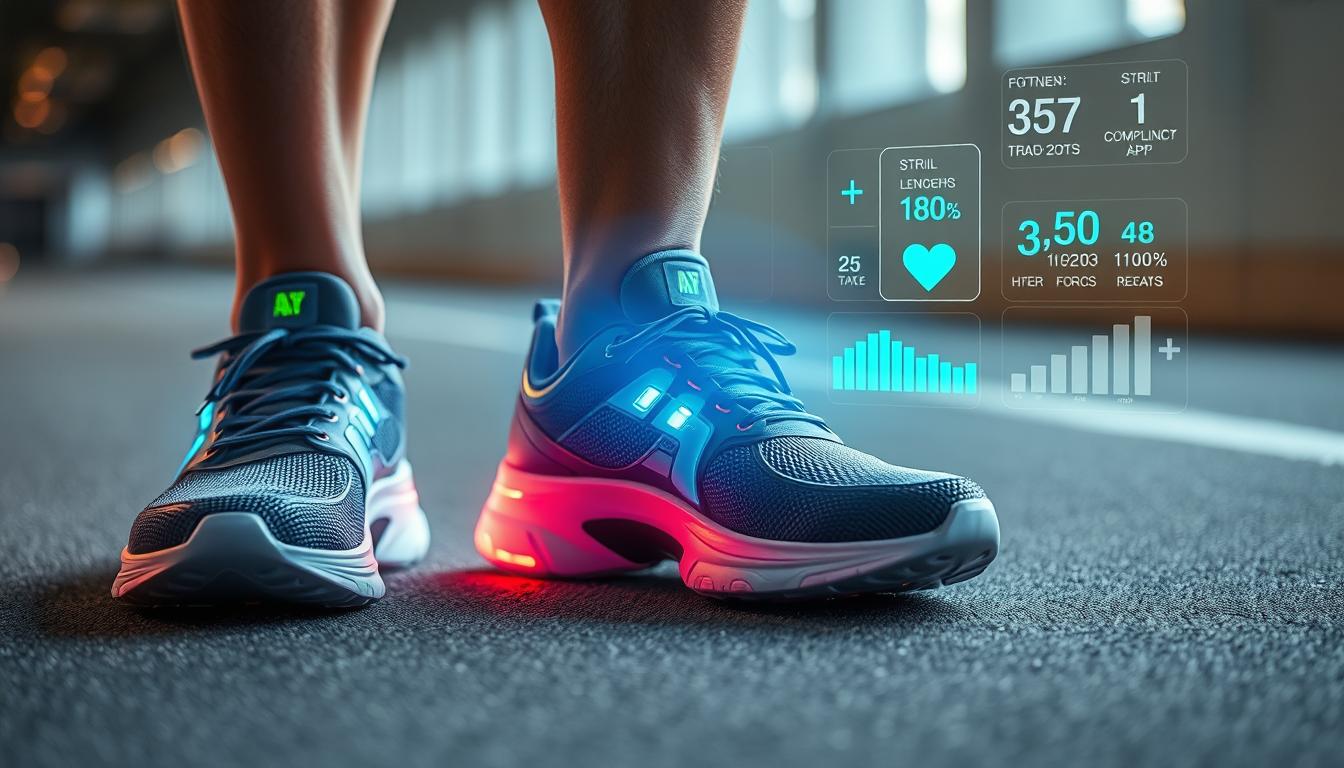
On-shoe inference gives near-zero delay for coaching cues. It reduces uplink needs and protects
short-term privacy. Cloud analysis enables deep personalization and long-term trend models that adapt to a
user over weeks or months.
How deep learning reads motion
Multivariate models fuse accelerometer and pressure streams to classify gait, flag anomalies, and estimate injury
risk. Sampling rates and chosen features directly affect model accuracy and power draw.
| Approach | Benefit | Cost | Best use |
|---|---|---|---|
| On-device inference | Low latency, instant cues | Higher local compute, power use | Real-time coaching |
| Cloud analytics | Deep personalization, large models | Latency, bandwidth needs | Long-term trend analysis |
| Hybrid updates | Firmware model refreshes | Complex deployment | Balance reliability & improvements |
| Energy-harvesting systems | Extended autonomy | Added hardware complexity | Low-power, long-term use |
- Privacy by design limits raw data transfer and uses on-device summaries.
- Personalization loops build baselines to refine fatigue and asymmetry thresholds.
- Fail-safes revert to rule-based cues when model confidence is low.
Iottive builds embedded inference and cloud pipelines that match model placement to battery and performance goals,
while keeping firmware updates and user privacy front of mind.
Inside the Tech: Sensors, Connectivity, and Energy in Smart Shoes
Sensor choice and system design determine how well a product turns motion into useful signals.
Engineers must balance sensitivity, durability, and power to support accurate monitoring without bulky
batteries.
Pressure sensing options
Pressure arrays come in four common types: piezoresistive, capacitive, piezoelectric, and resonant. Piezoresistive
sensors are cost-effective and simple to read but drift over time.
Capacitive types offer higher sensitivity and lower drift but need careful encapsulation. Piezoelectric sensors
suit dynamic loads; resonant elements give high fidelity in labs yet raise integration cost.
IMUs for motion intelligence
IMUs merge accelerometers and gyroscopes to detect steps, orientation, and stride dynamics. Axis alignment and
mounting repeatability are critical to reliable data.
On-device fusion reduces uplink needs by extracting step events and features before wireless transfer.
Temperature and sweat biosensing
Temperature options include RTD, NTC, thermocouple, IR thermopile, and digital ICs. IR sensors can be useful when
contact is inconsistent.
Sweat biosensors can hint at hydration or glucose trends but require calibration and comfort-aware placement for
valid health signals.
Connectivity and energy realities
Bluetooth LE is the common link for low-power data transfer. Designers must handle packet
loss, burst buffering, and sync strategies during intense sessions.
Energy harvesting—mechanical-to-electrical—can extend battery life but complicates hardware and cost. Firmware
power modes, compression, and edge feature extraction deliver the best autonomy per gram of battery.
Mechanical and lifecycle considerations
Use flexible PCBs, robust encapsulation, and strain relief to survive repeated loading and moisture. Component
choices affect maintenance, warranty costs, and long-term value.
Iottive’s BLE app development and hardware-software integration expertise helps teams achieve
robust syncing, low-latency telemetry, and efficient battery usage across these trade-offs.
From Adidas “1” to AIoT: The Evolution of Smart Footwear
A. The journey from microprocessor cushioning to full-stack personalization spans two decades of hardware and app
milestones.
In 2005, the Adidas “1” introduced microprocessor-controlled cushioning and proved consumer footwear could embed
real control logic. By 2012, Nike+ used smartphones to scale tracking to millions and normalized app-driven
experiences.
In 2016 Under Armour added built-in tracking to mainstream models, tightening the link between sensors and daily
use. The 2020s brought deeper machine learning, broader device ecosystems, and device-grade health features.
Key shifts include component miniaturization for comfort, BLE standardization for reliable
pairing, and firmware updates that extend product life. Community data now refines models and guides product
updates.
- Trace: from cushioning control to sensor-rich platforms
- Scale: smartphone adoption unlocked cloud services and better apps
- Future: healthcare validation and sustainability will shape new milestones
| Milestone | Year | Impact |
|---|---|---|
| Adidas “1” | 2005 | Introduced on-device control for comfort |
| Nike+ | 2012 | Made phone-linked tracking mainstream |
| Under Armour smart models | 2016 | Embedded sensors in consumer lines |
| AIoT era | 2020s | Personalization, health features, and OTA model updates |
Iottive helps brands modernize legacy concepts with today’s BLE, machine learning, and cloud
stacks to deliver reliable, wearable technology experiences that users trust.
Healthcare-Grade Smart Footwear: Beyond Fitness Tracking
Healthcare teams increasingly rely on localized pressure and temperature readings
to guide care for vulnerable feet. Precise deltas in load and warmth can flag early tissue stress and reduce ulcer
risk in diabetes through timely intervention.
Rehabilitation use cases include step-quality scoring, asymmetry detection, and adherence tracking
that clinicians review remotely. IMU thresholds and pattern recognition enable reliable fall detection and
real-world event capture for older adults.
Clinical deployment needs documented repeatability, validated accuracy, and clear protocols for data handling.
Privacy, consent, and secure transmission are essential to preserve patient trust and meet regulatory guidance for
health monitoring.
- Integration: EHR and telehealth dashboards allow remote clinician review and
clinician-configured alerts. - Wearability: Comfort, washable encapsulation, simple charging, and long battery life drive
long-term adherence. - Accessibility: Large-text interfaces, voice prompts, and caregiver notifications improve
outcomes for diverse users.
Design note: durable, repeatable sensors and validated analysis are prerequisites before clinical use.
Iottive’s IoT & AIoT Solutions and compliance-aware cloud integration support healthcare-grade deployments that
prioritize data privacy, reliability, and clinician workflows.
Industrial and Occupational Use Cases for Smart Shoes
Workplace movement data turns everyday tasks into measurable signals that safety teams can act on.
In construction, logistics, and manufacturing, pressure and motion streams reveal risky patterns such as
overreaching, twisting, or long static loading.
Ergonomics monitoring, posture insights, and worker safety
Pressure maps and IMU-derived features detect prolonged time on feet and unsafe postures. Those signals feed
role-based dashboards so supervisors and individuals see different views of the same data.
Practical outcomes include fewer musculoskeletal injuries, smarter task allocation, and targeted training
programs that reduce strain. Operations teams use these insights to improve scheduling and reduce overtime fatigue.
- Rugged design: slip resistance, sealed sensors, and impact-rated housings for real sites.
- Operational needs: shift-long battery life, reliable syncing in RF-noisy environments, and
fleet firmware management. - Policy: clear privacy, consent, and labor rules to protect workers and maintain trust.
Iottive delivers custom systems and mobile dashboards that turn
movement signals into safety and productivity insights. Framing benefits as cost savings and reduced incident rates
helps win support from safety and operations leaders in the market.
Mainstream Market Snapshot: IoT smart shoes, AI sports footwear, connected running analytics
The consumer market is moving fast. North America leads adoption while APAC growth is picking up as incomes rise
and more people move to cities.
Buyers want three things: simple setup, dependable syncing, and clear everyday insights. Social features like
challenges and shared milestones boost engagement and retention.
Platform ecosystems that link shoes, watches, and fitness apps make products stickier. Price tiers are emerging:
entry-level trackers, mid-range lifestyle models, and premium analytics systems for serious users.
Retail and e-commerce education reduces returns by setting fit and feature expectations.
Durability, transparent warranty terms, and visible firmware support give shoppers confidence.
| Consumer Need | Why it Matters | How Brands Win | Example KPI |
|---|---|---|---|
| Easy pairing | Reduces setup friction | Robust BLE apps, clear guides | First-run success rate |
| Social sharing | Boosts motivation | Integrated leaderboards | Monthly active users |
| Privacy & updates | Builds trust | Transparent settings, firmware roadmap | Churn rate |
| Durability & warranty | Drives purchase confidence | Longer warranty, rugged design | Return frequency |
Iottive partners with consumer brands to scale
mainstream-ready platforms with dependable BLE apps and mobile-cloud pipelines. Clear data controls and influencer
outreach help normalize these products in daily fitness routines.
Smart Shoe Market Outlook: Size, Segments, and Growth
Two headline forecasts highlight how assumptions change projections for the next decade.
Market size and CAGR through 2032
One estimate values the market at USD 155M in 2023, growing to USD 270.9M by 2032
at a 6.40% CAGR (2024–2032).
Another study projects a larger expansion: from USD 269M in 2023 to USD 2.1B by
2033 at a 22.7% CAGR. These gaps show why methodology and scope matter for any market forecast.
Segment leaders and user mix
Running products hold the largest share, and male end-users lead adoption and spend. Price tiers—from basic
trackers to premium platforms—shape who buys and why.
Drivers, restraints, and ecosystem opportunities
Health awareness, habitual fitness tracking, and richer app ecosystems drive demand. Key restraints include
hardware durability, sensor reliability, and ongoing software maintenance.
- Opportunities: interoperable ecosystems that link apps, watches, and cloud analysis.
- Regional note: North America leads now; APAC is the fastest-growing market.
- Design priorities: comfort, battery life, accurate metrics, and clear consumer value.
Iottive helps brands capture growth with scalable mobile-cloud backends, BLE apps, and custom product
development that align features to segment needs and support robust analysis at scale.
Regional Insights: Where Adoption Leads and Why
Where consumers live and shop matters as much as what a product can measure. North America leads the market thanks
to deep fitness ecosystems, broad retail distribution, and strong mobile infrastructure.
APAC is the fastest-growing region. Urbanization, rising disposable income, and wide e-commerce reach push demand
for entry models that scale quickly.
Europe balances growth with strict data rules. Consumers expect wellness features, clear privacy controls, and
regional certification before trust builds.
- Localization: language, sizing standards, and privacy norms change product expectations and UI
needs. - Partnerships: local retailers and running communities speed adoption through demos and trials.
- Logistics & support: reliable after-sales, repair networks, and warranty plans reduce
returns and boost lifetime value.
Price sensitivity in emerging markets favors simpler entry models, while mature markets pay for richer analysis and
integration. Regulatory nuances for health-leaning features affect rollout timing and required clinical evidence.
Iottive supports localized app rollouts and regulatory alignment across North America, Europe, and
APAC to help brands stagger features and scale by region.
Integration Playbook: Bringing Footwear, Apps, and Cloud Together
Bridging on-device firmware with cloud services is what turns prototypes into reliable products. A clear
architecture keeps teams aligned and reduces field issues.
BLE app development and mobile-cloud pipelines
Map the stack: on-shoe firmware → BLE transport → mobile SDK → cloud analytics and secure APIs. Tune connection
intervals, MTU, and buffering to balance power and throughput.
Design mobile-cloud pipelines that convert raw packets into indexed features for fast analysis and long-term trend
models. Add clock-drift correction, loss recovery, and telemetry quality checks.
Data privacy, security, and compliance for consumer health data
Encrypt in transit and at rest, enforce role-based access, and define retention policies for
health-adjacent records. Use consent flows, granular permissions, and transparent policies as default.
| Area | Best practice | Why it matters | Example KPI |
|---|---|---|---|
| BLE transport | MTU tuning & reconnection logic | Stable syncing, lower drops | Pair success rate |
| Telemetry | Time sync & buffering | Accurate analysis | Packet loss % |
| Security | Encryption & access control | Regulatory compliance | Audit pass rate |
| Delivery | CI/CD for app & firmware | Safe rollouts | Crash-free sessions |
Iottive specializes in BLE app development, cloud & mobile integration, and end-to-end
solutions that link devices, systems, and user experience. For platform support and integration smart services,
contact www.iottive.com or sales@iottive.com.
User Experience Meets Biomechanics: Designing for Comfort and Insight
Designing a product that people wear every day starts with balancing human comfort and precise
biomechanics. Good material stacks preserve sensor fidelity while keeping the insole soft and supportive.
Material choices, insole design, and sensor placement
Layer cushioning to isolate sensors from shear while maintaining normal pressure patterns under
the foot. Use thin, durable encapsulation over pressure arrays to prevent drift and protect electronics
from moisture.
Place arrays under the heel and forefoot and mount IMUs on a stable midsole region to capture repeatable motion
patterns. Offer trim lines on insoles so sizing matches anatomical landmarks.
Reducing friction: charging, updates, and pairing reliability
Favor ergonomic charging—wireless pads or pogo pins that align easily—and OTA firmware that resumes after
interruption. Build pairing flows that handle interference, re-authentication, and multi-device scenarios to keep
the user experience smooth.
| Area | Design choice | User benefit |
|---|---|---|
| Material stack | Encapsulated cushion layers | Comfort + sensor fidelity |
| Sensor layout | Heel/forefoot arrays, midsole IMU | Repeatable pressure & motion patterns |
| Charging & OTA | Wireless/pogo + resumable updates | Higher compliance, low disruption |
Iottive helps teams prototype UX flows that balance biomechanics accuracy with everyday
convenience. Test across diverse users to validate insight clarity and long-term hygiene of the platform.
Challenges to Watch: Fit, Complexity, and Cost vs. Value
Product teams often discover that every added capability brings trade-offs in fit, assembly, and price. Design
choices can erode comfort and push a product above its target price if not carefully scoped.
Compute and sensor selection affect the bill of materials, manufacturing steps, and serviceability. High-sample
sensors and on-device inference raise component cost and test complexity, increasing returns risk when pairing or
updates fail.
Field validation is essential: lab results must translate into user-perceived benefits in real
conditions. Without robust trials, market claims on accuracy and analysis become a liability, not an advantage.
- Value-first roadmap: start with reliable core metrics, then layer advanced insights that users
actually use. - Modularity: design replaceable modules to simplify repairs and extend product life.
- Regulatory & privacy: health-leaning features add overhead for compliance and secure data
handling. - Supply chain: specialized sensors and flexible electronics require vetted suppliers to avoid
delays and quality issues.
Iottive’s end-to-end approach helps teams de-risk complexity, optimize BOM, and align features to user
value. Transparent marketing and continuous feedback loops keep expectations realistic and improve
long-term product trust in the market.
Partner with Iottive to Build Your Next Smart Shoe Platform
Brands accelerating from prototype to production rely on partners who can own firmware, mobile, and cloud
workstreams.
Iottive delivers end-to-end support for smart shoe projects. Our services cover firmware, mobile
SDKs, analytics pipelines, and admin portals. We focus on stable connectivity, battery-friendly
telemetry, and dependable OTA updates.
We offer co-design on sensor selection, placement, and calibration so gait and health analysis are
reliable in real use. Workflows include PoCs, pilot programs, and scaled rollouts with observability built-in.
- Integration: firmware → BLE transport → mobile SDK → cloud APIs
- Compliance: security and privacy frameworks for consumer and healthcare-grade data
- Platform links: Apple Health, Google Fit, and third-party training integrations
| Block | What we deliver | Benefit | When to engage |
|---|---|---|---|
| Firmware | Low-power sampling & feature extraction | Longer battery life, robust telemetry | Prototype → pilot |
| Mobile SDK | Pairing flows & UI components | Higher first-run success, lower churn | Pre-launch & updates |
| Cloud & Admin | Dashboards, device fleet management | Operational visibility, secure storage | Pilot → scale |
| Validation | Sensor calibration & clinical-grade testing | Trustworthy metrics for users and clinicians | Health market entry |
We draw on experience across Healthcare, Automotive, Consumer Electronics, and Industrial systems to reduce
time-to-market. Expect measurable outcomes: improved user retention, fewer pairing failures, and lower return rates.
Get started: schedule a discovery session or scoping workshop at www.iottive.com or email sales@iottive.com. Partner with Iottive to turn device concepts into
market-ready products that users trust.
Conclusion
strong, The latest platforms focus on usable metrics, reliable pairing, and long-term value for
users in the evolving market for smart shoes.
Modern shoes convert each step into clear analysis that improves training and lowers injury risk. Integrated
sensors capture pressure, IMU motion, and temperature, then turn raw data into timelier cues.
Buyers should weigh sensor fidelity, connectivity and battery life, comfort, and app quality when comparing
footwear. AI helps personalize guidance, while healthcare and industrial uses prove the tech’s reach beyond simple
fitness tracking.
Fit, cost, and system complexity remain real constraints. Choose products with robust firmware, strong privacy
policies, and ecosystem interoperability. For platform design, trials, or scaled rollouts, contact Iottive: www.iottive.com | sales@iottive.com.
FAQ
What key metrics do these intelligent running shoes track?
Most models measure cadence, stride length, ground contact time, and pressure distribution. Many also add IMU-based motion data (accelerometer and gyroscope) for gait and pronation analysis, plus temperature or sweat sensing for basic health signals.
Which sensors should I look for when buying performance-focused footwear?
Prioritize pressure sensors, an IMU suite (accelerometer and gyroscope), and a reliable temperature sensor. These give the core inputs for gait analysis, load monitoring, and early signs of overheating or localized pressure that can lead to injury.
How do connectivity choices affect battery life and data quality?
Bluetooth Low Energy (BLE) conserves power and works well for live sync to phones. Wi‑Fi moves larger datasets faster but drains battery sooner. On‑shoe processing reduces wide data transfers and saves energy, while cloud uploads enable deeper analytics at the cost of more frequent syncing.
Are integrated sensor shoes better than sensor insoles?
Integrated shoes offer seamless data capture and consistent sensor placement, improving reliability. Insoles are modular and cost-effective, letting you upgrade existing footwear. Choose based on budget, desired durability, and whether you need multi‑shoe flexibility.
How accurate are calorie and training load estimates from footwear?
Estimates vary by algorithm and sensor quality. When motion data is combined with individual metrics (weight, age, VO2 estimates), accuracy improves. Expect close approximations for activity-based calories but some variance for metabolic rate estimates compared with lab tests.
Can these products help prevent injuries?
Yes. Pressure maps, asymmetry detection, and abnormal gait alerts can identify risk patterns early. Paired with coaching features that suggest cadence changes or strength work, they support injury prevention but don’t replace professional medical advice.
Do on‑shoe AI features work without internet access?
Some shoes run inference on-device for latency‑sensitive feedback, so basic coaching and alerts work offline. Advanced personalized models and long‑term trend analysis often require cloud connectivity to process larger datasets.
What are the practical maintenance and durability concerns?
Expect to manage battery charging, firmware updates, and occasional sensor recalibration. Water resistance, sole wear, and connector longevity matter—choose brands known for build quality and clear maintenance guidance.
How is health data protected when apps sync with cloud services?
Look for end‑to‑end encryption, clear privacy policies, and compliance with regional health data standards like HIPAA where applicable. Reputable vendors publish security practices and allow users to control data sharing.
Which brands have led the evolution of intelligent footwear?
Major milestones include Adidas’s early connected models, Nike’s fuel‑tracking efforts, and Under Armour’s partnerships around wearables. Today, several athletic and medical device companies advance on‑shoe sensing and analytics.
Are there clinically validated options for medical use?
A few systems target clinical markets with validation studies, particularly for diabetic foot care and rehabilitation. For medical applications, choose devices with peer‑reviewed evidence and regulatory clearances.
How should developers integrate shoe data into mobile and cloud platforms?
Use BLE for near‑real‑time sync, implement robust mobile SDKs, and design a scalable pipeline to cloud analytics. Prioritize low‑power data formats, user consent flows, and secure storage for personal health metrics.
What performance trade-offs exist between comfort and sensing capability?
Adding sensors, batteries, and rigid housings can affect fit and weight. The best designs place sensors to minimize pressure points and use lightweight power systems to preserve comfort while retaining accurate measurements.
How do temperature and sweat sensors add value beyond motion data?
Thermal and moisture signals help detect overheating, localized inflammation, or blister risk. Combined with pressure maps, they enrich context for injury prevention and recovery monitoring.
What should a buyer consider about price versus features?
Match features to goals: casual runners need basic cadence and distance; competitive athletes benefit from detailed ground contact and form analytics; clinicians require validated metrics. Higher price often buys durability, better sensors, and stronger app ecosystems.

Transform Your IoT Vision Into Reality.
Get free expert insights, architectures & cost breakdowns.
Drop your email to schedule free meeting.