Lost sales in brick-and-mortar stores often happen quietly. A customer reaches for a product, but the shelf is empty. Your backend system says you have stock, but the physical reality tells a different story.
This gap between recorded inventory and actual stock levels is a critical challenge. It leads directly to missed revenue and frustrates shoppers. Modern operations need a way to see what’s happening at the point of sale in real time.
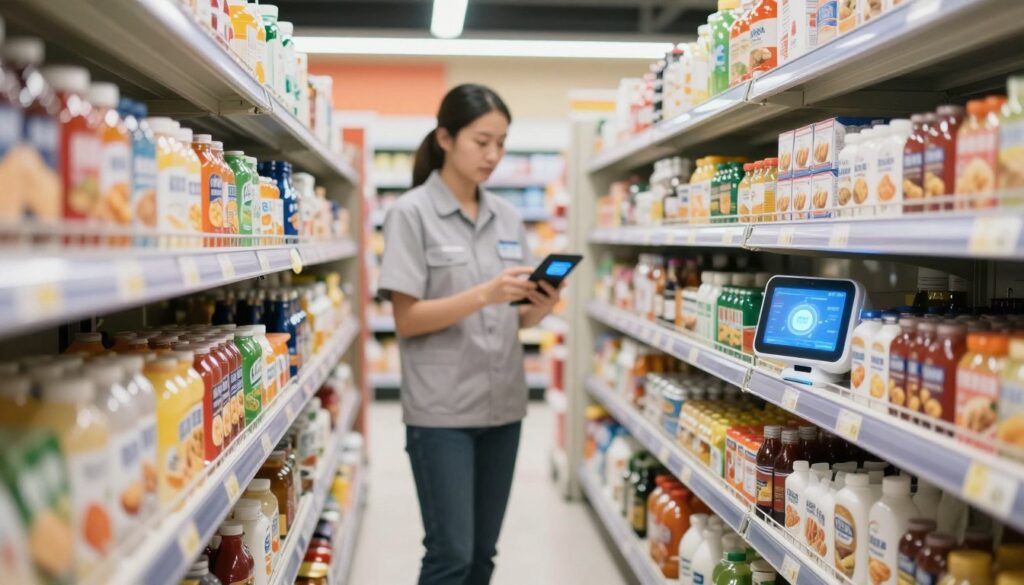
Electronically connected shelving systems provide the answer. These intelligent units use IoT sensors and RFID tags to track product availability automatically. The global market for this technology is projected to reach $15.34 billion by 2030, highlighting its growing importance.
This guide will walk you through understanding the problem, exploring available technologies, and implementing a system step-by-step. It focuses on transforming inventory accuracy and operational efficiency for competitive stores. These systems bridge physical spaces with digital commerce expectations, preventing customer frustration.
Key Takeaways
- Inventory mismatches between systems and shelves cause lost sales and customer frustration.
- Real-time visibility at the point of sale is essential for modern retail operations.
- Electronically connected shelving uses sensors and IoT to automatically track stock.
- The market for intelligent shelving is growing rapidly, indicating its value.
- Implementing these systems improves inventory accuracy and supports omnichannel strategies.
- They help prevent out-of-stock situations and misplaced merchandise.
- Accurate shelf data enables better replenishment and reduces revenue leakage.
Understanding the Importance of Accurate Inventory Management
The disparity between what a store’s system reports and what sits on its shelves is a primary profit leak. Precise inventory management is the foundation for operational efficiency and revenue protection in physical commerce.
When counts are wrong, every part of the business suffers.
Identifying the Causes of Inventory Mismatches
Several factors create this gap. Human error during manual counts is a major one. Theft, misplaced goods, and unreported damage also distort records.
A critical flaw is the lag between a sale at the register and the system update. This delay means data is always playing catch-up with reality.
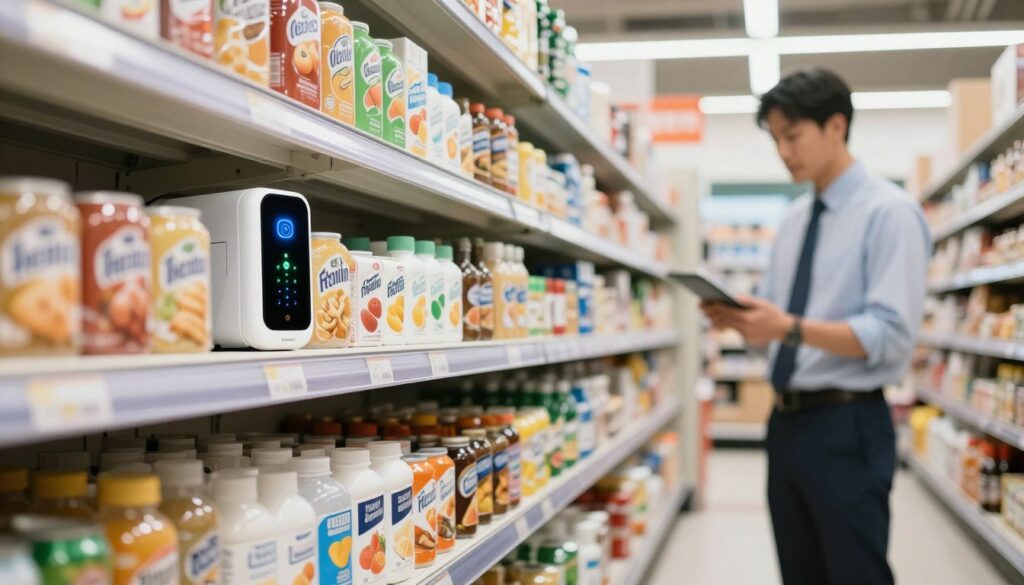
The Impact on Lost Sales and Customer Experience
Empty shelves mean lost sales. Shoppers will buy elsewhere or abandon their trip. This directly hits a location’s bottom line.
The shopping experience erodes when online promises don’t match in-store availability. Trust and brand loyalty fade. According to the National Retail Federation, in-store purchases can be more profitable, making shelf accuracy critical.
Real-time data from connected units minimizes out-of-stock scenarios. This leads to higher satisfaction and more return visits, securing future revenue.
Exploring the Technologies Behind Smart Shelves
A technological ecosystem of sensors, cameras, and digital labels turns ordinary shelving into a data hub. This combination provides the eyes and intelligence needed for accurate, real-time stock visibility.
Each component plays a distinct role in capturing and communicating inventory status.
Digital Shelf Labels and Their Multifunctional Roles
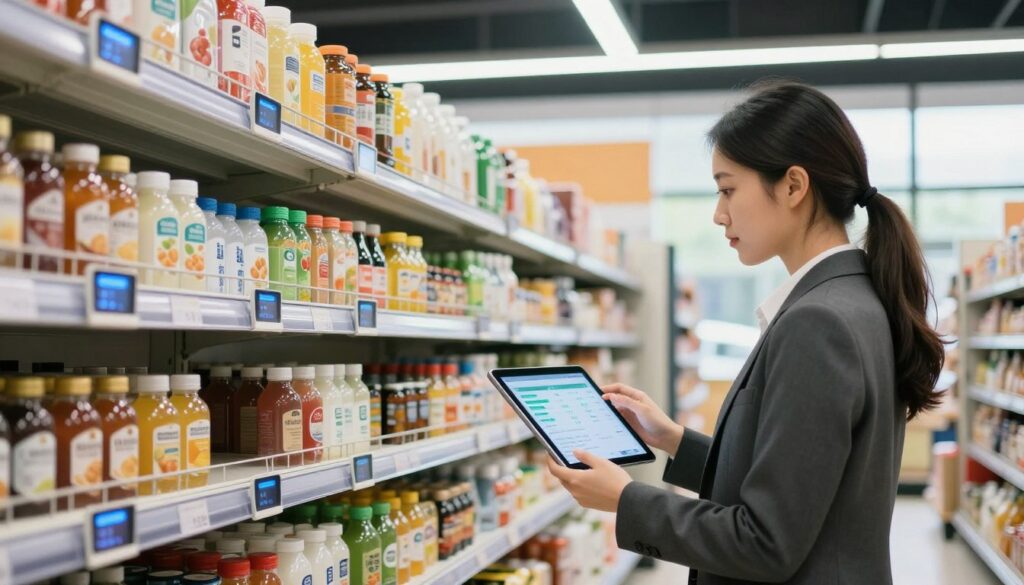
Electronic shelf labels (ESL) replace paper tags. These digital displays show pricing, promotions, and detailed product information instantly.
Advanced solutions like SOLUM Newton labels can show multiple pages of data. This helps with stocking tasks and attracts customer attention.
They integrate into central management systems. This allows for updates across all store locations from one platform.
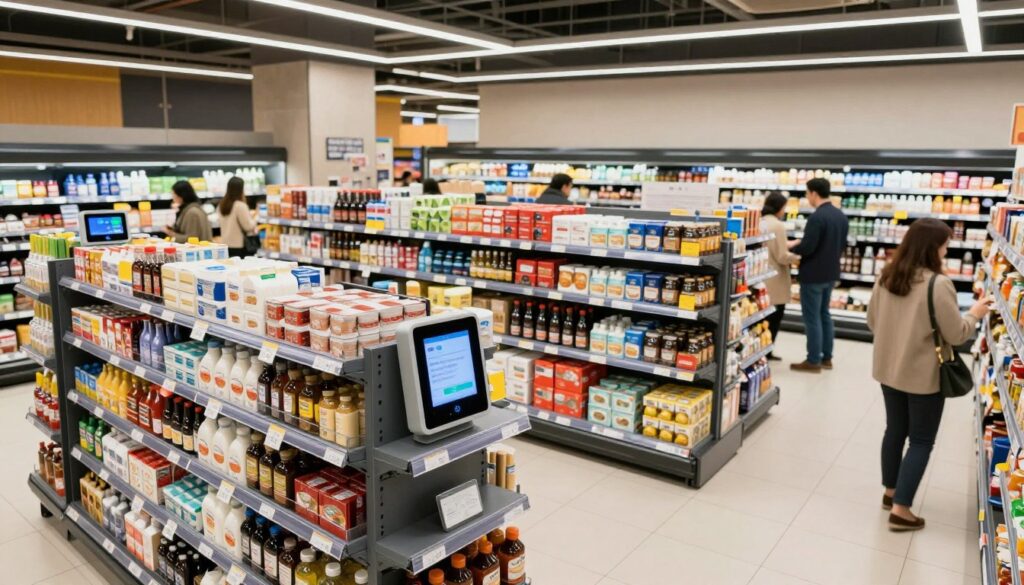
Shelf Sensors, Cameras, and RFID Integration
Weight sensors monitor shelf load continuously. They calculate removal and trigger restock alerts automatically.
IoT devices like motion sensors and cameras add another layer. Cameras use computer vision to spot empty spaces and track shopper engagement.
RFID tags enable item-level tracking. Radio frequency readers identify products from warehouse to shelf, improving accuracy.
| Technology | Primary Function | Data Granularity | Best Use Case |
|---|---|---|---|
| Digital Labels (ESL) | Dynamic information display & price updates | Shelf/Product SKU | High-turnover items with frequent price changes |
| Weight Sensors | Continuous load monitoring & removal detection | Unit count by weight | Bulk, uniform products like canned goods |
| RFID Tags | Item identification & supply chain tracking | Individual item level | High-value goods, apparel, electronics |
Choosing the right mix depends on product type and operational goals. Integration creates a powerful, unified system for inventory control.
Leveraging Smart Retail Shelf, Smart Retail Solution for Inventory Accuracy
Moving from traditional stock counting to automated, real-time tracking is a strategic project. It demands careful execution and a clear roadmap.
Retailers must begin with a thorough assessment. This includes auditing high-priority items and calculating the expected return on investment.
A phased rollout minimizes disruption. Start with a pilot program in one store section to test performance.
Step-by-Step Implementation Guide for Retailers
The first phase involves vendor selection and hardware procurement. Ensure new technology is compatible with your current systems.
Installation includes physical retrofitting of units and sensor mounting. Network infrastructure must support continuous data flow.
Comprehensive training for staff is critical. They need to learn new workflows and how to respond to restock alerts.
After deployment, a calibration phase fine-tunes the system. Validate sensor accuracy and refine alert thresholds.
| Implementation Phase | Key Activities | Success Metric |
|---|---|---|
| Pre-Assessment | Inventory audit, ROI calculation, pain point identification | Clear business case defined |
| Pilot Deployment | Limited section rollout, workflow refinement, integration testing | Measurable accuracy improvement |
| Full Integration | API connections to POS & ERP, staff training, network setup | Unified operational intelligence |
| Optimization | KPI tracking, threshold adjustment, continuous feedback | Reduction in out-of-stock incidents |
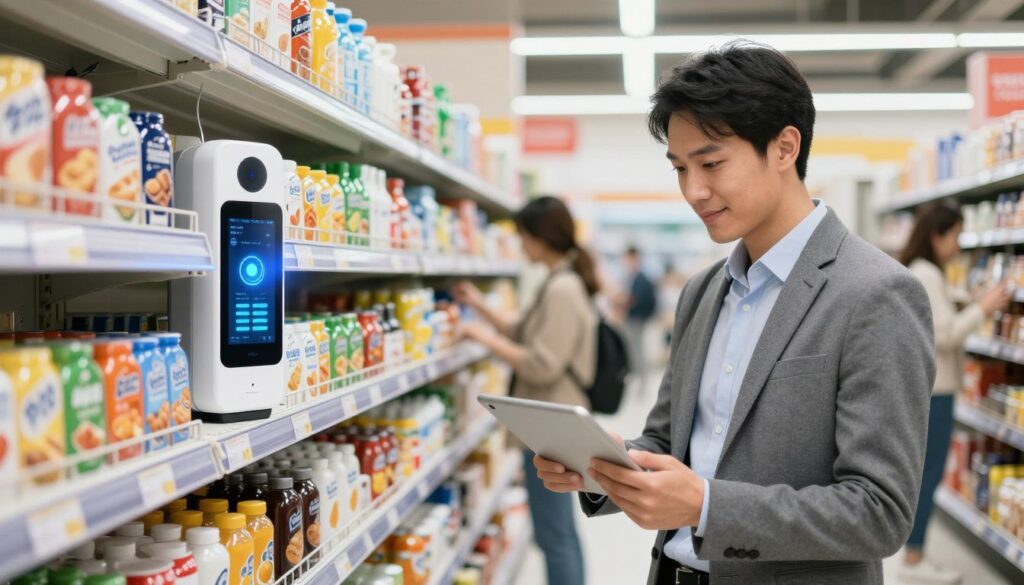
Integrating with Existing Systems and IoT Connectivity
Seamless connection to your existing tech stack is non-negotiable. API links to inventory management and point-of-sale platforms create a single source of truth.
The IoT architecture decides how data moves. Cloud-based options offer scalability, while edge computing reduces latency.
“Integration is where data turns into actionable insight. It bridges the gap between the physical shelf and the digital ledger.”
Strong cybersecurity measures protect this valuable data stream. This ensures business continuity and customer trust.
This holistic approach transforms operations. It turns real-time shelf data into a powerful tool for growth.
Utilizing Data Analytics and Insights to Enhance Retail Operations
Analytics platforms turn raw sensor data from store fixtures into strategic insights for boosting sales and service. This intelligence moves beyond simple stock counts.
It reveals detailed patterns in consumer behavior and product performance. Retailers gain a powerful tool for decision-making.
Tracking Customer Behavior and Optimizing Store Layouts
Heat maps show where shoppers linger and which items they pick up. Dwell time analysis indicates engagement levels.
This data directly informs planogram redesign. High-margin goods can be placed in premium, high-traffic zones.
Complementary product adjacencies are tested and refined. The result is a layout that guides the shopper journey and increases basket size.
Improving Operational Efficiency with Real-Time Data
Live inventory feeds enable just-in-time restocking. This minimizes backroom stock and wasted labor.
Staff schedules align with predicted peak restocking needs. Automated alerts replace manual shelf checks.
This streamlines operations and cuts costs. Capital is not tied up in excess stock.
Dynamic Pricing and Promotional Strategies
Digital price tags can update instantly based on algorithms. Prices adjust for demand, time of day, or competitor actions.
Promotions are tested in real-time. Their effectiveness is measured by immediate sales velocity.
This agile approach maximizes revenue per product. It turns pricing into a dynamic brand strategy.
Conclusion
Forward-thinking retailers are turning to intelligent store fixtures to secure their future in a competitive market. This technology directly tackles the costly problem of inventory mismatches. It prevents lost sales and protects customer relationships.
Real-time monitoring eliminates stockouts and optimizes staff labor. Shoppers enjoy a better experience with consistent product availability. These multi-layered benefits create a strong value proposition for any store.
The move to data-driven operations is now a strategic necessity. Begin with a pilot program in a single location. Then, expand and optimize using advanced analytics.
Success requires commitment to training and system integration. Looking ahead, these connected smart shelves will evolve with AI and predictive tools. They form the foundation for a truly responsive retail environment.
FAQ
How does a Smart Retail Shelf solution directly prevent lost sales?
What are the core technologies powering these intelligent store displays?
Is implementing this technology disruptive to a store’s current operations?
Beyond stock control, what other benefits do these systems offer?
How does this technology improve the shopper’s in-store experience?
How Iottive Delivers End-to-End Smart Retail Solutions
1. Retail Strategy & Solution Design
Iottive collaborates with retail leaders, digital heads, store operations teams, and supply chain stakeholders to understand customer journeys, inventory challenges, and growth objectives. This phase includes retail use-case validation, omnichannel architecture design, IoT device selection, AI personalization planning, and defining measurable KPIs such as promotion ROI, stock accuracy, and conversion rates.
2. Smart Systems Engineering & Retail Integration
Iottive engineers scalable Smart Retail solutions by integrating IoT sensors, RFID, smart shelves, digital mirrors, edge devices, and cloud platforms. We ensure seamless connectivity between POS systems, ERP, CRM, warehouse systems, and e-commerce platforms. The focus is on real-time visibility, secure data flow, and unified customer and inventory intelligence across stores and digital channels.
3. Pilot Deployment in Stores & Warehouses
Before enterprise rollout, Iottive deploys pilot solutions in selected retail stores, warehouses, or pharmacy locations. This includes testing AI-driven recommendations, smart inventory tracking, cold chain monitoring systems, and digital try-on experiences. Retailers can validate performance, customer engagement impact, and operational feasibility in live environments before scaling across locations.
4. Customer Experience & Retail Intelligence
Iottive builds intuitive dashboards and retail intelligence platforms that provide real-time insights into:
- Customer behavior & segmentation
- Promotion performance & ROI
- Store-level inventory accuracy
- Warehouse efficiency metrics
- Cold chain compliance tracking
- Online conversion and upsell analytics
Advanced analytics, alerts, and AI-driven insights empower retail teams to make faster, data-driven decisions that improve revenue, reduce losses, and enhance customer satisfaction.
5. Enterprise Rollout & Retail Scale-Up
From MVP to multi-location deployment, Iottive supports solution hardening, cloud scalability, cybersecurity, and long-term support. Smart Retail solutions are designed for:
- Multi-store expansion
- Omnichannel integration
- Regional inventory balancing
- Cross-border retail operations
- Continuous optimization using AI insights
Our approach ensures measurable ROI through improved customer engagement, reduced shrinkage, better inventory control, and operational efficiency.
Why Retailers Choose Iottive
- Proven expertise in Smart Retail & IoT-driven transformation
- Deep understanding of store operations, warehousing, and pharmacy compliance
- Seamless integration with POS, ERP, CRM, and e-commerce platforms
- Secure, scalable, and production-ready retail architectures
- Strong focus on measurable business outcomes — not just technology
📧 Contact Email: sales@iottive.com

Transform Your IoT Vision Into Reality.
Get free expert insights, architectures & cost breakdowns.
Drop your email to schedule free meeting.