One evening in Los Angeles, a driver spent 20 minutes circling a single block. That extra time burned fuel
and frayed nerves, mirroring a citywide pattern where cruising makes up about 30% of urban traffic.
Modern smart parking systems use sensors, gateways, cloud platforms, and an app to turn live data
into spot availability and short routes. This cuts search time for drivers and trims congestion.
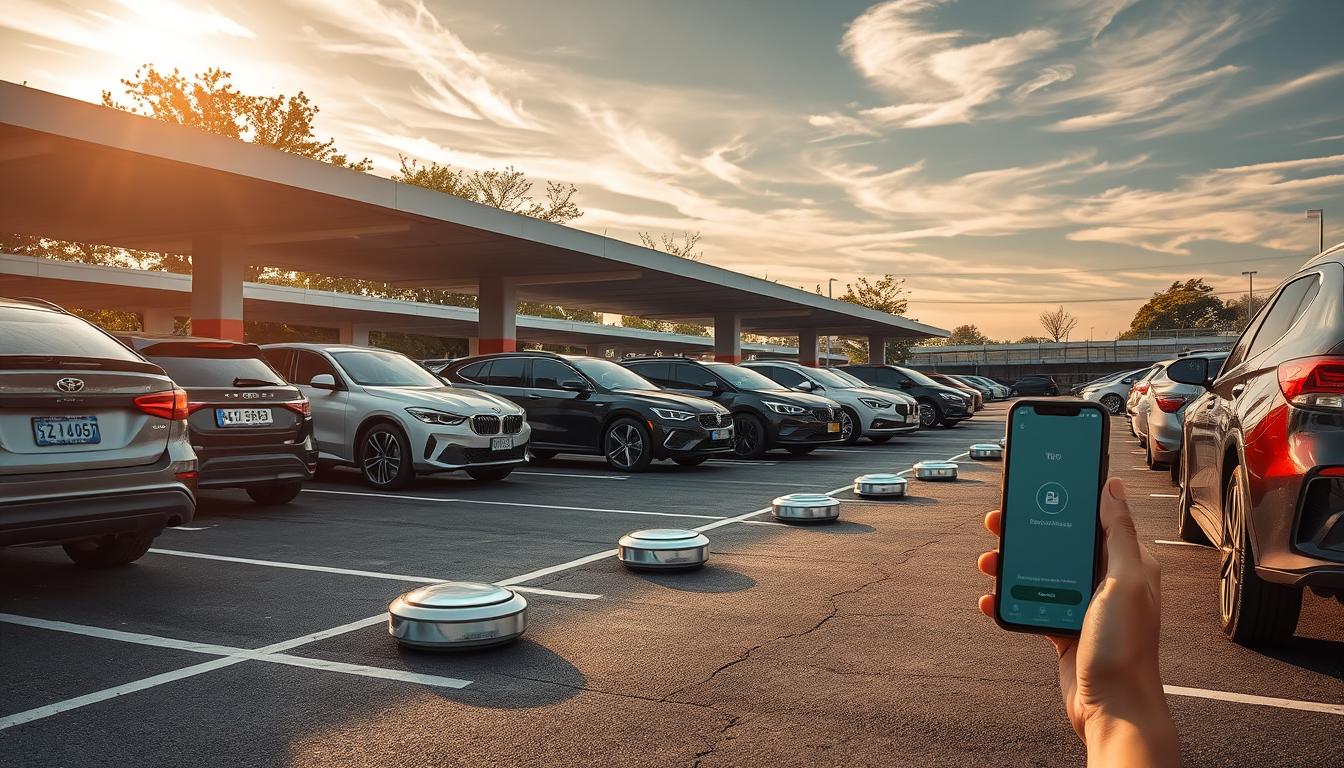
The result is both environmental and economic: less cruising means lower emissions and better use of existing
space. Cities can pilot small networks, scale to citywide coverage, and rely on partners like Iottive for BLE apps, cloud integration, and end-to-end solutions.
Key Takeaways
- Real-time guidance from sensors and apps reduces search time for drivers.
- Better availability data lowers traffic and cuts fuel use and emissions.
- Scalable systems let cities grow from pilots to full deployments.
- Dynamic pricing and demand forecasting improve space utilization.
- Expert vendors provide integration across devices, cloud, and user interfaces.
The present-day parking challenge in U.S. cities and why it matters now
Cruising for a space now drives measurable congestion, higher emissions, and frustration for city
drivers.
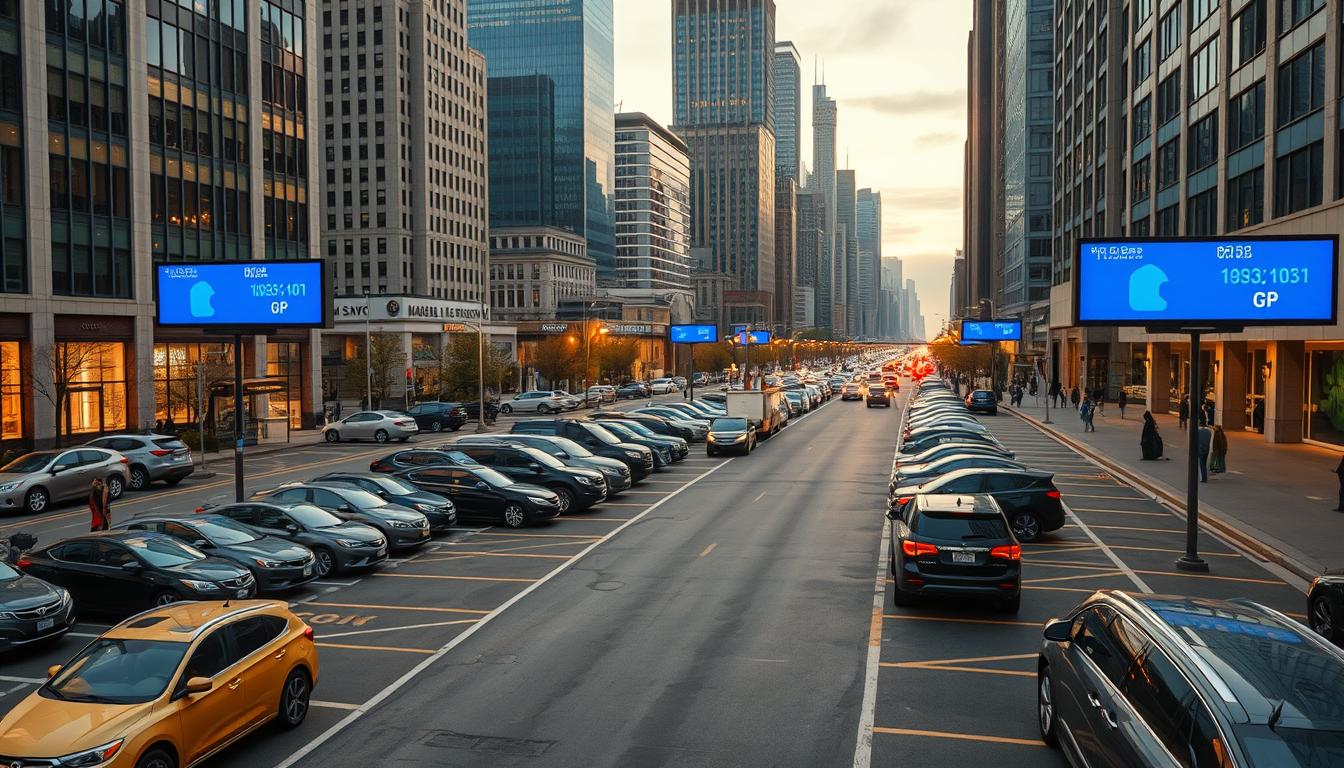
Studies show roughly 30% of urban traffic comes from drivers searching for parking. In one Los Angeles business
district, cruising equaled 38 trips around the globe, burned 47,000 gallons of gasoline, and released 730 tons of
CO2 in a year.
The daily effects are clear. Drivers face longer time spent circling blocks, added stress, and unpredictable trip
times. That frays the user experience and can reduce foot traffic for local businesses.
- Traffic and fuel waste: searching parking increases congestion and emissions across metro areas.
- City operations: enforcement and revenue collection strain under uneven curb use.
- Supply pressure: rising urban populations mean fixed space cannot keep up without better management.
Legacy systems lack live data and transparency. This creates pockets of empty stalls while other blocks
stay full. Modern data-driven systems and digital solutions are now essential to balance demand and guide drivers
quickly to open space.
| Issue | Legacy systems | Data-driven outcome |
|---|---|---|
| Visibility | No real-time availability | Live spot status reduces search time |
| Enforcement & revenue | Manual checks, delays | Automated reports, fair billing |
| Space utilization | Uneven use, hotspots | Balanced occupancy across areas |
What a smart parking system is and how AIoT makes it work
A modern system turns sensors, networks, and cloud logic into an on-demand guide for drivers.
In short: smart parking systems are AIoT platforms that link on-spot detectors, gateways,
cloud analytics, and a user-facing app to show live availability and simplify the journey.

From sensors to smartphones: the end-to-end loop
Sensors and cameras detect occupancy at the curb or lot. Gateways then relay those signals over LoRaWAN, NB‑IoT, or
Wi‑Fi to central cloud services.
Cloud engines fuse raw data, run pattern recognition, and produce real-time availability and short-term forecasts.
The mobile app and web portal present routes, pricing, reservations, and payments in one flow.
- Accuracy: AI fuses multiple signals to spot anomalies and raise trust in availability.
- Edge filtering: Local devices aggregate messages to cut latency and lessen cloud load.
- Reservations & payments: Users can book a spot, navigate to it, and complete checkout
without leaving the app. - Modular rollout: Cities can pilot small zones, reuse legacy meters, and scale coverage as
demand grows.
Operations teams get dashboards that track KPIs and live status. That same architecture supports
reporting and optimization so operators can tune pricing, enforcement, and space use with real-time data.
AI & IoT smart parking architecture that scales for cities
A layered architecture ties user interfaces, edge devices, and back-end services into a single, scalable
city platform.
User-facing layers: mobile app and web portal
The user layer presents live availability, reservations, pricing, and account tools via a mobile app and web
portal. It guides drivers to an open space, handles payments, and offers operator dashboards for management.
Cloud platforms for real-time processing and storage
Cloud services ingest telemetry, store time-series data, and run ML models for short-term forecasts and alerts.
APIs expose those results so cities and vendors can build further solutions and integrate with transit systems.
Gateways and edge intelligence to reduce latency
Gateways filter messages, normalize payloads, and queue telemetry when backhaul is intermittent. Local edge logic
lowers round-trip time and reduces cloud load, while MQTT is used for efficient publish/subscribe messaging.
On-spot sensors and lot infrastructure
Stall-level sensors, cameras, barriers, signage, and power systems enable real-time operations at scale. Device
twins and autoscaling cloud resources support multi-site deployments, tenant isolation, and the security practices
cities require.

Core IoT sensors that detect vehicle presence accurately
Picking the correct detector mix is the first step to reliable vehicle occupancy data. Different
sensors suit curbside lanes, garages, and open lots. Choice depends on accuracy needs, weather, and installation
cost.
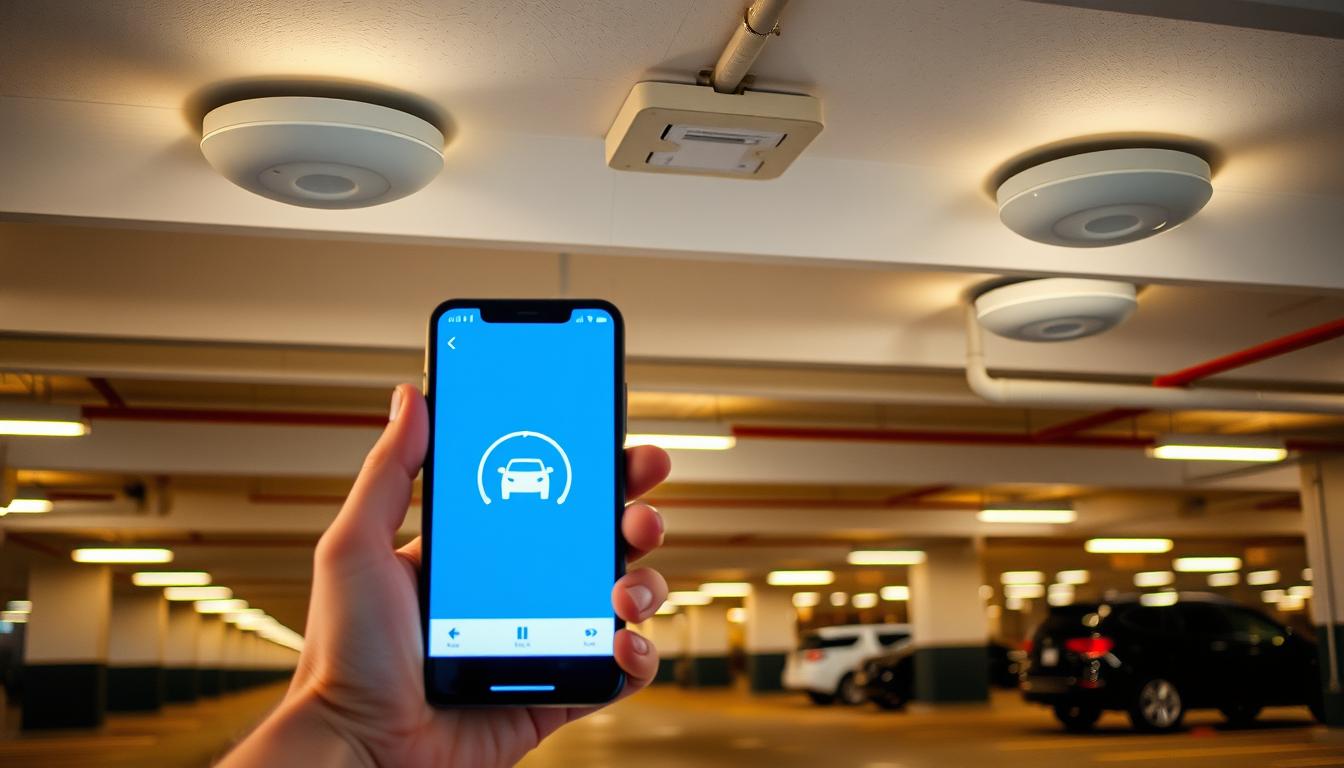
Magnetic, ultrasonic, infrared, radar, and inductive loops
Common field devices include ground-embedded magnetic probes, overhead ultrasonic units, infrared detectors, radar
modules, and inductive loops. Each modality senses a different physical change to detect vehicle presence.
- Magnetic: senses disturbances in the earth’s magnetic field from a metal mass. Good for
curbside stalls and low power needs. - Ultrasonic: measures acoustic reflections from a vehicle under a canopy or ceiling. Works well
indoors but needs clear mounting. - Infrared: detects heat signatures and works for short-range occupancy checks in controlled
lighting. - Radar: uses radio wave reflections and performs robustly in harsh weather and varied lighting.
- Inductive loops: count vehicles by measuring changes in inductance at the pavement. High
accuracy but invasive to install.
Computer vision and occupancy detection cameras
Video with computer vision adds licence-plate capture, lane analytics, and multi-space sensing from a
single device. Modern models tackle occlusion and low-light scenes to estimate which parking spaces are occupied.
Blending sensors and vision improves resilience. Vision fills gaps in sensor fields, while spot
sensors reduce false positives during weather or interference.
| Sensor Type | Strengths | Trade-offs |
|---|---|---|
| Magnetic | Low power, low cost, good curb accuracy | Limited range, ground work for install |
| Ultrasonic | Ceiling-mounted for garage stalls, non-invasive | Sensitive to mounting, affected by noise |
| Infrared | Simple heat-based detection, compact | Less reliable in variable temperatures |
| Radar | All-weather, long range, robust | Higher cost, potential interference |
| Inductive loop | Very accurate per-stall detection | Pavement cuts, higher installation effort |
| Computer vision | Multi-space coverage, ALPR, analytics | Privacy concerns, bandwidth and compute needs |
Calibration, routine health checks, and remote diagnostics keep data accurate over time. Operators should weigh
installation complexity, power draw, and network needs when selecting sensors for garages versus curbside
environments.
Data flow, protocols, and real-time updates that drivers can trust
Reliable data flow is the backbone that turns raw sensor events into timely guidance for drivers.
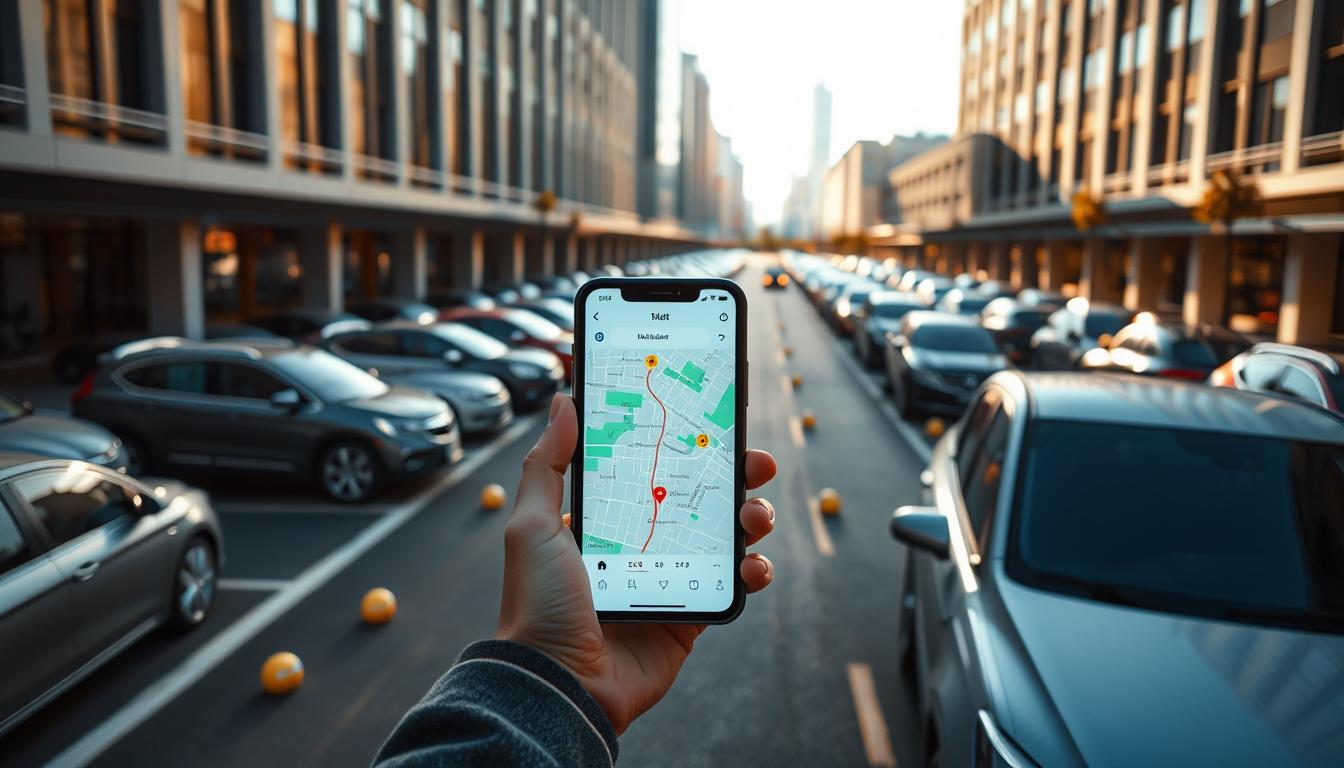
From LoRaWAN, NB‑IoT, or Wi‑Fi to MQTT and cloud ingestion
Sensors publish occupancy events over LPWAN or Wi‑Fi to local gateways. Gateways forward telemetry to cloud
services using MQTT or HTTPS for low-latency delivery.
Turning raw signals into dependable availability
Cloud pipelines run de-duplication, filtering, and aggregation to convert noisy inputs into a single availability
state per stall.
Confidence scoring fuses sensor and camera signals to reduce false positives and false negatives.
- Edge inference reduces round-trip time for guidance when drivers approach a destination.
- Defined SLAs for data freshness keep updates within seconds for high-demand zones.
- Observability—metrics, traces, and dashboards—verifies correctness and aids troubleshooting.
- Standardized APIs enable integration with navigation providers, enforcement platforms, and city data hubs.
| Stage | Function | Outcome |
|---|---|---|
| Device | Detect occupancy events | Low-power, local signals |
| Gateway | Normalize and forward | Resilient telemetry delivery |
| Cloud | Clean, fuse, score | Reliable availability for user displays |
| Edge | Inference and caching | Lower latency for guidance |
Connected parking analytics: using AI to optimize space and time
Data-driven models convert historical patterns and live feeds into forecasts that guide daily
operations and long-term planning.
Predictive availability forecasts stall occupancy so operators can align staffing, enforcement, and
signage. Drivers gain better confidence about arriving times and likely availability.
Predictive availability and demand forecasting
Machine learning blends time-series and live telemetry to forecast short-term demand by block and hour. That
forecast helps cities reduce cruising and improve space utilization.
Dynamic pricing aligned with live demand patterns
Price signals respond to occupancy to smooth peaks and boost turnover. Dynamic rates increase revenue stability
while keeping access fair near key destinations.
Traffic flow analysis and heatmaps for planning
Ingress/egress counts and curb activity produce heatmaps that reveal hotspots and time-of-day trends. Planners use
these visuals to reallocate curb rules and coordinate with broader traffic flow systems.
- Definition: application of ML to reveal patterns, forecast occupancy, and optimize space
utilization. - Outcomes: less time searching, lower emissions, and steadier revenue for operators.
AI mobility apps that elevate the driver experience
When discovery, booking, and checkout live in one place, drivers spend less time circling and more time
arriving.
Modern AI mobility apps consolidate discovery, reservations, navigation to parking spots, and
contactless payments into one cohesive flow. Real-time availability detection feeds the map so the user can reserve
a slot and head straight to it with turn-by-turn guidance via Google Maps or Mapbox.
Reservations, navigation, and contactless payments
Secure payment flows support stored methods and fast checkout. Many solutions use Stripe or PayPal for tokenized
cards and digital receipts.
- Reserve a slot in seconds and store multi-vehicle profiles for quick selection.
- Navigation hands off to maps for precise routing and ETA updates.
- Voice search and accessibility options speed discovery in multi-level facilities.
ALPR for seamless entry and ticketless operations
License plate recognition enables automatic gate opens and ticketless billing. Plate recognition
reduces queues at entry and exit and ties sessions to a user account for smooth invoicing.
Predictive guidance suggests arrival windows or nearby alternatives when availability looks tight. Push
notifications and trip history keep the driver informed and in control.
smart parking IoT, AI mobility apps, connected parking analytics
A three-part system links field sensors, a user-facing app, and real-time models to cut cruising and
improve curb use.
The first layer captures ground truth occupancy with on-stall detectors and cameras. This field telemetry gives
operators accurate, second-by-second data for each stall.
The second layer delivers that availability to drivers through a convenient app. Users get turn-by-turn guidance,
reservations, and live status so they arrive with confidence.
The third layer runs models that turn behavior and history into policy. Forecasting and dynamic pricing adjust
rates, curb rules, and signage to match demand.
Feedback loops keep the triad adaptive: user choices feed models, the models update guidance, and
the system tunes supply-side levers like time limits or rates.
| Function | Input | Outcome |
|---|---|---|
| Sensing | Stall telemetry | Accurate occupancy |
| User layer | Real-time availability | Faster arrivals, less cruising |
| Analytics | Behavior + history | Dynamic pricing, better turnover |
Platform interoperability matters. Sharing anonymized feeds with transit, micromobility, and venues supports
coordinated demand management.
KPIs to track include reduced cruising time, higher turnover per stall, revenue per space, and
user satisfaction. Robust privacy, security, and governance keep public trust as deployments scale.
Operational benefits for municipalities, operators, and drivers
Real-time visibility turns scattered curbside activity into clear operational choices for cities and
vendors.
City teams gain centralized dashboards that show occupancy, revenue, and alerts in one view. This improves response
time and helps prioritize maintenance or enforcement without guesswork.
Reduced congestion, fuel use, and emissions
Lower cruising cuts emissions: deployments in busy corridors have shown up to a 40% drop in
vehicle emissions by reducing search time.
Fewer vehicles circling means less fuel burned and lower traffic congestion, supporting municipal climate goals.
Higher space utilization and better parking operations
Higher turnover raises effective capacity so cities get more use from existing assets without new construction.
Better space utilization and targeted pricing increase revenue and save capital and time on expansion projects.
Stronger security and enforcement with real-time alerts
Automated compliance, ALPR, and rule-driven alerts reduce unauthorized use and speed violation handling.
Operators and enforcement teams work from the same evidence, making enforcement fairer and less intrusive for the
user.
Implementation hurdles and how to address them
A clear rollout plan can turn resistance into momentum for citywide deployments. Start with
governance that names roles across departments, operators, and the public. Publish transparent KPIs and a phased
timeline to build trust.
Organizational readiness, cost, and stakeholder buy-in
Mitigate budget concerns with a pilot-to-scale financing model. Use SaaS pricing, hardware leasing, and measured
pilots that show benefits in reduced search time and lower traffic.
Data privacy, correctness, and standard tool availability
Privacy-by-design limits collection, anonymizes records, and enforces retention rules. Maintain
correctness with sensor fusion, routine calibration, and continuous validation so users trust live availability.
Bridging legacy systems and talent gaps
Integrate meters, gates, and back offices via APIs and adapters to avoid rip-and-replace. Close talent gaps through
vendor partnerships and training programs that upskill staff in cloud and edge management.
Practical checklist:
- Governance, KPIs, and phased rollout plans.
- Pilot financing and cost-to-benefit tracking.
- Data minimization, compliance controls, and validation routines.
- API-led integration and workforce development partnerships.
Business models and revenue levers for smart parking solutions
Monetization mixes subscriptions, device sales, and per-use charges to fund deployments.
Recurring SaaS revenue typically comes from tiered subscriptions for operations dashboards, API access,
and data analytics. Fees scale with deployment size and feature sets, giving predictable income for operators and
cities.
Hardware sales add upfront revenue. Sensors, gateways, meters, and access controllers sell with optional warranties
and maintenance packages to extend lifetime value.
Transaction fees and premium user features drive per-use income. Operators can charge a small percentage on digital
payments, offer fleet accounts, or sell subscriptions for priority access in an app.
Additional levers include dynamic pricing to match demand, short-term space rentals, premium services like EV
charging and valet, and revenue from digital signage and geotargeted advertising.
| Revenue Lever | Model | Typical Outcome |
|---|---|---|
| SaaS subscriptions | Tiered access, APIs, dashboards | Recurring predictable ARR |
| Hardware & services | Device sales, install, maintenance | Upfront cash + service margins |
| Transactions & premium | Payment fees, fleet plans, VIP passes | Variable, scales with usage |
| Data & reporting | Custom reports, forecasting | High-margin enterprise contracts |
| Demand levers | Dynamic pricing, rentals, ads | Higher yield per parking space |
Integrating with smart city infrastructure and mobility systems
When curb availability feeds traffic centers in real time, signal timing can adapt to reduce congestion. This link
turns stall-level status into actionable control across urban systems.
Data sharing across traffic, public transit, and urban planning
Traffic management platforms ingest stall and garage feeds to avoid spillback and smooth traffic flow. Coordinated
signals and dynamic lane controls keep entry points clear and reduce queuing.
Transit partners receive availability feeds so their app can suggest park-and-ride options when downtown supply is
low. That improves multimodal choices and lowers single-occupant trips.
Planners use longitudinal data to refine curb rules, set price schedules, and allocate accessible space for equity
goals. Heatmaps and KPIs help evaluate policy outcomes over months and years.
Event and interoperability benefits
- Pre-stage guidance and surge pricing around venues to smooth arrivals and departures.
- Open standards and APIs prevent vendor lock-in and enable city-wide solutions to interoperate.
From MVP to full rollout: a practical development roadmap
Begin pilots with a narrow zone and a tight scope to prove value quickly. Start by validating core
features that matter most to drivers and operators: live availability, reservations, and secure payments. Use a
single lot or a short curb corridor to collect real-world data and KPIs.
Defining scope, UX, and core features for a pilot
Define clear KPIs—reduce time to find parking, increase adoption, and meet accuracy targets.
Design the user flow so discovery and booking take seconds. Test a lightweight mobile app with real users and
iterate on UI based on session metrics and surveys.
AI model integration, payments, and security hardening
Choose detection models like YOLO or MobileNet for stall-level inference and forecasting. Host
model training and deployment on AWS, Azure, or GCP and monitor drift with MLOps tools.
Integrate mapping (Google Maps or Mapbox) and payments (Stripe or PayPal). Enforce PCI compliance, use OAuth 2.0
and JWT for identity, and apply data minimization across the lifecycle.
Scaling, monitoring, and continuous improvement
Move from pilot to production using containerization (Docker) and orchestration (Kubernetes). Implement CI/CD
pipelines for safe releases and automated tests.
Set up observability, SLOs, and incident response. Use analytics to collect feedback and run iterative releases
that improve accuracy, uptime, and user satisfaction.
Feature set and tech stack to build a future-ready parking platform
A clear feature plan and a modular stack let cities deliver reliable curb services today and scale
tomorrow.
Must-have features include real-time availability, stall-level occupancy detection, reservations,
contactless payments, and ALPR for ticketless entry. Add account management, billing, and robust reporting so
operators can do day-to-day management with confidence.
Advanced capabilities lift the user experience: AR indoor guidance for garages, conversational
chatbots for support, ML demand forecasting, and anomaly detection to catch fraud or sensor drift. Include computer
vision where wide-area sensing or plate recognition adds value.
Recommended modular stack
| Layer | Examples | Notes |
|---|---|---|
| Client | React Native, Flutter, Swift, Kotlin | mobile app + web UI |
| Backend | Django / Node.js, PostgreSQL, MongoDB | API-first, multi-tenant |
| ML & Edge | TensorFlow, PyTorch, MQTT, edge Python | computer vision, forecasting |
| Cloud & DevOps | AWS/Azure/GCP, Docker, Kubernetes, Jenkins | scalable, observable |
Security &ops demand OAuth/JWT, SSL, cert management, encrypted OTA updates, and PCI-compliant
payment flows (Stripe/PayPal). Test performance under event surges and multi-lot scale to ensure uptime and smooth
user experience.
About Iottive: your partner for end-to-end IoT, AIoT, and mobile parking solutions
Iottive’s engineering teams focus on secure, scalable platforms that
fuse device telemetry with clear user flows. The company builds BLE-enabled mobile solutions, cloud
integration, and custom hardware to help cities and operators manage curb and lot space more effectively.
Expertise in BLE app development and cloud integration
Iottive delivers rapid prototypes and MVPs that reduce
risk and speed time-to-value. Their teams craft BLE app experiences, APIs, and back-end services that turn sensor
signals into actionable status for drivers and operators.
Industries served
- Healthcare
- Automotive
- Smart Home
- Consumer Electronics
- Industrial IoT
Get in touch
Visit: www.iottive.com | Email: sales@iottive.com
Conclusion
A focused deployment that ties sensors to user guidance can quickly prove value for drivers and operators
alike. AIoT-powered smart parking aligns real-time sensing, routing, and forecasting to cut
cruising, lower emissions, and save time.
Across stakeholders the benefits are clear: less time to find a spot for drivers, higher utilization and revenue
for operators, and reduced congestion for cities. Durable impact requires scalable systems,
privacy-by-design, and integration with broader city infrastructure.
Start with a narrow MVP, measure KPIs, and iterate using live data and user feedback. For end-to-end support—from
sensors to mobile and cloud—engage expert partners like Iottive: www.iottive.com
| sales@iottive.com. They help cities deliver robust
solutions that reclaim curb space and improve daily life.
FAQ
What problems do modern cities face with on‑street parking and why act now?
Urban areas in the U.S. face rising vehicle counts, limited curb space, and unpredictable demand. These issues increase search time, congestion, emissions, and lost revenue for cities. Deploying availability detection and real‑time guidance reduces cruising time and improves curb management, making traffic flow smoother and streets safer.
How does an end-to-end system detect and show available spaces to drivers?
Sensors at the curb or in lots detect vehicle presence and send signals via low‑power networks or Wi‑Fi to gateways. Edge processing filters data, then cloud services aggregate and publish availability to mobile and web interfaces. The loop closes when navigation or reservation features direct drivers to the confirmed spot.
Which on‑spot detection technologies are most reliable for occupancy sensing?
Inductive loops, magnetic sensors, ultrasound, and radar provide robust presence detection in many settings. Camera‑based computer vision adds plate recognition and lane‑level accuracy. Choosing the right mix depends on installation cost, lighting, weather, and desired features like ALPR.
What communication protocols keep real‑time updates dependable?
Networks such as LoRaWAN and NB‑IoT offer long range and low power for sensors, while Wi‑Fi and LTE support higher throughput. MQTT and HTTPS move telemetry to cloud platforms, where APIs feed apps with low latency and high availability for drivers and operators.
How do analytics and machine learning improve space utilization?
Historical occupancy and transaction data let models predict peak demand, forecast availability windows, and suggest dynamic pricing. Heatmaps and flow analysis reveal bottlenecks so cities can reallocate curb space, adjust signage, and optimize enforcement for better utilization.
What user features should a driver expect from a modern mobility app?
Core features include live availability maps, turn‑by‑turn navigation to reserved or nearest space, contactless payment, and booking. Advanced functions add estimated time to spot, expansion of AR guidance, and automated entry/exit via license plate recognition for ticketless operation.
How does license plate recognition (ALPR) enhance operations?
ALPR automates entry, exit, and payment reconciliation, reducing queuing and manual checks. It supports permit checks, enforcement alerts, and event management. Proper privacy controls and secure storage are essential when using plate data.
What operational benefits do cities and operators gain after rollout?
Benefits include reduced congestion and emissions, higher turnover and revenue from better utilization, faster enforcement with real‑time alerts, and improved traveler satisfaction. Data also supports long‑term planning and coordination with transit and traffic systems.
What common implementation hurdles should be expected and how can they be mitigated?
Challenges include upfront hardware cost, stakeholder alignment, integration with legacy systems, and data governance. Start with a focused pilot, define clear KPIs, choose interoperable standards, and set privacy policies to build trust and measure value before scaling.
Which business models make deployments financially viable?
Typical models combine SaaS subscriptions for software, hardware sales or leases, transaction fees for payments, and premium services like analytics. Dynamic pricing, reserved spaces, and advertising also create recurring revenue streams for operators and municipalities.
How do you ensure data privacy and accuracy in these systems?
Implement encryption in transit and at rest, role‑based access, and data retention limits. Validate sensor feeds with cross‑checks—camera verification or loop sensors—to reduce false positives. Regular audits and transparent privacy notices help maintain compliance and public trust.
How do these systems integrate with broader city mobility and traffic platforms?
Use open APIs and standardized data formats to share availability, demand forecasts, and curb usage with transit agencies and traffic management centers. Shared datasets enable coordinated signal timing, multimodal routing, and smarter curb allocation across agencies.
What roadmap steps deliver a successful pilot to full city rollout?
Start by defining scope, user experience, and KPIs for a small area. Deploy sensors and a minimal app with reservation and payment. Integrate edge filtering and cloud analytics, then iterate on ML models and security. Scale by expanding geographies, adding features, and automating operations.
What core features and tech stack are recommended for a future‑ready platform?
Must‑have features include real‑time availability, reservations, and payments. Recommended stack: resilient sensors, edge gateways for preprocessing, cloud platforms for storage and ML, MQTT/REST APIs, and mobile/web front ends. Add monitoring, DevOps, and fraud detection for reliability and security.
Which industries and use cases benefit from this technology beyond municipal curb management?
Commercial operators, airports, hospitals, retail centers, and campuses gain from reduced search time, better revenue capture, and improved user experience. Industries like automotive and logistics use these systems for fleet routing and loading zone management.
Who can enterprises contact for end‑to‑end product and integration services?
Look for firms with experience in BLE apps, cloud/mobile integration, hardware design, and custom deployments. Check vendor portfolios for cross‑industry projects in healthcare, automotive, and industrial IoT, and request references to verify delivery and support.

Transform Your IoT Vision Into Reality.
Get free expert insights, architectures & cost breakdowns.
Drop your email to schedule free meeting.