Case Study
Relay Response
Healthcare / CPR Training Technology
On-demand CPR/BLS training platform using Apple Watch sensors for real-time compression feedback, with 77% improvement in compression depth consistency.
Relay Response
Tech Partnership
Healthcare
Ongoing
- compression depth consistency after one training session
- Multiple US and international patents
- CPR Training is an advanced training


Key Outcomes
Achieved 77% improvement in compression depth consistency using Apple Watch sensor-based real-time feedback during CPR training validated in a 2024 peer-reviewed study
Delivered synchronized team training where Apple Watch data streams live to an instructor’s iPhone, enabling group BLS skills practice with individual performance metrics
Built a patented system (US 10,376,441 + international patents) leveraging existing consumer hardware (Apple Watch) no proprietary training manikin or sensor equipment required
The Challenge
Before partnering with Iottive, Relay Response was facing several issues:
Infrequent CPR Recertification
Healthcare professionals recertify CPR skills every 1–2 years — skills degrade significantly between certifications. There was no convenient, on-demand way to practice with real-time feedback outside of scheduled training sessions.
Expensive Training Equipment
CPR training manikins with sensor-based feedback cost $2,000–$10,000 per unit. This limits practice to institutional settings and scheduled sessions, preventing the frequent, short practice sessions that build muscle memory.
No Wearable-Based Compression Feedback
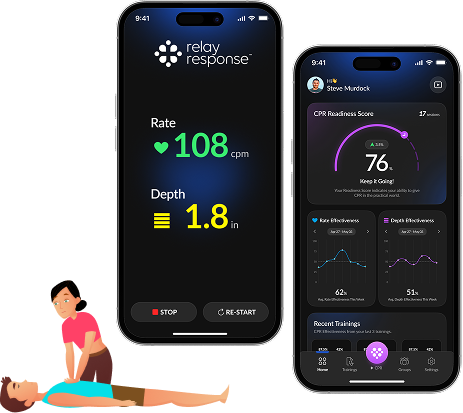
Apple Watch contains accelerometer & gyroscope sensors capable of measuring compression depth and frequency, but no existing software translated this raw sensor data into clinically validated CPR feedback.
Team Coordination During Resuscitation
Real CPR events involve teams of 2–5 providers performing compressions in rotation. Training systems that focus on individual performance miss the coordination, switching, and communication skills that determine outcomes in real events.
Our Solution
Iottive delivered a complete AIoT solution under a full-cycle product development model.

Bluetooth/IoT Expertise
Leveraged Apple Watch’s BLE connectivity to stream compression data in real time to an instructor’s iPhone. Watch Connectivity framework handles the data pipeline, with custom signal processing converting raw accelerometer data into compression depth, frequency, and consistency metrics.

Design Thinking Approach
Designed the Apple Watch interface for use during physical exertion — large, high-contrast visual indicators and haptic feedback that provider can feel through compression motion. The instructor iPhone app shows multiple trainees’ metrics simultaneously in a dashboard view.

Project Planning & Execution
Phased development: individual training (Apple Watch + iPhone, 10 weeks), then team training (multi Watch to single instructor iPhone, 12 weeks), then analytics and reporting (8 weeks). Clinical validation study coordinated in parallel with development.

Functionalities Delivered
Real-time compression depth and frequency feedback on Apple Watch, audio-visual metronome for target rate (100–120 compressions/minute), post-training analytics with compression quality scoring, live instructor dashboard for team training, virtual victim skills check mode, medical reference library, and session recording for review.
Implementation Highlights

Sensors & Hardware
Apple Watch accelerometer and gyroscope sensors measuring compression depth (target: 2–2.4 inches / 5–6 cm) and rate (target: 100 120/min). No additional hardware required — the watch the trainee already owns becomes the training device.

Edge & Connectivity
On-watch signal processing converts raw accelerometer data into compression metrics locally, then streams processed results to the instructor’s iPhone via Watch Connectivity. Works in airplane mode (no cellular required).

Firmware & Performance Optimization
Custom motion processing algorithms filter out arm movement artifacts to isolate chest compression displacement. Achieves clinically validated depth measurement accuracy using consumer-grade MEMS sensors.

Data Analytics & Visualization
Post-session reports show compression depth distribution, rate consistency, and quality scoring aligned to AHA guidelines. Longitudinal tracking reveals skill degradation patterns and optimal recertification timing.

Dashboard & UX
Apple Watch face: large depth gauge with green/yellow/red zones, real-time rate counter, and haptic alerts for out-of-range compressions. Instructor iPhone: multi-trainee grid showing live metrics from all connected watches.

Security & Compliance
Training data stored locally on device with optional iCloud backup. No patient data involved (training only). Pending FDA 510(k) clearance for clinical use; currently approved for training purposes only.
Results & Impact
- 77% improvement in compression depth consistency documented in peer-reviewed study (PMC, 2024)
- Eliminated the need for $2,000–$10,000 sensor-equipped training manikins for skills practice
- Multiple US and international patents protecting the wearable CPR feedback technology
- Team training capability enabled coordinated group practice with individual performance tracking
- On-demand access allowed healthcare professionals to practice CPR skills in 5-minute sessions between shifts

“Our peer-reviewed study showed 77% improvement in compression depth consistency — that’s clinically significant for patient survival. Iottive turned the Apple Watch into a CPR training device using sensors that were already on providers’ wrists. The team training feature where
I can see every trainee’s compression quality on my iPhone in real time changed how we run BLS skills sessions. No more $5,000 manikins gathering dust in a closet.”
— Beno Oppenheimer , XiMiO Health Inc/ Relay Response
Lessons & Best Practices
Leverage Existing Hardware
Building on the Apple Watch — a device trainees already own and wear — eliminated hardware procurement, distribution, and maintenance costs. The sensor quality in consumer wearables is sufficient for clinically validated CPR feedback.
Validate with Peer-Reviewed Research
Publishing the 77% improvement in a peer reviewed journal transformed Relay Response from a training app into an evidence-based clinical tool. Healthcare procurement requires clinical evidence, not marketing claims.
Design for Physical Exertion
CPR is physically demanding — trainees sweat, their arms shake, and they can’t focus on small UI elements. The Apple Watch interface uses the entire screen as a single depth gauge, visible through motion blur.
Build for FDA Readiness
While currently approved for training only, the firmware architecture, data logging, and quality management processes were built to support a future FDA 510(k) submission for clinical use.

Technology
Comprehensive IoT Technology Stack
From devices and connectivity to cloud, apps, and security — we leverage a full-stack IoT ecosystem to build scalable, secure, and future-ready solutions.

Apple Watch

ios swift

Why Iottive’s the Right Partner
- Apple Watch development expertise: Iottive has built watchOS applications that leverage raw sensor data for real-time motion analysis — going beyond standard watch app development into custom signal processing
- Healthcare-grade sensor algorithms: experience translating consumer MEMS sensor data into clinically validated measurements, bridging the gap between wearable hardware and medical standards
- Clinical validation support: Iottive structures development to support peer-reviewed research, FDA submission, and healthcare procurement requirements
Next Steps for Relay Response

Complete FDA 510(k) submission to extend from training-only to clinical use during actual resuscitation events
Add recoil and hand position feedback using additional Apple Watch sensor axes
Develop an Android Wear OS version to expand beyond the Apple ecosystem
Build an institutional license management system for hospitals and medical schools deploying Relay Response across departments