Case Study
VATA7
Life-Saving Visibility Technology
Building the Mobile App for the World’s Only Smart LED Motorcycle Helmet
VATA7
Tech Partnership
Utility
12 Months
- VATA7 – Illuminating the Human Machine
- Allows riders to customize their LED experience on their VATA7 gear.


Key Outcomes
Delivered a cross-platform mobile app (iOS + Android) that controls LED modes, customizes visibility sequences, and enables the AUTO-BRAKE LIGHT feature for VATA7’s patented smart LED helmet (12+ global patents)
Engineered the accelerometer-based AUTO-BRAKE LIGHT mode that automatically activates the helmet’s brake light when the rider decelerates — without any physical switch or wire connection to the motorcycle
Built a wireless control system reliable at highway speeds exceeding 100 mph, with sub-200ms response times for safety-critical brake light activation
The Challenge
Before partnering with Iottive, VATA7 was facing engineering challenges where failure could cost lives:
Wireless Reliability at Highway Speeds
VATA7’s system wirelessly mirrors a motorcycle’s brake, tail, and turn signal lighting onto the rider’s helmet. At highway speeds of 100+ mph, wind vibration, electromagnetic interference from the motorcycle’s ignition system, and rapid relative motion between the Tx Unit and helmet create a hostile environment for wireless communication. A dropped signal during braking is not a minor inconvenience — it’s a safety failure.
Sub-Millisecond Brake Light Response
When a motorcycle’s brake light activates, the helmet must illuminate within a timeframe that appears instantaneous to following drivers. The wireless link between the Tx Unit (mounted on the motorcycle) and the helmet’s LED array had to deliver consistent latency under 200ms — fast enough that the helmet and motorcycle appear synchronized to the human eye.
Regulatory Compliance for Safety Equipment
The X1 helmet carries DOT (US) and ECE 22.06 (international) certifications. Any electronic component integrated into the helmet — including the LED system controlled by the app — must not compromise the helmet’s structural certification. The app’s firmware update and LED control features had to be validated against these regulatory constraints.
Battery Endurance for Full-Day Riding
Long-distance motorcyclists ride 8-12 hours per day. VATA7’s 12-hour battery specification left minimal margin for inefficient wireless protocols or excessive LED duty cycles. The app had to optimize LED power consumption across all modes while maintaining visibility intensity sufficient for daylight riding conditions.
Our Solution
Iottive delivered a cross-platform mobile application under a full-cycle product development model.

Wireless Protocol Engineering
We engineered the app’s communication layer to maintain a reliable link between the phone, the Tx Unit, and the helmet’s LED controller. The system uses 7-second auto-sync on startup and maintains connection integrity through adaptive frequency management and error correction — validated at sustained speeds exceeding 100 mph during track testing.

Design Thinking Approach
We worked directly with VATA7 CEO Brian Jon Garvey, whose founding mission — inspired by witnessing the fatal aftermath of an accident where army veteran Jack Dyer, 26, was struck by traffic because following drivers couldn’t see him — informed every design decision. The app was designed so riders could configure their visibility preferences before a ride and never need to touch their phone while riding.

Project Planning & Execution
Safety-critical features (AUTO-BRAKE LIGHT, wireless brake signal) were developed and tested first, before any cosmetic LED customization features. We conducted phased testing: bench validation, lowspeed riding, highway riding, and extended duration tests. VATA7’s $1.59M in funding enabled thorough track testing with professional riders.

Functionalities Delivered
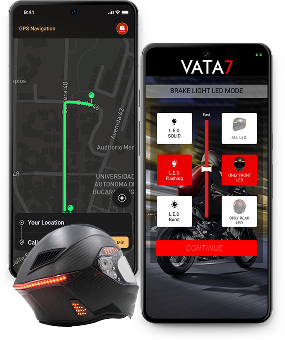
The production app includes: LED mode selection (Solid, Flashing, Burst, Ghost, Stealth, full-on), AUTOBRAKE LIGHT mode with accelerometer-based deceleration detection, brake/tail/turn signal wireless mirroring configuration, Tx Unit pairing and status monitoring, battery level display, multi-device management (unlimited VATA7 gear per Tx Unit), and firmware update capability.
Implementation Highlights

AUTO-BRAKE LIGHT Accelerometer System
The flagship safety feature uses the phone’s accelerometer to detect deceleration events. When the rider slows down or stops — even without touching the motorcycle’s brake lever — the app triggers the helmet’s brake light wirelessly. The algorithm distinguishes genuine braking from road vibration, leaning into turns, and other motion artifacts using a tuned threshold model validated across riding conditions from city traffic to highway cruising.

Edge & Wireless Connectivity
The system architecture includes three nodes: the Tx Unit (wired to the motorcycle’s brake light), the helmet’s LED controller, and the rider’s phone. The Tx Unit mirrors the motorcycle’s native lighting wirelessly to the helmet, while the phone provides supplementary control and the AUTO-BRAKE LIGHT override. The 7-second auto-sync eliminates manual pairing on every ride.

LED Control & Power Optimization
Six LED modes offer different visibility profiles: Solid for maximum brightness, Flashing for attention grabbing pulses, Burst for rapid strobe, Ghost (all off) for stealth, Stealth (tail light only), and full 360° illumination. Each mode’s duty cycle was calibrated to balance visibility intensity against the 12-hour battery target. Burst mode, the most power-intensive, still achieves 8+ hours.

Signal Processing & Filtering
The AUTO-BRAKE LIGHT algorithm processes accelerometer data at 50Hz, applying a low-pass filter to remove high frequency vibration and a threshold detector calibrated for motorcycle deceleration profiles. False positive rate was reduced to under 1 per 100 miles through iterative track testing with varied riding styles and road surfaces.

Dashboard & UX
The app opens to a single screen showing the helmet’s current LED mode, battery level, and connection status. Large, glove-friendly toggle buttons let riders switch modes before a ride. The AUTO-BRAKE LIGHT toggle is prominently placed and defaults to ON. Visual feedback uses the same LED colors displayed on the helmet, creating a direct “what you see is what you get” experience.

Security & Firmware Management
Wireless firmware updates are delivered through the app with integrity verification — ensuring that no corrupted update can disable safety features. The Tx Unit pairing uses a secure bonding model, and the app validates device identity on every connection to prevent interference from nearby VATA7 devices or unauthorized controllers.
Results & Impact
- Delivered production iOS and Android apps supporting VATA7’s X1 helmet and GEN2 Smart LED Tech Pack product lines
- AUTO-BRAKE LIGHT feature achieved under 1 false positive per 100 miles in real-world riding conditions
- Maintained wireless brake signal synchronization at sustained speeds exceeding 100 mph during professional track testing
- 12-hour battery life achieved across all standard LED modes, supporting full-day riding without charging
- App supports unlimited VATA7 gear per Tx Unit, enabling riders to manage helmets, tech packs, and future accessories from a single interface

“I started VATA7 because I watched a 26-year-old veteran die on the road — struck by drivers who never saw him. This helmet exists to make riders visible, and the app is what makes it smart. Iottive built the AUTO-BRAKE LIGHT feature I’d been dreaming about for years: your helmet lights up when you slow down, no wires, no switches. They understood that we’re not building a gadget — we’re trying to save lives.”
— Brian Jon Garvey, VATA7
Lessons & Best Practices
Safety Features Must Be the First Sprint, Not the Last
In a life-safety product, the temptation is to build the “fun” features (LED customization, color modes) first and tackle safety later. We inverted this: AUTO-BRAKE LIGHT and wireless brake signaling were validated before any aesthetic features were started.
Accelerometer Algorithms Need Real-World Data, Not Lab Data
Motorcycle vibration profiles differ dramatically from lab bench conditions. Our deceleration detection algorithm was calibrated using data from actual rides on sportbikes, cruisers, and adventure bikes across highway, city, and gravel road surfaces.
Glove-Friendly Design Is Non-Negotiable
Motorcyclists wear thick gloves. Every button, toggle, and slider in the app was tested with gloved hands. Touch targets that felt generous in a design review were too small on a vibrating motorcycle. We increased all interactive elements to a minimum 60×60 point hit area.
Test at Speed — Not Just at Rest
Wireless protocols that work perfectly in a parking lot can fail at 80 mph. We invested in track time for speed validated testing, treating it as essential QA infrastructure rather than a nice-to-have.

Technology
Comprehensive IoT Technology Stack
From devices and connectivity to cloud, apps, and security — we leverage a full-stack IoT ecosystem to build scalable, secure, and future-ready solutions.

iOS (Swift)

Android (Kotlin)

BLE

Why Iottive’s the Right Partner
- Specialized expertise in safety-critical wireless systems where latency and reliability directly impact human safety — not just user experience
- Cross-platform mobile development (iOS + Android) with deep sensor integration for accelerometer, gyroscope, and motion processing algorithms
- Engineering discipline proven under regulatory constraints (DOT, ECE 22.06) where software decisions affect hardware certification
Next Steps for VATA7
Enable V2V alerts to notify nearby vehicles when a VATA7 rider brakes or signals.
Integrate crash detection using accelerometer impact signatures, with automatic emergency contact notification
Expand the platform to support group ride coordination — shared visibility modes, convoy spacing alerts, and lead rider signal propagation
Explore integration with motorcycle OBD-II systems for direct telemetry data (speed, RPM, lean angle) to enhance AUTO-BRAKE LIGHT accuracy