
By the Iottive Engineering Team · 12 min read · April 2026
You’ve thought about this for months. Maybe years.
You’re a physiotherapist watching the same six rehabilitation problems show up across hundreds of patients, and the existing products on the market don’t quite solve any of them. You’re a strength coach noticing that the testing tools you use are either cheap-and-unreliable or expensive-and-tethered to a single piece of furniture in a single room. You run a gym chain and you’ve watched three competitors launch branded recovery devices that doubled their average revenue per member. You’re a cardiologist whose elderly patients need a continuous-monitoring solution that costs less than a gold bracelet and is easier to charge than a Tesla.
You have the idea. You know exactly who needs it. You probably have early sketches on a napkin, in a Notion doc, or on a slide deck you’ve shown three trusted colleagues.
What you don’t have is a clear picture of what happens between “I have an idea” and “my product is in the hands of patients or athletes.”
This is that picture.
We’ve taken healthcare professionals, sports coaches, and clinic owners from sketch to shipped product more than 150 times since 2016 — including for elite golf coaching, FDA-cleared neuromuscular stimulation, ESD-protection wristbands, smart misting systems for hospitals, baby-safety monitors, and remote patient monitoring platforms. The journey is more predictable than most first-time founders realize. It’s also more expensive in some places and significantly cheaper in others than the internet would have you believe.
Here’s the honest version.
Why Practitioners Make the Best Hardware Founders (and the Worst Engineers)
The strongest health and fitness hardware products in the market today were started by practitioners — not engineers. There’s a structural reason for this.
A physiotherapist who has tested 500 athletes has internalized something an engineer cannot: the specific, repeating moment of friction that real users experience. The seven-second pause where the data isn’t loading. The strap that doesn’t fit. The metric that everyone glances at but no one actually uses. The follow-up appointment that gets skipped because the at-home device is too confusing.
Practitioners see these moments. Engineers don’t, until practitioners point them out.
But practitioners also tend to make three predictable mistakes when they try to build the product themselves:
- They underestimate how much engineering is involved. Building a hardware product that works is roughly 10x the work of building a software-only app. Connected hardware adds another 3x.
- They overestimate their need to “own” the engineering. The companies that succeed don’t try to learn embedded firmware programming. They partner with engineering teams who have shipped these products before — and stay focused on the clinical or athletic insight that made the product worth building in the first place.
- They assume they need a finished prototype before talking to anyone. The opposite is true. The earlier you bring engineers into the conversation, the cheaper the product becomes to build.
If you take nothing else from this article, take this seriously: most expensive mistakes in hardware happen in the first 90 days, not the last.
The Six Stages of Going From Idea to Shipped Device
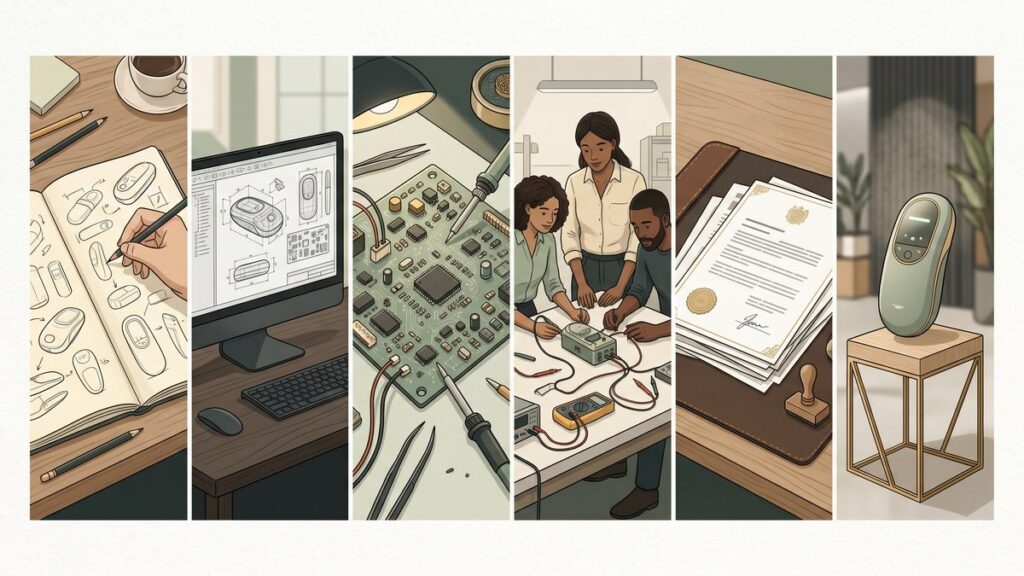
Almost every successful product we’ve shipped has moved through the same six stages. The total journey is typically 9 to 18 months.
Stage 1 — Concept Validation (Weeks 1–4)
Before any hardware exists, before any sketches are real, you need to answer three questions on paper:
- Who is this for, specifically? Not “physiotherapists.” A name. A clinic. A patient profile. The product gets clearer or vaguer based on the precision of this answer.
- What measurement, signal, or stimulus does the device provide that nothing else does? If the answer is “the same as competitor X but cheaper” — stop. That product will be commoditized within 24 months. The successful products do something measurably different, not just similarly.
- What does the user do with the device every day? Walk through the full daily workflow. Where does the device live when not in use? How does it charge? Who does the data go to? What happens if the user loses it?
You don’t need engineering for this stage. You need brutal honesty and conversations with 15–20 of your potential users. Cost: under $3,000, mostly time.
Stage 2 — Technical Feasibility (Weeks 5–8)
This is where engineers enter the picture, and it’s the stage most first-time founders skip — to their cost.
A good engineering partner spends 4–6 weeks producing a technical feasibility report covering:
- Sensor selection. What hardware can actually measure what you need at the accuracy you need at the cost you need?
- Wireless protocol decision. BLE, WiFi, cellular, or LoRaWAN? The choice constrains every downstream decision — battery life, cost, range, certification.
- Power budget. How long does the device need to run between charges? That answer determines battery size, which determines product size, which determines what your product physically looks like.
- Regulatory pathway. Is this a wellness product or a medical device? FDA 510(k), CE-MDR, or unregulated? The answer changes timeline and budget by 3–6x.
- Cost-of-goods estimate. What will each unit cost to manufacture at 100 units, 1,000 units, and 10,000 units?
Cost: $5,000 to $6,000. This is the single highest-leverage spend in the entire journey.
Stage 3 — Prototype Development (Months 3–6)
The first physical prototype gets built. Not the final product — a working “ugly” version that proves the concept on a benchtop.
This stage typically includes:
- Custom PCB design (the circuit board)
- Initial firmware that captures and transmits data
- A bare-bones companion app for testing
- 5 to 10 prototype units for internal trials
This is also where the BLE protocol gets designed — the structured “language” your device and app use to talk to each other. Most first-time founders don’t realize this is its own engineering discipline. It is. A poorly designed BLE protocol will haunt the product for its entire lifetime.
Cost: $20,000 to $30,000.
Stage 4 — Pilot Testing (Months 6–9)
Twenty to fifty units in the hands of real users. This is where the product stops being a theory.
You’ll discover:
- Things that worked in your office that don’t work in a real clinic
- Failure modes you didn’t anticipate (sweat, drop tests, battery anxiety)
- App workflow problems that your engineering team would never have spotted but your users will name within five minutes
- Whether the regulatory category you assumed at Stage 2 is actually correct
Your engineering team revises the firmware, app, and sometimes the hardware itself based on what the pilot reveals. Plan for one to three iteration cycles here. Most products that fail in market fail because they skipped this stage or rushed it.
Cost: $30,000 to $80,000 including hardware iteration.
Stage 5 — Certification & Production-Readiness (Months 9–14)
This is where the product becomes legal to sell. Almost every connected health or fitness device needs some combination of:
- FCC Part 15 (US) and CE RED (EU) — required for any product transmitting wireless signals. $15,000–$40,000.
- Bluetooth SIG Qualification — required to legally use the Bluetooth trademark. $8,000–$10,000.
- FDA 510(k) — if the product is classified as a medical device. $50,000–$300,000 and 6–18 months. (Most products you imagine as medical are actually wellness products and don’t need this — verify in Stage 2.)
- IEC 60601-1 — medical electrical equipment safety. $30,000–$100,000.
- IEC 62133 — battery safety. Required for most rechargeable products. $5,000–$15,000.
Plan certification from Day 1, not when you’re ready to launch. We’ve seen companies finish their hardware design and then discover that an antenna placement mistake killed their FCC certification. Fixing that mistake meant a new PCB revision, three lost months, and $300,000 unbudgeted.
Stage 6 — Manufacturing & Launch (Months 12–18)
The factory makes the product. The app launches on the App Store and Play Store. The cloud goes live. You ship.
This stage is more operational than engineering, but engineering still matters: OTA firmware update infrastructure, production-line testing protocols, and the customer support backend all get built here.
What It Actually Costs (Honest Numbers)
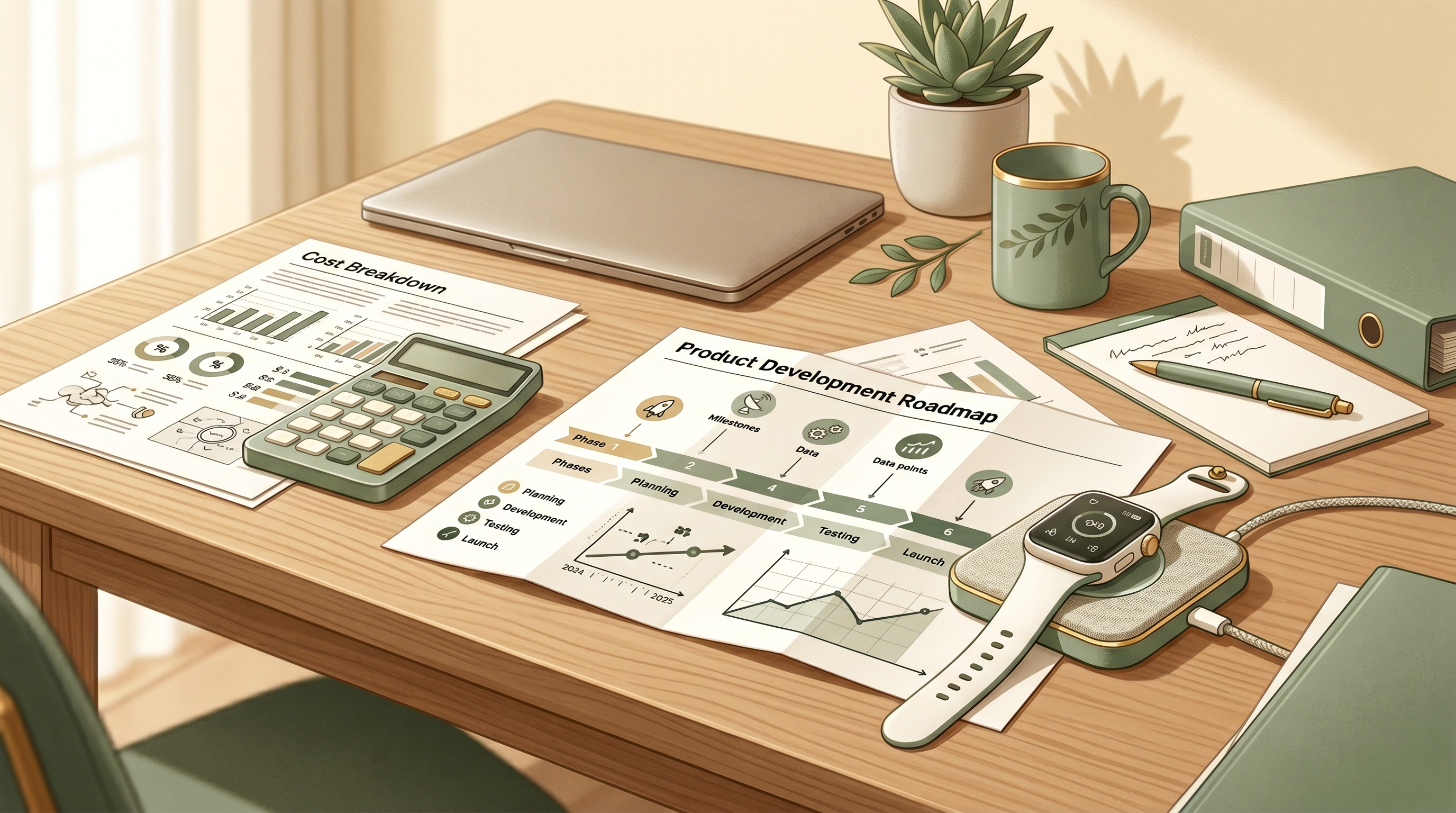
The internet will tell you a smart consumer hardware product costs $50,000 to launch. The internet is lying. Here are the real ranges based on more than 150 shipped products.
| Product Category | Realistic Total Investment | Typical Timeline |
|---|---|---|
| Wellness wearable (no medical claims) | $100,000 – $200,000 | 4 to 6 months |
| Connected fitness device with companion app | $200,000 – $300,000 | 5 to 10 months |
| FDA-cleared medical device (Class I) | $500,000 – $1,200,000 | 10 to 12 months |
| FDA-cleared medical device (Class II, e.g., neurostimulator) | $1,000,000 – $2,500,000 | 10 to 12 months |
| Clinical-grade diagnostic device | $1,500,000 – $5,000,000+ | 12 to 24 months |
These ranges include hardware, firmware, mobile apps (iOS + Android), cloud backend, certification, and pilot testing. They do not include marketing, manufacturing scale-up beyond initial production, or salaries for an in-house team.
If you’ve raised money for a connected health product and the budget is below the bottom of these ranges, something is being underestimated. We’d rather tell you that now than have you discover it 14 months in.
The Build vs. Outsource Question

Practitioners often ask: do we hire an in-house engineering team, or partner with a development firm?
A realistic in-house team for a first connected product looks like one embedded firmware engineer, one iOS engineer, one Android engineer, one backend engineer, and a part-time QA. Fully loaded, that team costs $80,000 to $120,000 per month. Over 12 months, you’re committing more than $1 million before you’ve shipped a single unit. You also have to find, recruit, retain, and manage that team — which is roughly a full-time job in itself, and not the job you wanted to do.
For a first product, the math almost always favors specialized firms. In-house becomes the right call after you’ve shipped, validated the market, and have a clear two-year roadmap for v2 and v3.
What to Look For in an Engineering Partner
If you’re going to partner, the right partner has four characteristics:
- They’ve shipped connected products in your category before. Not generic “IoT projects.” Actual health or fitness or sports products that exist on the market today. Ask for case studies. Ask to talk to their previous clients.
- They lead with technical depth, not slides. A first conversation should leave you smarter, not sold to. If a partner can’t explain BLE background-mode constraints or the difference between FDA wellness and medical-device classification in five minutes, they haven’t shipped enough product.
- They speak the language of your domain. A partner who has worked with clinicians, athletes, or coaches will understand that data accuracy isn’t negotiable, that the user is more demanding than a consumer, and that the regulatory layer changes everything.
- They’re transparent about cost and timeline. A real partner gives you honest ranges and explains the variables. A weak partner gives you a single confident number and a 90-page pitch deck.
Where Most Practitioner-Founded Products Quietly Die
We’ve seen the same five failure patterns repeatedly:
- The product was a feature, not a category. “A better X” is rarely defensible. Successful products are categorically different.
- The companion app was an afterthought. The hardware works; the app is unusable. Users abandon the product within 30 days.
- Regulatory category was misdiagnosed. The team assumed wellness, the FDA classified it as medical, and the product is now in 18-month re-certification.
- The data model was wrong. Sessions weren’t standardized, research-grade analysis was impossible, and the clinical credibility roadmap evaporated.
- The team ran out of money before pilot testing. Hardware budget was right; everything around it (firmware, app, cloud, testing) was underestimated.
Each of these is preventable in Stage 1 or Stage 2. None are preventable once they happen.
A Final Word — Your Insight Is the Most Valuable Asset
If you’re a healthcare or fitness provider seriously considering building a connected device, the most valuable thing you bring to the project is not capital. It’s not even the product idea.
It’s the daily, weekly, year-after-year insight into the specific moment of friction that real users experience. That insight is what makes products that win in this category. It’s what we’ve seen drive every successful connected health product we’ve ever shipped.
Engineers can build anything. The hard part is knowing what to build. You already know that. The rest is execution.
What to Do Next
If you have an idea for a connected health or fitness device and want to understand what it would actually take to build it, we offer a free 45-minute Product Feasibility Call. On the call we’ll:
- Listen to your concept and the user problem you’re solving
- Sketch a rough technical architecture (sensor type, wireless protocol, regulatory pathway)
- Give you a realistic timeline and investment range tailored to your product
- Tell you honestly whether the idea is ready to start engineering or needs more validation first
No slides. No pitch. Just a conversation between practitioners and engineers who’ve shipped 150+ connected products together.
About Iottive
IOTTIVE is an AIoT product engineering firm with teams in India, Europe, and North America. Since 2016 we have engineered connected products for 155+ companies across 30+ countries — with deep specialization in connected health wearables, sports technology, and FDA-cleared medical devices. Our portfolio includes Vertex Golf (used by 150+ tour professionals), BionicGym (FDA-cleared NMES wearable), Vagal Tones (medical vagus nerve stimulation), 360Care (HIPAA-compliant remote patient monitoring), and SafeyApp (FDA-cleared Bluetooth spirometer for asthma and COPD).

Transform Your IoT Vision Into Reality.
Get free expert insights, architectures & cost breakdowns.
Drop your email to schedule free meeting.