Case Study
360Care
Healthcare / Remote Patient Monitoring
Real-time wearable health data platform for Ellerca Health Corp
360Care
Tech Partnership
Healthcare
6 Months
- Remote Patient Monitoring technologies and services
- Caregivers with real time medical information
- Providing optimal management of patients


Key Outcomes
Integrated Google Fit and Fitbit APIs to deliver continuous heart rate, SpO2, blood pressure, and activity data to a unified patient dashboard
Achieved full HIPAA compliance across data storage, transmission, and access controls — enabling deployment across US healthcare providers
Reduced manual vitals logging by an estimated 80%, giving clinicians real-time patient visibility between office visits
The Challenge
Before partnering with Iottive, Ellerca Health Corp was facing several issues:
Fragmented Health Data Sources
Patients used multiple wearables and devices — Google Fit, Fitbit, standalone blood pressure monitors — with no unified view. Clinicians had to manually reconcile data from disparate systems, wasting time and increasing error risk.
Lack of Real-Time Monitoring
Health data was only available during in-office visits. Between appointments, providers had no visibility into patient trends, making it difficult to detect deterioration early.
Regulatory Compliance Complexity
Building a patient data platform that met HIPAA requirements — encryption at rest and in transit, access audit trails, role-based permissions — required specialized expertise that the internal team lacked.
Poor Patient Engagement
Existing tools offered no meaningful way for patients to visualize their own health trends or receive actionable feedback, resulting in low adherence to monitoring protocols.
Our Solution
Iottive delivered a comprehensive Remote Patient Monitoring platform under a full-cycle product development model.

Mobile Development Expertise
Built a native Android application with deep API integrations for Google Fit and Fitbit, enabling automatic sync of heart rate, blood pressure, SpO2, respiration rate, HRV, steps, sleep, and blood sugar data. BLE connectivity was implemented for direct pairing with compatible medical peripherals.

Design Thinking Approach
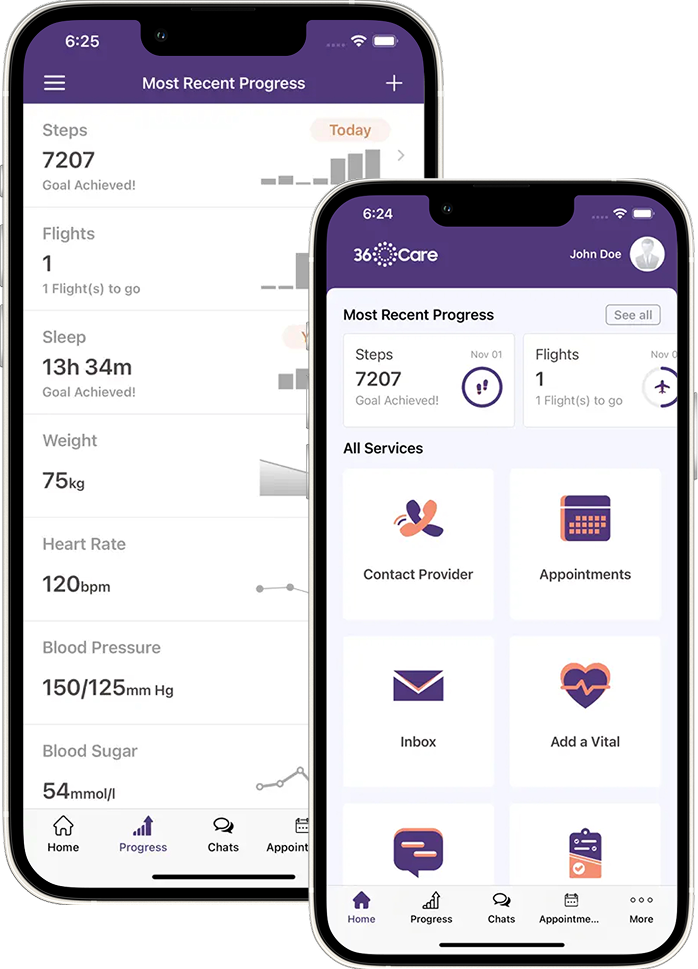
Conducted collaborative design workshops with Ellerca’s clinical team to map care workflows. The resulting UX prioritized a “Most Recent Progress” dashboard where providers could triage patient data at a glance, with drill down views for historical trends and predictions.

Project Planning & Execution
Structured the project into three delivery phases: core data ingestion and dashboard (Phase 1), wearable integration and trend analytics (Phase 2), and compliance hardening with 24/7 support infrastructure (Phase 3). Bi-weekly sprint reviews kept stakeholders aligned.

Functionalities Delivered
Real-time vitals dashboard (HR, BP, SpO2, respiration, HRV), Google Fit and Fitbit data sync, blood sugar manual entry and tracking, digital trend analysis with historical comparisons and predictive indicators, patient profile management, and 24/7 support channel integration.
Implementation Highlights

Wearable API Integration
Implemented OAuth-based connectivity with Google Fit and Fitbit REST APIs, handling token refresh, data normalization across different device formats, and graceful fallback when devices are temporarily disconnected.

BLE Health Device Connectivity
Built a BLE communication layer supporting standard health profiles (Heart Rate, Blood Pressure, Pulse Oximetry) for direct-pair medical peripherals, ensuring reliable data capture even without cloud connectivity.

Health Data Visualization
Designed interactive charts showing daily, weekly, and monthly trends for each vital sign. Color-coded thresholds alert clinicians when values fall outside normal ranges, with tap-to expand detail views.

HIPAA-Compliant Architecture
All patient data encrypted with AES-256 at rest and TLS 1.2+ in transit. Implemented role-based access control, audit logging for every data access event, and automatic session timeouts per HIPAA technical safeguard requirements.

Predictive Analytics Engine
Deployed trend analysis algorithms that flag deterioration patterns — such as declining SpO2 over 72 hours or rising resting heart rate — giving clinicians early warning before acute episodes.

24/7 Support Infrastructure
Integrated in-app support channels and built monitoring dashboards for the Ellerca operations team, ensuring patients always have access to assistance and system uptime exceeds 99.5%.
Results & Impact
- Continuous monitoring of 6+ vital parameters from wearables and manual entry in a single dashboard
- HIPAA-compliant architecture approved for deployment across multiple US healthcare providers
- Estimated 80% reduction in manual data entry for patients and clinical staff
- Real-time trend detection enabling proactive clinical interventions between office visits
- Patient engagement improved through personalized health visualizations and progress tracking

“Iottive built exactly what we envisioned — a platform where our clinicians can see the full picture of a patient’s health without asking them to do anything differently. The wearable integration just works, and the HIPAA compliance gave us confidence to deploy at scale.”
— Daniel Yeboah, Ellerca Health Corp
Lessons & Best Practices
Normalize Data Across Wearable Ecosystems
Google Fit and Fitbit report data in different formats, units, and intervals. Building a robust normalization layer early prevented inconsistencies from propagating into clinical dashboards.
Design for Clinical Workflows, Not Features
The most valuable design input came from observing how clinicians actually triage patients. A feature list means nothing without understanding the decision-making context.
Treat Compliance as Architecture, Not a Checklist
HIPAA compliance was embedded into every architectural decision — database design, API design, deployment topology — rather than applied as a post-development audit layer.
Plan for Intermittent Connectivity
Wearable devices disconnect, APIs throttle, and patients forget to sync. Designing for graceful degradation and clear “last synced” indicators maintained clinician trust in the data.

Technology
Comprehensive IoT Technology Stack
From devices and connectivity to cloud, apps, and security — we leverage a full-stack IoT ecosystem to build scalable, secure, and future-ready solutions.

Android (Kotlin)

BLE

Firebase

Node.js

Why Iottive’s the Right Partner
- Deep experience integrating wearable health APIs (Google Fit, Fitbit) with medical-grade data requirements — not just consumer fitness tracking
- Proven HIPAA-compliant architecture design, including encryption, access controls, and audit trails built into the foundation
- Full-stack capability spanning BLE device connectivity, mobile development, cloud backend, and health data analytics under one team
Next Steps for 360Care

Expand platform to iOS for broader patient reach across Apple Health ecosystem
Add Apple Watch and continuous glucose monito(CGM) integrations for richer metabolic data
Implement AI-driven risk scoring to prioritize patients needing immediate clinical attention
Build a provider-facing web dashboard for multi-patient population health management