By the Iottive Engineering Team · 14 min read · May 2026
Imagine a connected glucose monitor whose companion app, in real time, explains exactly why a patient’s glucose spiked an hour after lunch — not by querying a cloud LLM, not by making any network call, but by reasoning entirely on the iPhone in the patient’s pocket. No latency. No subscription. No HIPAA risk. No data ever leaves the device.
A year ago, this was speculation. Today it ships as a Swift function call.
Apple’s Foundation Models framework — a 3-billion-parameter language model that runs entirely on iPhone and Mac, free of per-token costs and offline by default — is the most consequential platform shift for IoT app development in a decade. WWDC 2026 is just 17 days away. The companies that adapt early will pull years of competitive distance before the rest catch up.
This is what we think is changing, why it matters specifically for connected products, and what hardware companies should be doing right now.
1. What Apple Actually Shipped (and What’s Coming June 8)
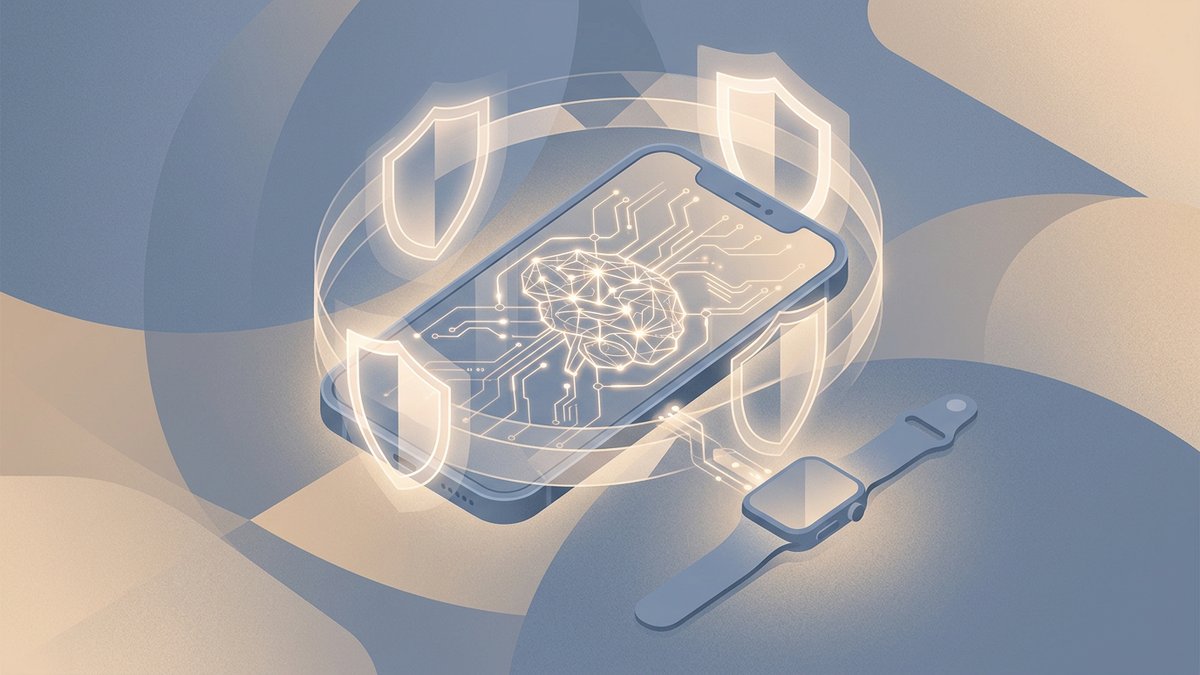
At WWDC 2025, Apple introduced the Foundation Models framework — a Swift-native API that gives developers free access to a 3-billion-parameter on-device language model. The headline facts:
- 3-billion-parameter LLM, runs entirely on-device. No internet required after the initial OS install.
- Swift-native API with a
@Generablemacro that produces type-safe structured output from Swift structs — no JSON parsing, no string wrangling. - LoRA fine-tuning support — developers can customize the base model for domain-specific tasks (medical reasoning, industrial diagnostics, sport-specific coaching) without retraining the entire model.
- Function calling — the model can invoke app functions directly, enabling agentic behavior across your app.
- Zero per-token cost. Zero API rate limits. Zero data egress.
- Hardware requirement: A17 Pro or later iPhones, M1 or later iPads and Macs. Older devices fall back to Core ML or cloud paths.
WWDC 2026 — the keynote runs June 8 — is widely expected to expand this surface significantly. Bloomberg’s Mark Gurman has reported that Apple is paying Google roughly $1 billion a year for a custom 1.2-trillion-parameter Gemini model to power the next generation of Siri and Foundation Models. iOS 27 is expected to introduce “Extensions” — a system that lets developers and users plug in third-party AI models (Gemini, ChatGPT, Claude) alongside Apple Intelligence.
For connected products specifically, what matters more than any single announcement is the architecture Apple has committed to: intelligence runs on the user’s device by default. Cloud is optional, not obligatory. That is a profound break from how every IoT companion app has been architected for the last decade.
For the first time, every modern iPhone has a competent LLM in its pocket that runs locally. For developers, this means no infrastructure cost, no privacy review process, and no internet dependency for shipping AI features.
2. Why This Matters Specifically for IoT
IoT apps have always been bottlenecked by three things. On-device AI fixes all three simultaneously.
Bottleneck 1 — Latency
Cloud LLM round-trips take 800ms to 3 seconds. For real-time sensor interpretation — a heart-rate spike, a manufacturing anomaly, a stroke deviation in a practice putting session — that’s too slow to feel useful. On-device Foundation Models responds in 100 to 300ms.
Bottleneck 2 — Cost
Cloud-LLM economics break for high-frequency sensor data. A connected wearable streaming biometrics 24 hours a day generates hundreds of thousands of inferences per user per month. At frontier-model prices, that’s $50 to $300 per user per month — economically infeasible for any consumer or healthcare product. On-device is free.
Bottleneck 3 — Privacy and Compliance
HIPAA, GDPR, and SOC 2 all become dramatically easier when sensor data never leaves the device. Health and fitness products have been constrained for years by the data-egress problem. Foundation Models solves it by architecture — the data does not go anywhere because the intelligence comes to the data.
What this means in practice
Looking across the products we have engineered:
- Health wearables (Vagal Tones, BionicGym, 360Care): Foundation Models can generate personalized stimulation protocols, interpret biometric trends, and summarize a week of remote-patient data — all locally, with no HIPAA exposure.
- Sports tech (Vertex Golf): Imagine the SmartCore app saying, “Your stroke tempo deteriorated 12% after the 8th putt — that’s a fatigue pattern, not a technique flaw” — generated from the player’s actual session data, on-device.
- Industrial IoT (SIMMM Cool App): Predictive maintenance summaries, anomaly explanations, and operator-language alerts (“the Foggy pump in zone 3 is drawing 8% above baseline, suggesting nozzle scaling”) generated locally on the technician’s phone.
- Consumer IoT (Heatsail, POQQ): Natural-language device configuration without sending user behavior to any LLM provider.
Cloud LLM vs. Foundation Models — at a glance
| Dimension | Cloud LLM | Apple Foundation Models |
|---|---|---|
| Latency | 800ms – 3s | 100 – 300ms |
| Per-inference cost | $0.001 – $0.10+ | Free |
| Internet required | Yes | No |
| Data egress | Yes (HIPAA/GDPR risk) | No |
| Model size | Up to 1T+ parameters | ~3B parameters |
| Hardware requirement | None on client | A17 Pro+ / M1+ |
| Best for | Heavy reasoning, long context | Real-time, private, frequent inference |
3. Five Things That Will Change in IoT Companion Apps
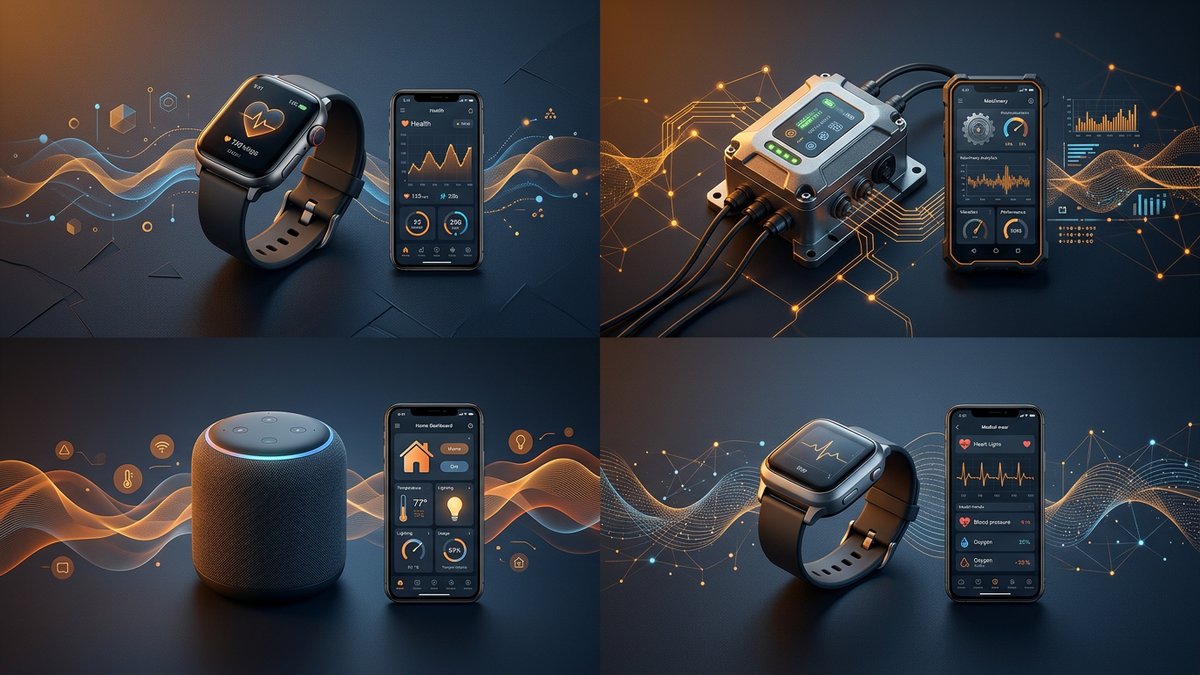
- Sensor data becomes conversational. Companion apps move from charts to conversations. “Why is my resting heart rate higher this week?” — the app answers locally, with reasoning grounded in the device’s actual data. A Vertex SmartCore user asks, “How did my stroke change after the 6th hole?” — and the app explains, citing the actual stroke metrics from that session.
- App UX shifts from menus to intent. With App Intents plus Foundation Models, users describe what they want, not how to do it. “Turn off all the misting zones except the patio” becomes a single utterance, not a navigation sequence. Heatsail, SIMMM Cool App, and any multi-zone connected product becomes immediately better with this pattern.
- OTA personalization replaces firmware features. Today, adding a new analysis capability to a connected product usually requires a firmware update. With LoRA adapters, app makers can ship updates that customize the on-device model for specific user cohorts — post-surgical rehab patients, golf coaches, asthma patients — without touching firmware.
- Edge inference becomes the default architecture. The standard IoT stack — device → BLE → phone → cloud → ML model → response — collapses to device → BLE → phone → response. Cloud is no longer in the critical path for intelligence. Cloud becomes a sync layer, not a thinking layer.
- The Siri-to-device gap closes. With expanded Siri and App Intents in iOS 27, users will invoke connected-product functions across the system. “Hey Siri, start a 20-minute mindfulness session on my Pulse Ring.” The companion app becomes the actor, not the destination.
The standard IoT architecture collapses. Cloud is no longer in the critical path for intelligence. It becomes a sync layer, not a thinking layer.
4. What Hardware Companies Should Do Now
- Audit your app for AI-eligible features. Every alert, every summary, every recommendation in your current app is a candidate for Foundation Models. List them. Score them by user impact. The top 3 are your roadmap for the next two quarters.
- Redesign your data model for on-device reasoning. LLMs need structured, queryable context. If your app’s data model is a flat time-series, you’ll need to add semantic layers — sessions, events, anomalies, narrative annotations — for the model to reason about. Start now; this work has long lead time.
- Plan for LoRA fine-tuning if your domain is specialized. Medical, industrial, and clinical use cases benefit from domain-fine-tuned models. Start collecting the data you’ll need for LoRA training now. Anonymized, structured, well-labeled session data is gold.
- Don’t wait for Android parity. Android has its own on-device AI stack (Gemini Nano), and the cross-platform pattern is forming. Native iOS-first is the right call for early-adopter products in iOS-dominant categories — consumer health, premium fitness, luxury IoT, prosumer audio. Android can follow.
- Treat the cloud as a sync layer, not a thinking layer. Redesign cloud services to handle data persistence, multi-device sync, and admin/clinician dashboards. Stop building cloud-side ML pipelines for features that can run on-device. The cost structure inverts.
- Watch WWDC 2026 carefully (June 8). Apple is expected to expand the Foundation Models API, add new modalities (vision and audio reasoning are widely rumored), and announce iOS 27 Extensions. Major IoT architecture decisions should pause until that lands. Ten days of patience now will save quarters of rework later.
5. The Risks and Limits Nobody Talks About
This is the section the typical “Apple AI is amazing” article skips. Here are the constraints we work with daily.
- Hardware fragmentation. Foundation Models only runs on A17 Pro+ and M1+. iPhone 14, iPhone 15 (non-Pro), and older iPads are locked out. If 40% of your user base is on those devices, your “on-device AI” feature is a “premium tier” feature whether you wanted it to be or not.
- Model size limits. 3 billion parameters is small by frontier standards. Complex multi-step reasoning still benefits from cloud LLMs. A medical reasoning chain involving four causal hops is not yet a job for Foundation Models alone.
- No streaming, no audio-out by default. Today’s Foundation Models is text-in, text-out. Voice and richer modalities are coming but not shipped. If your IoT product requires natural voice interaction today, you still need a hybrid architecture.
- Apple’s terms. Foundation Models output cannot (today) be used to train competing models. Read the developer agreement carefully if your business depends on closed-loop learning across users.
The right strategy is hybrid. On-device for low-latency, private, high-frequency inference. Cloud for heavy reasoning. The hardware companies that succeed will architect for both, with on-device as the default.
Building Connected Products for the Next Decade
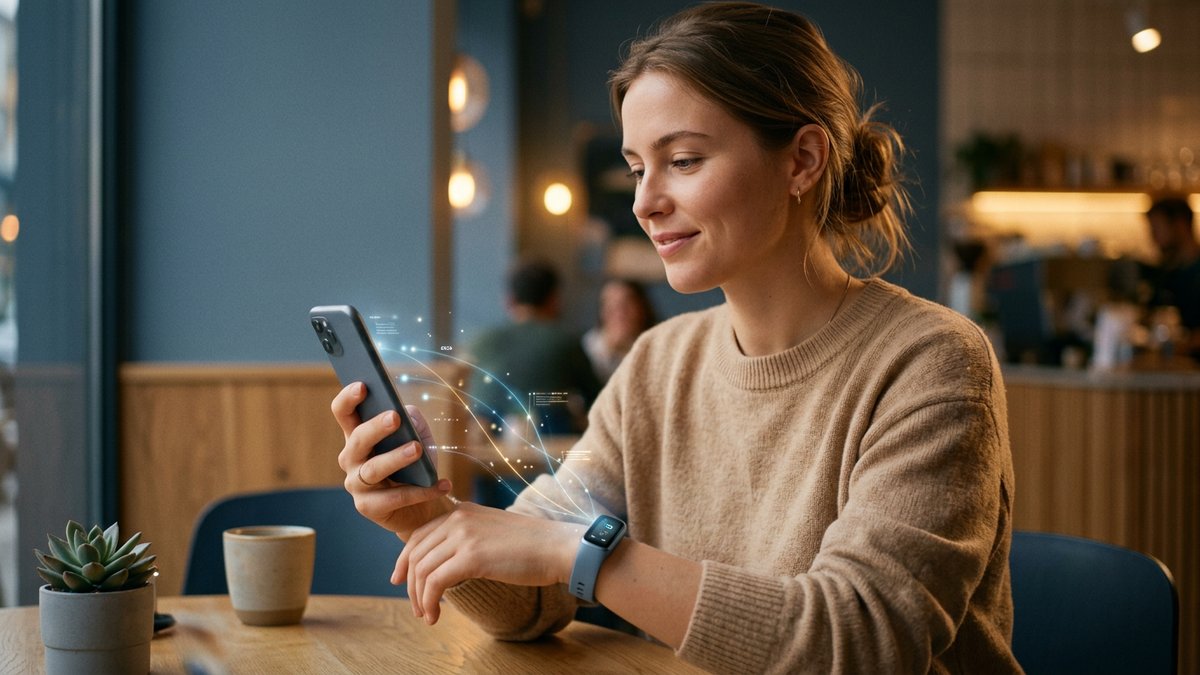
Apple’s bet on on-device AI is the most consequential platform shift in IoT since BLE became universal in 2014. The hardware companies that build for it now will pull years of competitive distance before their slower rivals catch up.
We are already designing connected products around Foundation Models for Iottive clients — extending companion apps with on-device intelligence, redesigning data models for LLM-friendly reasoning, and prototyping LoRA adapters for specialized verticals.
If you are building a connected product and want to understand how on-device AI changes your architecture — what to build now, what to wait for, and what to redesign — we offer a free 45-minute Architecture Briefing.
On the call we will:
- Review your current app and identify the top 3 Foundation Models opportunities
- Sketch a hybrid on-device + cloud architecture for your product
- Tell you what to ship before WWDC 2026 and what to wait for after
No slides. No pitch. Just engineering conversation between teams that have shipped connected products together for a decade.
About Iottive
Iottive is an AIoT product engineering firm with teams in India, Europe, and North America. Since 2016 we have engineered connected products for 155+ companies across 30+ countries — including Vertex Golf (used by 150+ tour professionals), BionicGym (FDA-cleared NMES wearable), Vagal Tones (medical vagus nerve stimulation), SIMMM Engineering (industrial misting control), Heatsail (premium outdoor heating), POQQ (luxury wireless charging), and Road Angel (automotive safety). Our work spans health and fitness sensors, industrial IoT, automotive safety, consumer products, and medical devices.

Transform Your IoT Vision Into Reality.
Get free expert insights, architectures & cost breakdowns.
Drop your email to schedule free meeting.