How LiDAR is Transforming Delivery Drone Navigation in 2025

In a tight urban alley last spring, a test run saved a package and a street lamp. A pilot watched as a compact lidar sensor and IMU teamed with high-accuracy GNSS to spot a stray cable and reroute a small drone in under a tenth of a second.

The moment felt routine, but it marked a shift. What began as experimental tech is now practical. Miniaturized sensors, faster onboard compute, and better software turn raw data into real-time mapping that keeps operations safe and on schedule.

This guide shows how lidar-driven systems enable precise route choices, sub-50 ms obstacle detection, and millions of distance measurements per second. We cover platform selection, payload trade-offs, compliance with FAA Part 107, and how partners like Iottive build cloud and mobile integrations to tie sensor outputs to business systems.

Read on to learn why 2025 is a turning point for safer, scalable applications across industries — from smart cities to healthcare — and how to judge ROI as you move from pilot to scale.
LiDAR delivery drones, AI flight planning, self-driving drone navigation

Key Takeaways

  • Miniaturized sensors and tighter stacks make precise mapping practical for real operations.
  • High-rate distance measurements and sub-50 ms detection improve safety in complex urban areas.
  • Choosing the right platform and payload affects accuracy and mission success.
  • Compliance with FAA Part 107 and BVLOS basics is essential from day one.
  • Partnering with IoT integrators like Iottive speeds integration of sensor data into business systems.

The state of LiDAR delivery drones in 2025: why precision sensing now powers last-mile autonomy

In 2025, precise sensing has moved from prototype labs into routine last-mile operations. Compact lidar sensors and stronger onboard compute let teams detect obstacles and validate landing zones across suburbs and dense urban corridors.

Faster surveys, better maps: Modern rigs—like the DJI Matrice 350 RTK with Zenmuse L2—combine lidar, RGB, IMU, and GPS to produce centimeter-level point clouds. Field time drops from days to hours while operators capture higher-fidelity data for safe route profiles.

  • Operational reliability: Robust sensing reduces aborted missions and reroutes by tracking dynamic obstacles and validating drop points.
  • Regulatory readiness: FAA Part 107 certification, VLOS or authorized BVLOS approvals, and NDAA/Blue UAS checks shape realistic timelines.
  • Cross-industry use: Healthcare cold-chain runs and industrial yard logistics benefit from accurate site mapping and auditable records.

“Secure cloud pipelines turn field captures into auditable operational records and analytics for continuous improvement.”

Iottive helps enterprises operationalize sensor outputs by feeding field captures into mobile apps and ERP/WMS systems so delivery status and mapping results inform the wider business in real time.

From laser pulses to real-time maps: how LiDAR, cameras, GNSS, and IMU work together

A pulsed laser and a tight sensor stack turn raw returns into live, three-dimensional maps in seconds.

LiDAR fundamentals and advantages. A sensor emits short laser pulses and measures return time to compute distances. Multiple returns capture through-vegetation echoes and reveal true ground profiles for accurate mapping.

This method cuts field time by an order of magnitude versus classic ground surveys. Teams get centimeter-grade models that support rapid obstacle detection and reliable corridor mapping.
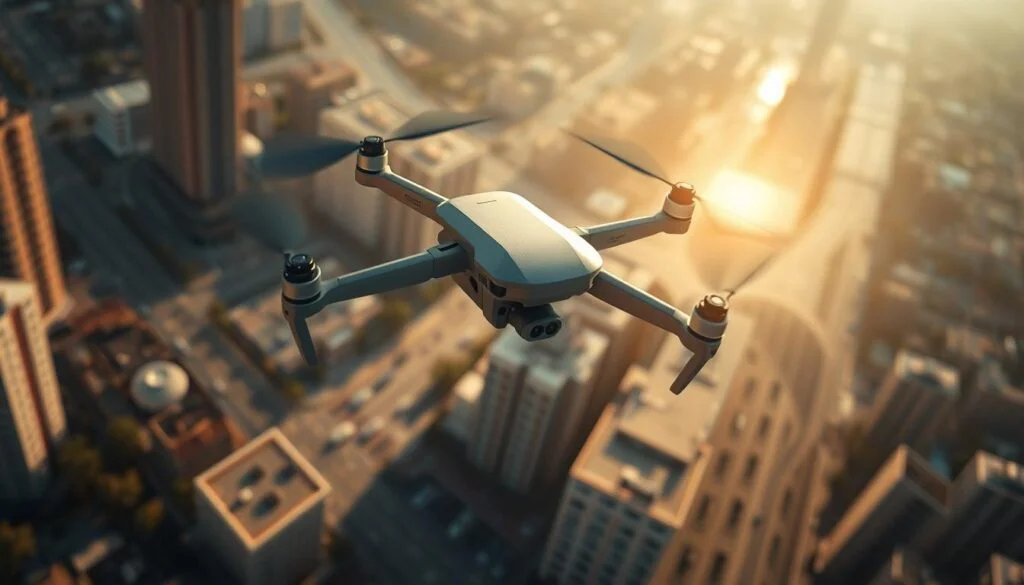
Cinematic scene of a delivery drone soaring over an urban landscape, its LiDAR sensors meticulously mapping the environment in real-time. Precision laser beams sweep across streets and buildings, capturing intricate details that translate into a detailed 3D point cloud. The drone's onboard cameras and GNSS receiver work in tandem, providing additional visual data and positioning information to create a comprehensive, high-definition map. Bathed in warm daylight, the scene conveys a sense of technological prowess and the seamless integration of advanced navigation systems.

Autonomous stack: GNSS, IMU, and onboard compute

High-accuracy GNSS—RTK or PPK—anchors every point to real-world coordinates. A high-rate IMU stabilizes orientation and fills gaps when GNSS varies.

Onboard computing fuses streams so the system keeps a tight state estimate. Representative payloads include DJI Zenmuse L2 with integrated RGB and IMU, and Phoenix units offering 300k–1.2M pts/sec and ~2–3 cm accuracy.

Sensor fusion in practice

Combining cameras and range returns boosts object classification and fixes edge cases like reflective surfaces or thin wires. Vision adds texture; range adds exact position and scale.

Advanced stacks process tens of millions of distance measurements per second and run perception loops under 50 ms to enable timely avoidance and object tracking.

“Fused point clouds and imagery power both real-time guidance and high-quality deliverables for planning and inspection.”

Component Role Typical Performance Example Payloads
Range sensor Distance sampling, multiple returns 300k–1.2M pts/sec; 2–3 cm Phoenix LiDAR series
Cameras Classification, texture, depth aid High-res RGB synced to point clouds Zenmuse L2 (RGB + IMU)
Positioning/IMU Georeference and attitude stabilization RTK/PPK accuracy to cm; high-rate IMU GNSS RTK modules + integrated IMU
Software stack SLAM, PPK workflows, fusion, QA Sub-50 ms loops; SLAM drift minimization Custom cloud apps and mobile tools

Integration note: well-structured data pipelines and SLAM/PPK workflows minimize drift and ensure consistent georeferencing. Iottive builds mobile and cloud apps that ingest lidar and camera data, sync with BLE devices, and visualize fused point clouds for field teams and QA dashboards.

AI flight planning and self-driving drone navigation workflows

Scalable routing separates strategic pathfinding from agile onboard avoidance to meet real-world limits.

Hierarchical routing and local avoidance

Global planners compute efficient routes across large regions. They use maps, weather, and population layers to pick safe corridors and optimize time and efficiency.

Local modules run onboard to handle sudden obstacles and sensor noise. These modules use fast methods—A*, dynamic window, ray-casting—to keep reactions within compute limits.

Reliability-based routing

Cells are scored by population density and ground condition. Routes avoid high-risk areas and favor wide, low-density corridors to reduce operational risk.

Dynamic map updating and latency

Live occupancy grids track moving objects and refresh trajectories so vehicles adapt in real time.

Perception-to-action cycles under 50 ms enable timely evasive maneuvers and abort branches to safe holds or landing zones when anomalies occur.

“Fleet-level data refines reliability maps and lets operators audit routes and incidents in real time.”
A sprawling metropolis, its streets a web of intersections and alleyways, as a sleek delivery drone soars overhead, its sensors probing the urban landscape. Bathed in golden daylight, the drone's LiDAR beams trace the contours of buildings and infrastructure, mapping the intricate pathways below. From a cinematic angle, we witness the drone's advanced navigation system plotting an efficient course, navigating obstacles and optimizing its trajectory for a seamless delivery. This futuristic scene captures the transformation of drone logistics, where AI-driven flight planning and self-driving capabilities redefine the future of urban transportation.

Workflow Layer Role Key Methods Outcome
Global Regional routing and scheduling Graph search, cost maps, weather inputs Efficient, low-risk routes
Local Real-time avoidance Dynamic window, reactive planning Sub-50 ms detection and evasive action
Reliability Maps Risk scoring Population density, ground score Safer urban paths
Cloud & Ops Fleet learning and oversight Telemetry ingestion, map updates Improved repeatability and audits

Iottive links planning engines to mobile ops and cloud analytics so teams monitor routes, adjust plans, and trigger incident workflows in real time.

Choosing the right LiDAR platforms and payloads for delivery missions

Platform choice boils down to endurance, payload limits, and how well sensors integrate with your software stack. Start by matching mission profiles—corridor hops, yard logistics, or broad-area mapping—to airframe strengths.

Enterprise-ready options include the DJI Matrice 350 RTK + Zenmuse L2 for integrated sensor, RGB, and IMU performance with up to 55 minutes endurance and IP55 rating.

Freefly Astro offers a modular, hot-swappable setup and ~38-minute endurance. WingtraOne Gen 2 excels for large-area mapping with VTOL efficiency and ~59 minutes. SkyFront Perimeter 8 and ArcSky X55 cover long-endurance or heavy payload needs up to 300 and 180 minutes respectively. Phoenix payloads deliver 300k–1.2M pts/s with ~2–3 cm accuracy and flex across platforms.
A high-tech LiDAR platform mounted on a delivery drone, scanning the cityscape below with a web of laser beams. The sleek, angular drone hovers gracefully, its sensors and actuators seamlessly integrated to capture precise 3D data of urban streets and buildings. Bright sunlight illuminates the scene, casting dramatic shadows and highlights across the drone's surfaces. The camera angle is cinematic, accentuating the drone's powerful yet agile presence as it navigates the complex environment, ready to guide the delivery mission with unparalleled accuracy and safety.

Selection criteria that matter

  • Accuracy and sensors: Aim for centimeter-level mapping to reduce post-processing and support precise route adherence.
  • Payload & endurance: Balance sensor weight against mission time—VTOL fixed-wing for coverage, hybrid multirotors for station-keeping.
  • Software & integration: Ensure compatibility with DJI Terra, Pix4D, PPK workflows, and your chosen cloud stack.
  • Costs & systems: Factor airframe, sensor, batteries, cases, processing software, and training into total operational cost.

Integration trade-offs matter: Phoenix + Alta X gives open-platform flexibility while M350 RTK + L2 delivers a turnkey path with less setup time. Consider NDAA/Blue UAS rules if you work with sensitive infrastructure.

Iottive helps evaluate platform-payload combos and unify telemetry, payload data, BLE devices, and mobile apps into cloud pipelines to speed turnaround and reduce errors.

Platform Strength Typical Use
DJI M350 RTK + L2 Integrated sensors, IP55 Urban LZ validation, corridor ops
WingtraOne Gen 2 VTOL fixed-wing endurance Wide-area mapping
SkyFront Perimeter 8 Hybrid long endurance Multi-hour station-keeping, heavy payloads

Compliance and airspace realities in the United States

Before any sortie, operators must align systems, records, and routes with federal and local rules. Clear processes reduce operational risk and help teams scale safe programs in populated corridors.

FAA Part 107 essentials

Commercial missions require a remote pilot certificate, visual-line-of-sight (VLOS) operations, and flights below 400 ft AGL unless authorized otherwise.

For controlled airspace, use LAANC or individual authorizations. Applicants should document procedures, maintenance logs, and pilot currency to meet regulations.

NDAA/Blue UAS and sensitive-project requirements

Some contracts demand NDAA or Blue UAS-compliant platforms. Platform selection affects eligibility for municipal, utility, or defense-adjacent work.

System-level compliance extends to firmware provenance, supplier attestations, and hardware traceability to satisfy procurement rules.

Privacy and data governance

Adopt privacy-by-design: collect the minimum data needed, enforce residency controls, and set firm retention windows.

Reliability-based path scoring helps avoid dense population cells and supports public acceptance during urban operations.

Area Requirement Evidence Outcome
Part 107 Pilot cert, VLOS, Training records, logs Legal commercial operations
Airspace authorizations LAANC or COA for controlled zones Submission screenshots, approvals Permitted access to controlled airspace
NDAA / Blue UAS Approved vendor list or waiver Procurement docs, attestations Eligible for sensitive contracts
Data governance Encryption, residency, retention Policies, audit logs Privacy-compliant operations

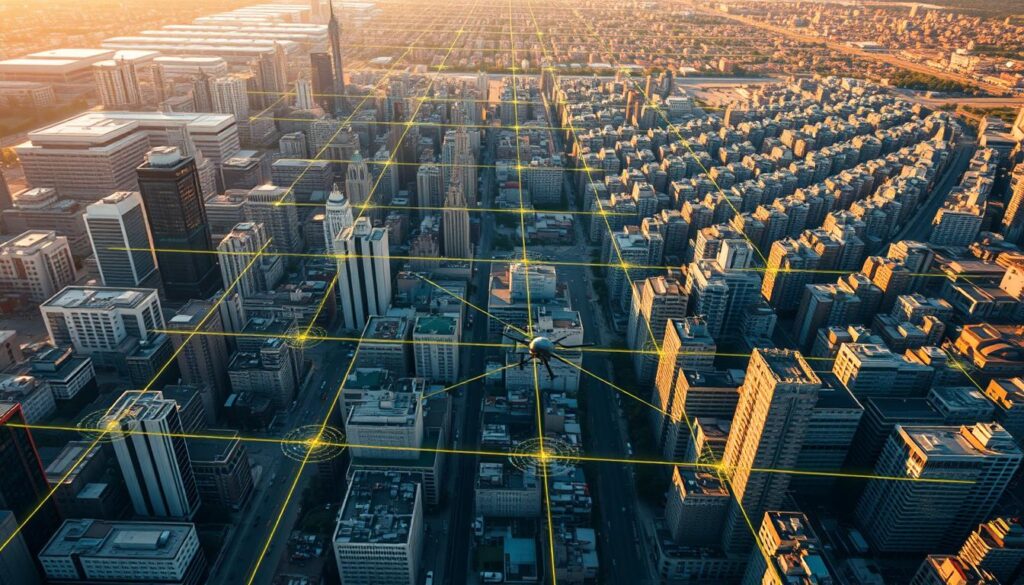
A vast, orderly grid of airspace sectors overlaid on a vibrant cityscape, illuminated by the warm glow of a midday sun. Delivery drones equipped with precision LiDAR sensors navigate this tightly regulated compliance airspace, their beams tracing intricate pathways through the urban canyons. The scene conveys a sense of technological mastery, where cutting-edge autonomy and surveillance systems work in concert to enable safe, efficient aerial navigation. Captured from a cinematic angle, the image emphasizes the scale and complexity of the airspace management challenge, while hinting at the transformative potential of LiDAR-powered drone delivery in the near future.

Document and audit every mission: logs, incident reports, and sensor provenance make BVLOS cases and waivers stronger. Robust retention and tamper-evident records reduce legal and operational risk.

“Operational transparency and documented controls are the backbone of scalable, acceptable programs.”

Iottive instruments telemetry and payload data, automates recordkeeping, and enforces governance rules via cloud and mobile tools. That helps teams prove compliance, manage pilot and aircraft records, and meet enterprise audit needs.

Operating in complex environments: urban canyons, weather, and contested RF conditions

Complex city corridors demand methods that score risk in three dimensions. Urban environments create narrow sightlines, variable ground elevations, and intermittent signal quality. Teams must balance safety with efficient paths through tight areas.

Planning methods for complex environments: 3D grid partitioning, cell-based occupancy, and route smoothing

Operators use 3D grid partitioning to classify space into free, obstructed, or uncertain cells. Cell-based occupancy maps then score collision probabilities per volume.

Probability-based metrics let systems favor safer volumes while keeping mission timelines. Smooth routes avoid sudden turns in narrow canyons and reduce sensor occlusions.

Robust IMU fusion and local sensing keep state estimates steady where GNSS weakens. Conservative path buffers and abort trajectories provide extra margin when signals drop.

Weather-aware autonomy: integrating multi-source data to minimize risk and maintain efficiency

Weather, crowd density, and RF interference feeds adjust a route before launch and in real time. Systems ingest radar, METARs, and local sensors to lower risk while preserving efficiency.

Sub-50 ms detection loops and ready abort paths handle sudden obstacles and contested RF conditions. Ground elevation and slope models refine landing-zone choice by checking clutter and approach angles.

  • 3D grids: classify free vs. obstructed cells for collision-optimized paths.
  • Probability scores: prioritize volumes with lower collision risk to keep schedules.
  • Multi-source feeds: weather, RF maps, and crowd data enable proactive reroutes.
  • Operator tools: visualize risks and alternate routes for quick human decisions.
Data Source Role Outcome
3D occupancy (Amazon 2023; HERE 2022) Collision scoring Safer, smoother paths
Weather & RF feeds Real-time adjustments Resilient routes and abort options
Local sensing & IMU GNSS-challenged positioning Maintain navigation quality

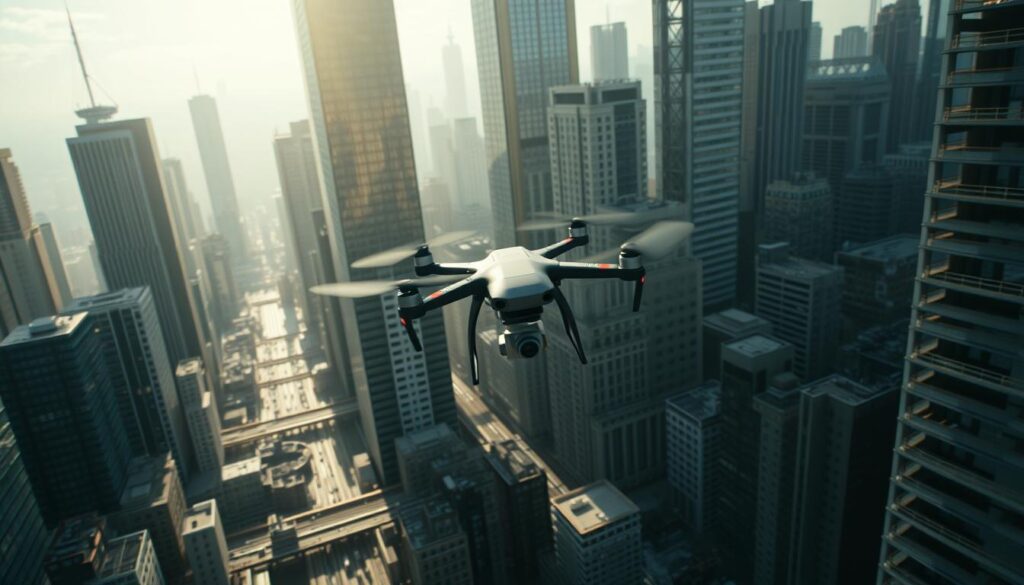
A modern city skyline, towering skyscrapers and dense infrastructure forming an intricate urban canyon. Sunlight filters through the gaps, casting dramatic shadows. A delivery drone hovers, its LiDAR sensors sweeping the scene, mapping the complex environment in real-time. The drone's path is carefully navigated, avoiding obstacles and contested radio frequencies as it deftly maneuvers through the treacherous urban landscape. The image has a cinematic, high-fidelity aesthetic, showcasing the advanced capabilities of LiDAR-guided autonomous flight in challenging conditions.

“Aggregating weather, RF monitoring, and mapping layers lets teams plan resilient missions and adapt in real time.”

Iottive pulls multi-source data into one interface so pilots, dispatchers, and ops managers see actionable insights and alternate paths at a glance.

LiDAR delivery drones, AI flight planning, self-driving drone navigation across industries

Sensor-backed autonomy is unlocking repeatable routes and verified landing areas for multiple industries.

Smart cities and logistics: curbside lanes get validated with lidar-derived surface models that cut ambiguity at pickup points. Corridor mapping creates geofenced routes and supports collaborative deconfliction in shared low-altitude airspace.

Healthcare and emergency response: priority routing reduces overflight of dense zones and speeds time-critical drops. Precise LZ validation at hospitals and clinics helps crews land or lower payloads safely.

Industrial and infrastructure: yard-to-warehouse transfers rely on accurate terrain models to avoid misaligned waypoints. Long-endurance platforms capture dense point clouds for corridor inspections around lines and pipelines while keeping safe standoff distances.

Data integrity matters across these applications. Chain-of-custody from field to back office ensures traceability and compliance in regulated sectors.

“Fewer aborted routes, faster turnaround, and higher success rates come when mapping and enterprise systems work as one.”

Iottive links sensors, platforms like DJI M350 RTK + L2 and Phoenix payloads, and cloud analytics to enterprise apps and mobile tools. That integration reduces manual work, improves repeatability, and gives operators confidence in complex urban environments.

Total cost, ROI, and integration: turning prototypes into scalable operations

Turning a prototype into a repeatable program begins by mapping expenses and expected savings. Start with a clear ledger of purchase and recurring costs so you know where integration pays back fastest.

Cost components and why long-term savings beat CapEx

Account for airframes, high-rate lidar payloads, batteries, spares, rugged cases, and training. Add software licenses and compute for PPK and point-cloud processing.

Examples help. A DJI M350 RTK sits near $10,000; a SkyFront Perimeter 8 about $47,000. Phoenix payloads range $150,000–$250,000+ depending on points-per-second needs.

Why it pays off: centimeter accuracy cuts site revisits and mission aborts. Less rework saves crew time and lowers per-mission cost over months.

Cloud and mobile integration: pipelines from field to fulfillment

Unified data pipelines move sensor captures into WMS, ERP, or EHR systems without manual steps. That shortens SLAs and improves customer outcomes.

Automation trims labor, reduces errors, and scales operations. Standardized checklists, operator training, governance, and dashboards make pilots repeatable and auditable.

  • Estimate software and compute needs for processing and analytics.
  • Match platforms to endurance and payload to avoid costly mismatches.
  • Capture operational data to iterate methods and compound efficiency gains.

“Compliance and documented controls are cost-avoidance tools that reduce fines and delay.”

Iottive speeds time to value by delivering cloud & mobile integration, BLE app development, and end-to-end IoT/AIoT solutions that link field data to fulfillment or ERP systems. Contact www.iottive.com | sales@iottive.com for integration support.

Conclusion

Practical success comes when accurate mapping, fast detection, and tight integration work as one. Modern systems fuse lidar, cameras, GNSS, and sensors so teams get reliable maps and timely object detection across varied environments.

Choose airframes, payloads, and software that match mission endurance and regulatory needs. Use hierarchical planners for broad routes and local modules for rapid avoidance and safe abort options.

Make weather-aware checks, ground modeling, and path smoothing part of every run. Measure time to deploy, processing time, detection latency, and route adherence to drive better outcomes.

Integration-first thinking—linking field apps, cloud analytics, and enterprise systems—reduces errors and scales programs. For IoT/AIoT strategy, BLE apps, mobile and cloud integration, or custom platforms contact Iottive: www.iottive.com | sales@iottive.com.

FAQ

How does laser-based sensing improve autonomous package transport accuracy?

Laser-based sensors create dense, real-time point clouds that reveal terrain, obstacles, and structures in three dimensions. When fused with cameras, GNSS corrections, and inertial units, this data enables centimeter-level positioning and precise hover or landing maneuvers. The result is shorter mission times, fewer aborted runs, and safer operations in congested areas.

What sensor suite is required for reliable urban missions?

A robust stack combines a high-resolution range sensor, high-frame-rate visual cameras, RTK/PPK-capable GNSS, and a calibrated IMU. Onboard computing for perception and control is essential. Together these subsystems provide redundancy and permit sensor fusion algorithms to handle occlusions, multipath GNSS errors, and dynamic obstacles.

How do route planners balance long-range routing with immediate collision avoidance?

Modern planners use hierarchical methods. A global planner computes efficient corridors and legal airspace paths. A local planner runs at high frequency to react to moving hazards and micro-changes in the scene. This split reduces compute load while guaranteeing responsiveness where it matters most.

Can systems update maps in real time to account for moving vehicles and pedestrians?

Yes. Dynamic mapping pipelines ingest continuous sensor streams and maintain short-term occupancy layers for moving objects. These layers feed the local planner so the vehicle can re-route or execute safe abort trajectories when needed.

What latency targets are needed for safe obstacle detection and avoidance?

For urban operations, sub-50 millisecond detection-to-decision latency is strongly preferred. That allows the control system to generate feasible avoidance maneuvers before the vehicle reaches a collision envelope, improving safety margins in dense environments.

Which commercial platforms are commonly used for enterprise missions?

Operators choose vehicles and payloads that match mission range, endurance, and payload mass. Examples include professional multirotors and fixed-wing hybrids paired with modular sensor pods from reputable vendors. Platform selection depends on integration with perception software and regulatory fit.

What criteria should buyers prioritize when selecting hardware and software?

Key factors include absolute accuracy, sensor refresh rate, payload weight, power draw, flight time, and interoperability with mapping and fleet systems. Also consider vendor support, certification status, and total cost of ownership rather than upfront price alone.

How do U.S. regulations affect beyond-visual-line-of-sight commercial operations?

Federal rules require compliance with Part 107 unless covered by a specific waiver or exemption. Visual-line-of-sight limits, altitudes, and controlled-airspace authorizations influence route design and operational approvals. Operators should maintain up-to-date records and use approved detect-and-avoid systems where required.

What privacy and data governance best practices apply when operating over populated areas?

Adopt strict data minimization, encryption in transit and at rest, and clear retention policies. Mask or blur personally identifiable imagery when possible, limit access to raw streams, and communicate operation intent to local communities to build trust and reduce liability.

How do teams plan for complex urban canyons and contested RF environments?

Planning combines 3D partitioning of the airspace, cell-based occupancy mapping, and route-smoothing algorithms to avoid narrow corridors. Redundant navigation modalities and robust communications planning mitigate GNSS outages and interference.

How does weather awareness get integrated into autonomy stacks?

Weather-aware systems ingest multi-source forecasts, on-board air data, and ground sensors. They score routes by wind, precipitation, and gust risk, then adjust speed, altitudes, or postpone missions when thresholds are exceeded to reduce risk.

What industries most benefit from autonomous last-mile capabilities?

Smart cities, logistics firms, healthcare providers, and infrastructure operators gain the most. Use cases include curbside delivery, urgent medical item transfer, corridor inspections, and site-to-site cargo moves that reduce transit times and on-ground traffic.

How should organizations evaluate total cost and expected ROI for deployment?

Calculate hardware, sensors, software licenses, training, and recurring compliance costs. Model labor savings, faster delivery cycles, and reduced accident rates. Many programs show payback through operational efficiencies within a few years when scaled intelligently.

What are common integration challenges with enterprise IT and cloud systems?

Challenges include secure data pipelines, real-time telemetry ingestion, schema compatibility, and latency requirements for decision support. Well-defined APIs, edge processing, and mature vendor integrations ease deployment into fulfillment and asset-management systems.

How do operators validate landing zones and conduct safe drops in dense areas?

Validation uses high-resolution sensing to confirm clear approach paths, suitable touch-down surfaces, and acceptable ground conditions. Priority routing and staging zones are scored for safety, and contingency procedures are enacted if a zone becomes unsafe mid-approach.


Let’s Get Started

How LiDAR is Revolutionizing Autonomous Navigation – Smart Automation

One evening, a fleet operator watched a vehicle adjust its path while sipping coffee. The update came through a mobile app that tied edge sensors, cloud analytics, and an over-the-air firmware patch together. Within seconds the team could make informed decisions and keep passengers safe.

This guide shows how LiDAR-driven 3D sensing and modern algorithms let autonomous vehicles process vast amounts of data from cameras, RADAR, and ultrasonics. These inputs help the vehicle perceive the road, predict movement, and plan safe driving around changing traffic and conditions.

Iottive builds end-to-end IoT platforms that bridge BLE-enabled edge devices, mobile apps, and cloud dashboards. Operators can monitor map accuracy, push OTA updates, and fine-tune systems from any connected device. That blend of edge compute and cloud models is why transportation is moving toward smarter, scalable automation.

LiDAR mapping for AVs, AI route optimization, self-driving navigation

Key Takeaways

  • LiDAR-powered 3D sensing helps vehicles process large streams of data for safer decisions.
  • HD maps, GPS/INS, and SLAM enable precise positioning for complex road layouts.
  • Complementary sensors—RADAR, cameras, ultrasonics—boost resilience in varied conditions.
  • Iottive’s IoT and mobile solutions connect vehicles to cloud analytics and OTA updates.
  • Advances in edge compute and learning algorithms make fleet-wide improvements possible.

Why LiDAR-led autonomy matters now: user intent, scope, and what this Ultimate Guide covers

Product leaders, engineers, and operations teams need clear answers about how autonomous vehicles gather and use data to improve overall safety and efficiency.

This guide explains the full scope: perception, localization, planning, and resilient systems that handle changing road conditions and traffic patterns.

A bustling urban landscape filled with sleek, autonomous vehicles navigating the streets with precision. In the foreground, a state-of-the-art self-driving car equipped with advanced LiDAR sensors, its carefully-calibrated array of laser beams sweeping the environment to map the surroundings in striking 3D detail. The middle ground features a variety of other autonomous models, their smooth, aerodynamic designs seamlessly blending with the cityscape of towering skyscrapers and bustling pedestrian traffic. Overhead, the warm glow of the midday sun casts a natural, ambient light, illuminating the scene with a sense of technological progress and efficient mobility. This harmonious symphony of man and machine showcases the transformative power of LiDAR-driven autonomy, paving the way for a future of smart, connected transportation.

We show practical steps to evaluate systems, reduce risk, and map investments to measurable safety gains.

  • How sensor families work together to supply detailed information for lane-level decisions.
  • How machine learning and algorithms consume vast amounts of multimodal data to make informed decisions quickly.
  • Priorities for prototyping, testing, and governance so teams can act with confidence.

“Iottive helps teams validate assumptions fast with BLE telemetry, rapid sensor prototypes, and cloud dashboards.”

Focus Why it matters Key deliverable
Perception Detailed, lane-level scene understanding in low visibility Reliable sensor fusion and object lists
Decision systems Real-time planning under variable traffic Predictive models and control policies
Operations Rapid validation with fleet data BLE telemetry, cloud dashboards, OTA updates

The perception backbone: LiDAR, radar, cameras, ultrasonics, and sensor fusion working together

Modern perception systems fuse diverse sensor streams to build a clear, real-time picture of the surroundings. This layered approach turns raw signals into the actionable data a vehicle needs to detect objects, estimate speed, and plan safe maneuvers.

LiDAR for high-resolution 3D environmental mapping and obstacle detection

LiDAR emits laser pulses to produce dense point clouds that reconstruct nearby surroundings. These clouds enable accurate object detection and lane-relative positioning, which helps early recognition of obstacles in complex environments.

RADAR for long-range speed and distance in adverse weather

RADAR tracks distance and speed reliably through fog, rain, and snow. Its long-range capability complements higher-resolution sensors by giving consistent motion estimates for distant objects and vehicles.

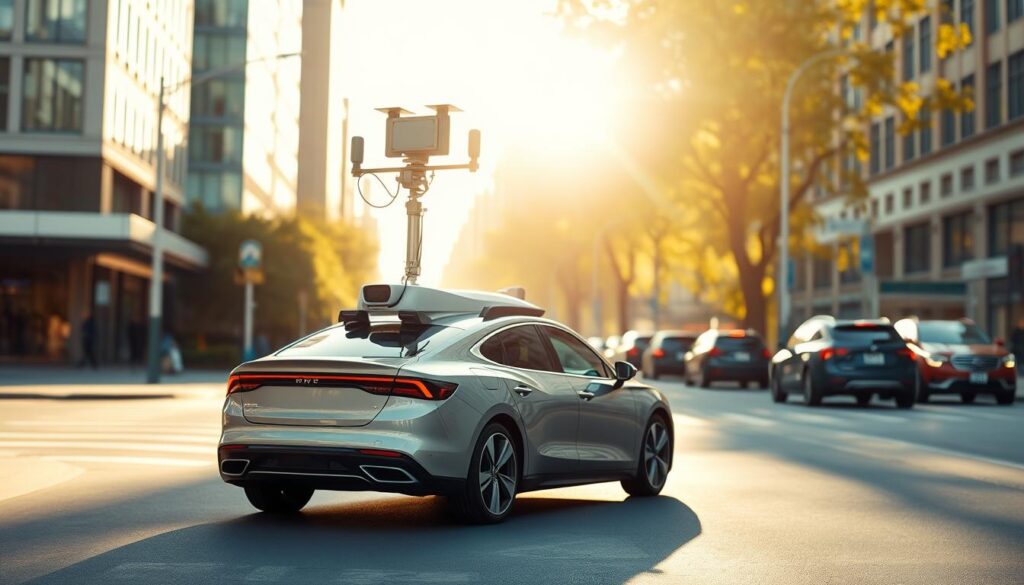
A bustling city street bathed in warm, natural daylight. In the foreground, a self-driving car equipped with an array of state-of-the-art sensors - a high-resolution LiDAR system sweeping the scene, complemented by radar modules and a suite of cameras capturing a comprehensive 360-degree view. The LiDAR's precise 3D mapping blends seamlessly with the radar's long-range object detection and the cameras' detailed color and texture information, creating a multifaceted perception backbone for autonomous navigation. The car's sleek, aerodynamic design emphasizes its cutting-edge technology, ready to safely navigate the urban environment.

Camera vision, ultrasonics, and fusion

Cameras read lanes, traffic signs, and semantic scene cues. They offer rich color and texture that help classify pedestrians and objects, though lighting can affect performance.

Ultrasonic sensors fill short-range gaps during parking and low-speed maneuvers. Together, sensor fusion aligns detections across modalities so algorithms and learning models keep consistent tracks and improve safety on busy roads.

“Iottive streams synchronized sensor data so teams can visualize point clouds, camera frames, and RADAR tracks in real time.”

  • Trade-offs: LiDAR resolution vs. cost; RADAR reliability vs. lower spatial detail; cameras’ richness vs. lighting sensitivity.
  • Iottive’s BLE and IoT gateways help teams profile noise, validate calibration, and iterate faster on fusion pipelines.

Localization and maps: HD maps, GPS, and SLAM powering precise vehicle positioning

A reliable position estimate blends HD map layers, GNSS telemetry with inertial backups, and SLAM that adapts to changing streets.

HD maps supply centimeter-level road geometry, lane markings, and traffic assets. That detailed information helps planners make lane-precise decisions and supports safer maneuvers in dense urban canyons.

GPS plus INS gives redundancy when satellite signals bounce or drop in tunnels. Combining GNSS and inertial systems stabilizes pose estimates so vehicles keep trustworthy position data while driving.

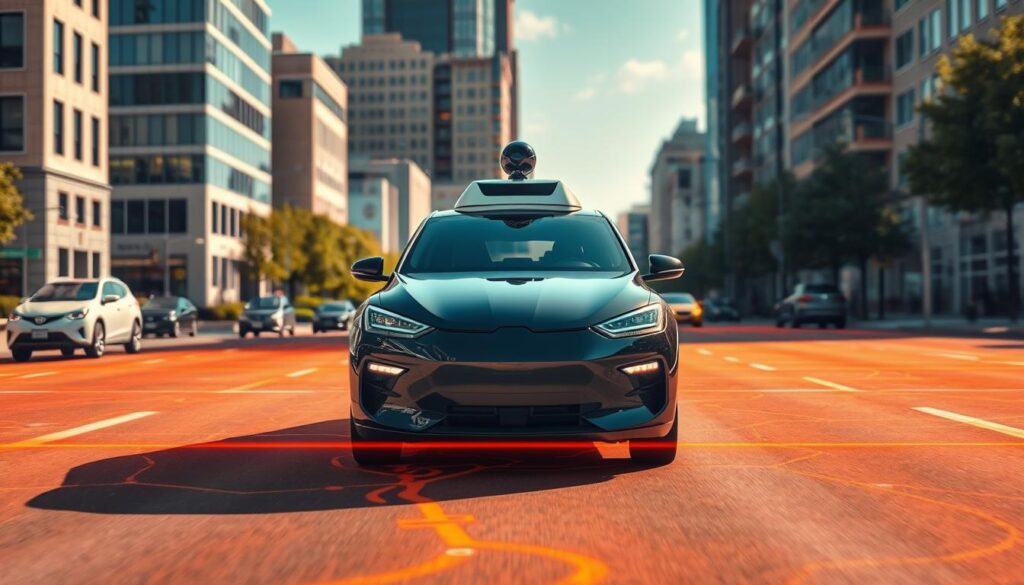
A city street scene with a self-driving car navigating the roads, its LiDAR sensors scanning the surroundings in vivid detail. The car is centered in the frame, its sleek, aerodynamic design conveying a sense of advanced technology. In the foreground, high-definition maps and GPS data are overlaid, providing precise localization and navigation information. In the middle ground, buildings, trees, and other urban elements create a realistic backdrop, bathed in natural daylight. The camera angle is a wide, panoramic view, capturing the seamless integration of the vehicle's autonomous systems with the real-world environment. The overall atmosphere is one of cutting-edge innovation, efficiency, and the future of transportation.

SLAM in dynamic environments

SLAM builds maps on the fly when prebuilt coverage is missing. It helps with immediate perception and detection of new obstacles.

But SLAM can drift and needs compute resources. Algorithms constrain error growth by fusing sensor data and anchoring to map primitives.

  • Cameras, radar, and LiDAR align to map layers to refine vehicle pose and improve perception.
  • Accurate object association between sensors and map features avoids misdetections that could harm safety margins.
  • Iottive’s telemetry visualizes alignment, audits drift, and enables OTA map updates so fleets stay synchronized.

“Iottive streams GPS/INS and SLAM outputs to help teams compare localization streams and detect anomalies.”

From perception to decisions: AI, deep learning, and behavioral prediction inside AV brains

Deep learning and forecasting let a vehicle predict nearby movement and choose safer, smoother maneuvers.

Deep learning for object detection, tracking, and scene understanding

Convolutional networks translate images and point data into labeled objects and semantic context. CNNs handle object detection and recognition, while trackers keep persistent IDs as objects move.

Scene understanding adds lanes, crosswalks, and occlusion cues so planners have richer information when making decisions.

Behavioral prediction to anticipate pedestrians, cyclists, and vehicle trajectories

Prediction models fuse past motion, scene context, and intent signals to forecast paths. This includes trajectory forecasting, intent detection, and real-time risk assessment.

Accurate forecasts let the control system select speed and gap acceptance that balance comfort, speed, and safety in traffic.

Reinforcement learning and model predictive control for path planning

Reinforcement learning uncovers high-level strategies by trial and error in simulation. Model predictive control refines short-horizon plans to meet safety envelopes while smoothing motion.

Runtime constraints demand low-latency inference on edge hardware so decisions stay timely when conditions change quickly.

Iottive’s AIoT solutions help teams curate labeled datasets, instrument edge sensors and BLE devices, and stream synchronized data to cloud dashboards. That workflow speeds model iteration for detection, tracking, and prediction.

“Curated data and robust labeling reduce bias and make decisions reflect real-world conditions across varied weather and scenes.”

Component Function Benefit
Deep learning Detects and classifies objects, builds scene context Improved perception accuracy and richer inputs for planning
Behavioral prediction Forecasts trajectories and intent Better anticipation of pedestrians and vehicles, lower risk
Reinforcement learning + MPC Strategy discovery and short-horizon control Smoother, safer path planning under constraints
AIoT data pipelines Collects synchronized sensor and BLE data, labels datasets Faster model iteration and validated performance on real roads

A hyper-detailed, photorealistic self-driving car navigates a bustling city street, its LiDAR sensors sweeping the environment with precision. The vehicle's complex neural networks analyze the intricate dance of pedestrians, cyclists, and other cars, predicting their behaviors in real-time to ensure safe, efficient navigation. The scene is bathed in warm, natural daylight, casting subtle shadows and highlights that enhance the technical details of the autonomous system. The composition is a wide, panoramic shot that captures the full scope of the vehicle's sensory awareness and decision-making capabilities, perfectly illustrating the "From perception to decisions" section of the article.

LiDAR mapping for AVs, AI route optimization, self-driving navigation: putting it all together

Predictive models turn streams of sensor information into timely decisions that avoid hazards and keep schedules.

Trajectory forecasting and intent detection feed planners with short-horizon predictions about pedestrians, cyclists, and nearby vehicles. Those forecasts shape candidate paths that respect traffic rules and passenger comfort.

Control systems then apply model predictive control to turn forecasts into smooth, feasible steering and speed commands. This keeps maneuvers both safe and efficient in dense traffic.

A bustling city street scene at midday, with a sleek, autonomous vehicle maneuvering through traffic, its LiDAR sensors scanning the environment in real-time. The car's advanced navigation system maps out the optimal route, anticipating the movements of pedestrians and other vehicles. The sunlight casts long shadows, highlighting the intricate details of the car's sensors and the surrounding architecture. In the background, high-rise buildings and bustling sidewalks create a dynamic, technologically-advanced urban landscape, showcasing the integration of LiDAR-powered self-driving technology into the modern cityscape.

Trajectory forecasting, intent detection, and risk assessment in real time

Fast classifiers and regressors use camera semantics, radar speed cues, and lidar point structure to guess intent. Risk scores rise when uncertainty spikes or objects cross predicted paths.

When scores cross thresholds, planners choose conservative actions and the control loop tightens to reduce collision risk.

Adaptive speed, lane selection, and proactive braking for overall safety

Adaptive loops coordinate speed, lane choice, and braking so the vehicle keeps flow while avoiding obstacles. MPC balances comfort, legal limits, and emergency handling.

Runtime guardrails provide fallback maneuvers when models disagree or sensors degrade. These guardrails enforce simple safe behaviors so edge cases do not cascade.

“Iottive connects telematics, BLE edge streams, and OTA model updates so operators can validate changes rapidly in the field.”

  • Forecasts inform planners that pick safe, efficient maneuvers through dense traffic.
  • Sensors—lidar, radar, cameras, ultrasonics—combine to detect objects early and keep trajectories smooth as road conditions change.
  • Deep learning models and systems logic convert sensor information into decisions that respect comfort, regulations, and right-of-way.
  • Iottive closes the loop with telematics, logging, and OTA updates to operationalize improvements across vehicles.

Resilience in the real world: weather conditions, edge cases, and redundancy strategies

Real-world roads force autonomous systems to cope with sudden weather shifts and rare events without losing safety.

Multimodal sensing keeps a vehicle aware when conditions change. In rain, fog, or snow, radar still measures speed and range while cameras and lidar may lose detail.

Operating through rain, fog, and snow with complementary sensors

Designs use radar as the weather-hardened backbone, ultrasonics for near-field checks, and cameras when visibility is good. Fusion preserves perception of objects across mixed environments.

Control logic then selects conservative maneuvers if confidence drops. Reducing speed and widening gaps keeps pedestrians and traffic safer during uncertain moments.

Handling rare events: emergency vehicles, road obstructions, and detours

Edge cases like emergency responders or unexpected obstructions need fast detection, classification, and a clear response policy. Systems flag unusual data streams and switch to fail-safe behaviors.

Iottive supplies redundant BLE and IoT pathways plus cloud alerts so operators see sensor health and intervene or schedule fixes before risks grow.

“Redundancy and test-driven detour scenarios are essential to keep vehicles operational and safe in messy, real roads.”

Connected mobility: V2X, 5G, and smart city integration that boost efficiency

When vehicles and infrastructure exchange live signals, traffic becomes a cooperative system rather than isolated agents. Low-latency 5G and V2X links deliver timely data that helps vehicles coordinate merges, crossings, and platoons. This reduces stop-and-go behavior and raises overall efficiency on the road.

Cooperative driving, platooning, and traffic signal coordination

V2X and 5G let vehicles share position, speed, and signal-phase information so they can form tight, safe platoons. Platooning improves fuel use and throughput while lowering congestion.

Signal phase and timing (SPaT) messages give vehicles a forecast of upcoming light phases. Navigation timing that uses SPaT reduces stops, saves energy, and keeps schedules on track.

Fleet planning and AI-driven efficiency

Fleet operators use machine learning and advanced algorithms to balance demand, schedule preventive maintenance, and make quick decisions during peak traffic. Models analyze streaming data to reroute vehicles around jams and shift capacity where riders need it most.

Edge and cloud streams synchronize dispatch, vehicle health, and handoffs so control remains reliable. These systems lower downtime and improve on-time performance for ride-hailing and delivery services.

“Iottive builds V2X-ready IoT stacks and mobile apps that tie vehicles to traffic signals, curbside systems, and dispatch tools.”

  • 5G and V2X share traffic and signal information to coordinate merges, crossings, and platoons.
  • Machine learning helps fleets balance demand and make timely decisions in peak traffic.
  • SPaT timing cuts stops and boosts energy efficiency and schedule adherence.
  • Edge-to-cloud data flows sync dispatch, maintenance, and driverless handoffs for safe control.
  • Iottive integrates sensors and system telemetry with city infrastructure to operationalize connected mobility plans.

Beyond passenger cars: transit, logistics, and agriculture use cases

Autonomous systems are proving their value in transit networks, urban delivery, and precision farming operations. These sectors rely on synchronized data, robust sensors, and practical planning to deliver real benefits in real environments.

Autonomous shuttles and buses improve transportation access and lower emissions. Transit agencies deploy on‑demand shuttles that keep schedules punctual and assist riders with limited mobility. Coordinated with traffic systems, these vehicles cut wait times and shrink local carbon footprints.

Autonomous shuttles and buses for accessible, low-emission public transport

Shuttles use sensor fusion, predictive models, and fleet data to stay reliable in mixed traffic. Operators tune performance with OTA updates and BLE telemetry so services adapt without long downtime.

Autonomous delivery vehicles for reliable, 24/7 last-mile logistics

Delivery vehicles run around the clock using planning and continuous data to avoid congestion and maintain SLAs. Predictive maintenance reduces surprises and keeps fleets moving in dense urban settings.

Autonomous farming equipment for precision agriculture and sustainability

Field vehicles pair GPS, sensors, and models to guide planting and harvesting. Precision workflows raise yields, save water, and lower input waste across varied environments.

Iottive helps transit agencies, logistics operators, and ag‑tech firms deploy BLE beacons, smart gateways, and cloud/mobile integrations. These products enable fleet monitoring, OTA updates, and real‑time dashboards that keep multi‑vehicle operations coordinated.

Use case Primary benefit Operational need
Transit shuttles Improved accessibility and lower emissions Traffic coordination, passenger apps, OTA updates
Delivery vehicles 24/7 service with higher SLA adherence Predictive maintenance, congestion data, fleet orchestration
Farming equipment Precision planting and resource efficiency Field connectivity, sensor telemetry, model updates
  • Practical challenges include rural connectivity, uneven road conditions, and unexpected obstacles that planning systems must handle gracefully.
  • Fleet monitoring and cloud integrations ensure operators react fast to sensor faults or changing traffic and weather conditions.

Challenges to solve on the road to scale: safety, regulation, and ethics

Scaling autonomous systems demands more than smart models and fast processors; it needs verified evidence that vehicles behave safely under real conditions.

Testing and validation must blend long-running simulation with staged public road trials. Simulators speed iteration, while on-road data supplies the detailed information regulators expect.

Testing, validation, and fail-safes for reliability

Teams should run exhaustive scenario tests, then confirm results with monitored road trials. Redundancy in sensors and control paths preserves operation when components fail.

Fail-safes must hand control to conservative behaviors when confidence falls. Auditable logs and synchronized data streams help engineers reproduce and fix faults fast.

Regulatory frameworks, liability, and data privacy in the United States

U.S. rules require clarity on who is liable after an incident and strict protections for personal data. Transparent logs and device identity make it easier to make informed assessments.

Iottive supports safety cases with auditable data pipelines and privacy-by-design architectures to help teams meet regulatory expectations.

Transparent AI and ethical decision-making in complex scenarios

Ethical frameworks must guide algorithms when trade-offs arise, especially around pedestrians and vulnerable road users. Explainable models build public trust.

“Openness in testing and clear logs are essential to show how decisions are made and why safe outcomes follow.”

Challenge Key action Outcome
Validation Simulate, then test on public roads with monitored trials Verified performance and detailed information for safety cases
Redundancy Dual sensors, backup control, health monitoring Continued control under faults and higher reliability
Regulation & privacy Auditable logs, device identity, privacy-by-design Clear liability paths and compliant data practices
Ethics & transparency Explainable models and public demonstrations Increased trust and accountable decisions

Summary: Rigorous testing, layered fail-safes, clear logs, and ethical transparency let teams scale with confidence. Secure device management and strong data practices turn compliance into an ongoing capability.

Conclusion

When data streams link to learning pipelines, each trip improves future vehicle performance.

Autonomous vehicles rely on a layered stack: perception, localization, planning, and control. That stack helps vehicles handle road and traffic challenges with growing confidence.

High-quality data and continuous learning keep models and algorithms improving as fleets scale. The payoff is clear: better safety, smoother navigation, and improved operational efficiency across transportation networks.

Plan pilots that tie sensors, cameras, and telemetry to cloud dashboards so you can turn insights into measurable gains. Partner with Iottive for BLE devices, mobile apps, and cloud platforms that accelerate deployment and de-risk innovation.

FAQ

What role does LiDAR play in modern autonomous vehicle perception?

LiDAR provides high-resolution 3D scans of the environment, enabling vehicles to detect shapes, distances, and obstacles in real time. When combined with radar, cameras, and ultrasonic sensors, it improves object detection and helps control systems make safer driving decisions.

How do different sensors work together to improve safety?

Sensor fusion merges data from 3D scanners, radar, cameras, and ultrasonics to cover each technology’s blind spots. Cameras handle signs and lane markings, radar measures speed at long range, ultrasonics manage close obstacles, and fusion algorithms create a consistent view for perception and planning.

Can autonomous systems localize accurately in urban environments?

Yes. High-definition maps, GPS aided by inertial measurement units, and SLAM methods work together to give centimeter-level vehicle positioning. Redundant localization reduces drift and helps vehicles navigate complex streets reliably.

How do AI and machine learning enable decision-making in autonomous vehicles?

Deep learning models detect and classify objects, while behavioral prediction forecasts trajectories of pedestrians, cyclists, and other vehicles. Reinforcement learning and model predictive control convert those predictions into safe trajectories, speed adjustments, and lane choices.

What systems manage route planning and adaptive driving behavior?

Planning stacks use trajectory forecasting, intent detection, and risk assessment to choose safe paths. They adjust speed, lane selection, and braking proactively to avoid collisions and improve traffic flow while balancing comfort and efficiency.

How do autonomous vehicles handle adverse weather and visibility issues?

Vehicles rely on complementary sensors—radar for penetrating rain and fog, cameras for visual cues when conditions allow, and 3D scanning for geometry. Redundancy and sensor calibration, plus conservative behavior under low confidence, keep operations resilient.

What happens during rare or unexpected events on the road?

Systems detect anomalies like emergency vehicles, sudden obstructions, or detours and switch to safe fallback strategies. These include reduced speed, increased following distance, or requesting remote operator support when needed.

How does connected infrastructure improve autonomous driving performance?

V2X communications and low-latency networks such as 5G let vehicles share traffic signals, hazard alerts, and cooperative maneuvers. This boosts route efficiency, enables platooning, and helps fleet operators optimize dispatch and routing.

Are autonomous technologies useful beyond private cars?

Absolutely. Autonomous shuttles, delivery vehicles, and farm equipment use the same perception and planning building blocks to provide accessible transit, reliable last-mile logistics, and precision agriculture that reduces waste and boosts productivity.

What are the main safety and regulatory challenges for wide deployment?

Scaling up requires rigorous testing, validation frameworks, and fail-safe mechanisms. Clear U.S. regulations on liability, data privacy, and certification are essential, along with transparent decision-making in edge cases to earn public trust.

How is privacy protected when vehicles collect vast amounts of sensor data?

Developers anonymize or aggregate sensor streams, apply strict data governance, and follow regional privacy laws. Limiting retention, encrypting transmissions, and providing transparency about data use help protect users.

How do companies validate autonomous systems before public use?

Validation combines simulation, closed-track testing, and staged on-road trials. Companies use scenario libraries, edge-case catalogs, and performance metrics to measure perception accuracy, planning robustness, and safe fallback behavior.


Let’s Get Started