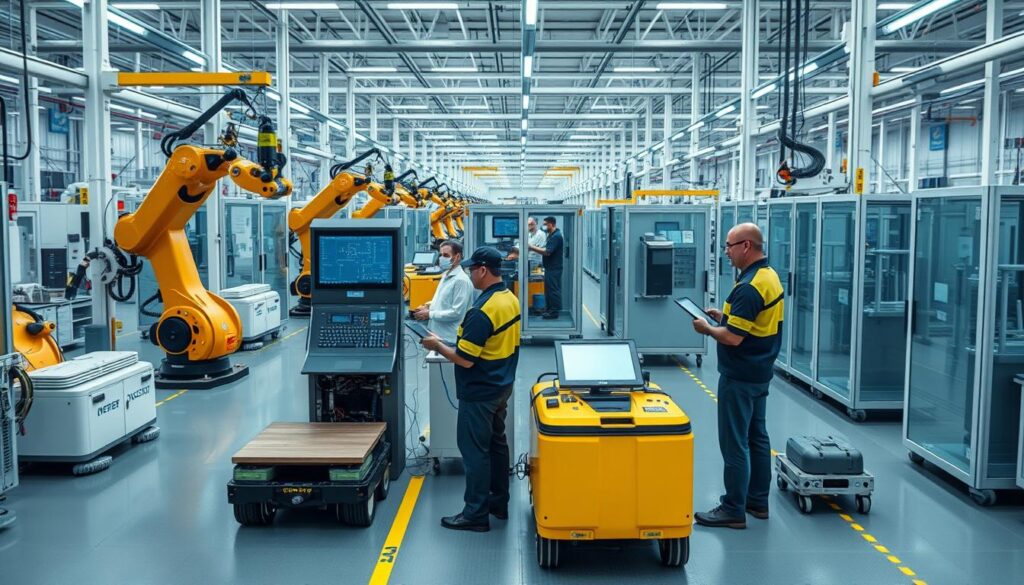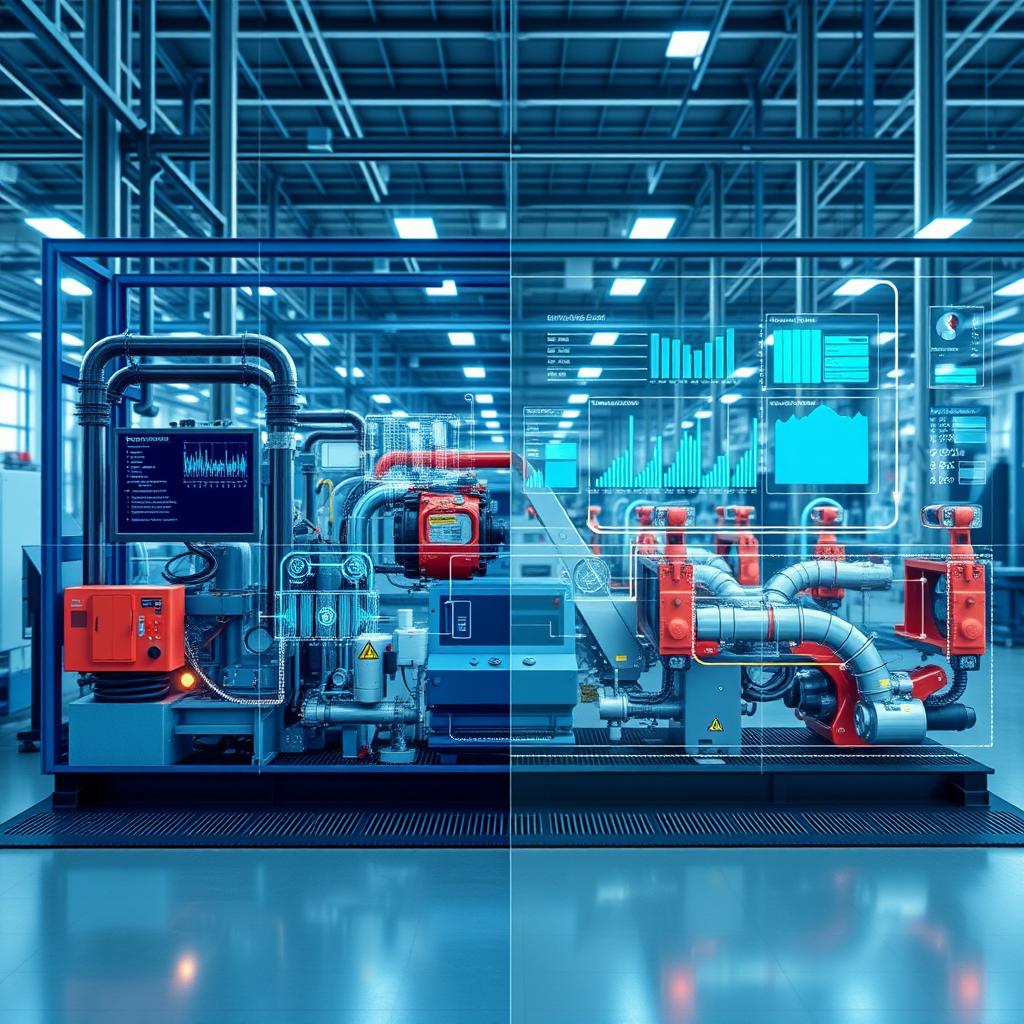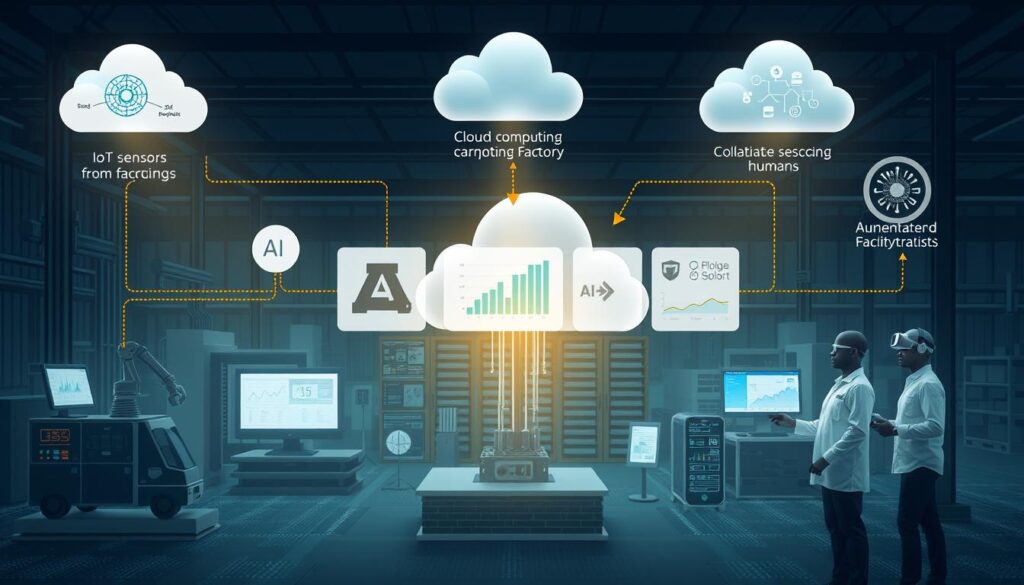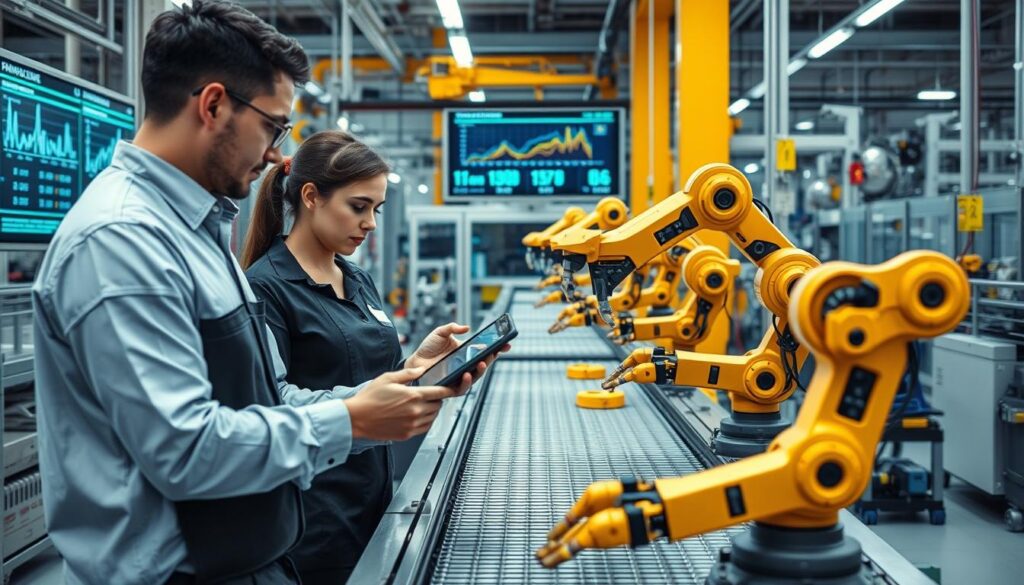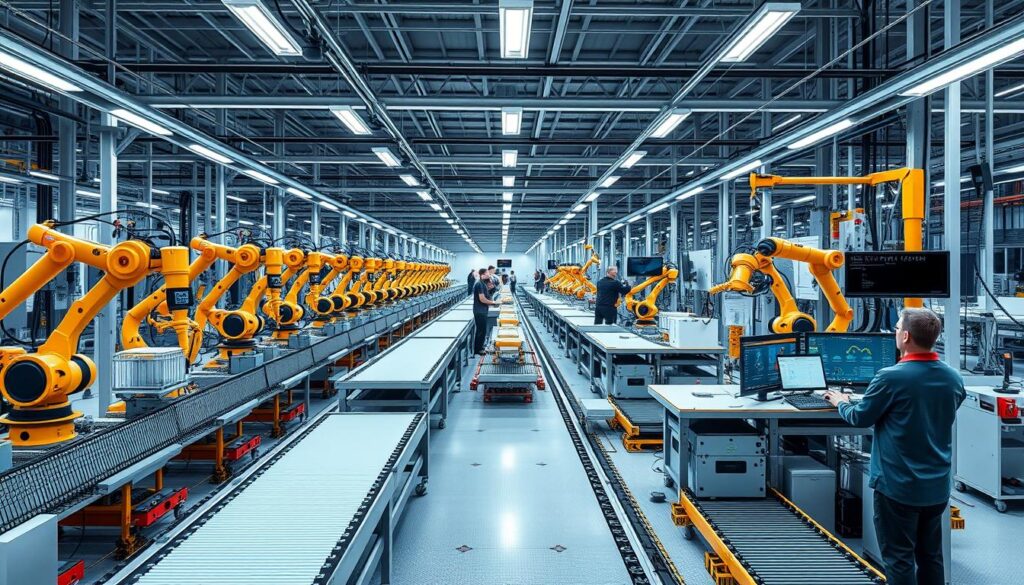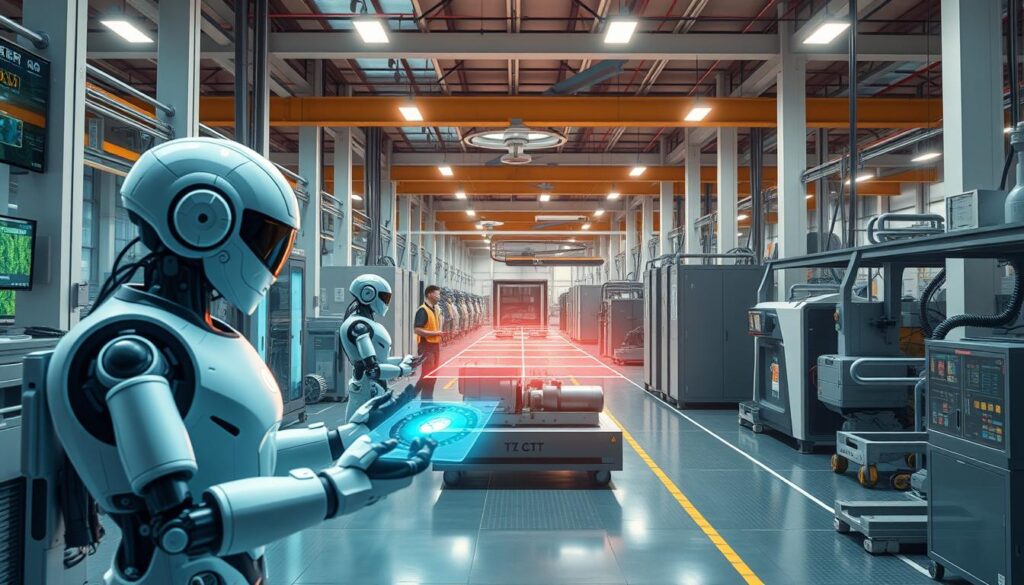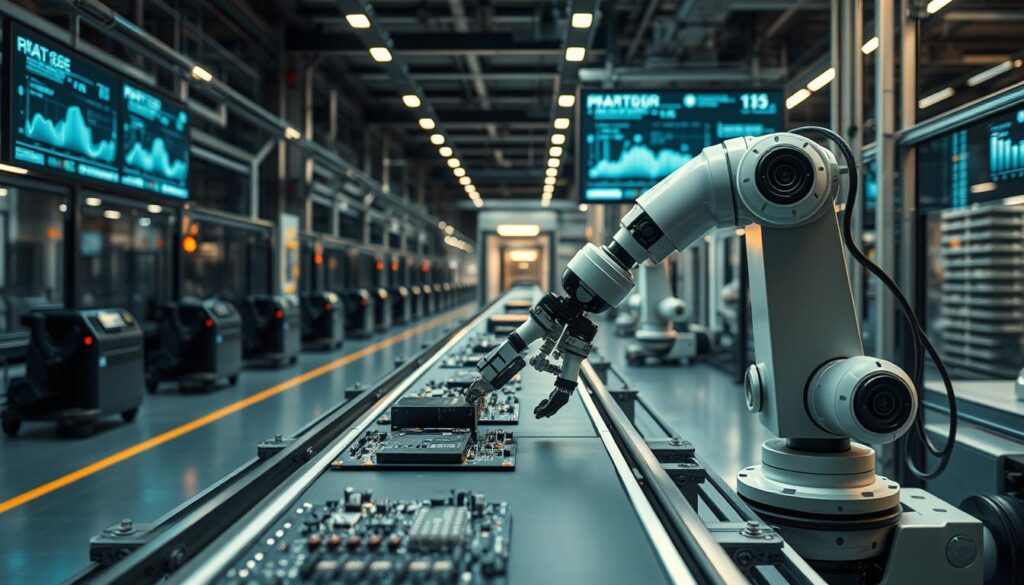
Digital Twins Model Engineering – Virtual simulation of production lines to identify bottlenecks

Factories today face immense pressure. They must deliver more, faster, and with perfect quality. Hidden slowdowns in assembly or logistics can cripple output and profits. These bottlenecks are often invisible until it’s too late.

A new approach changes everything. It involves creating a dynamic, virtual model of your entire operation. This model mirrors your physical line in real time.
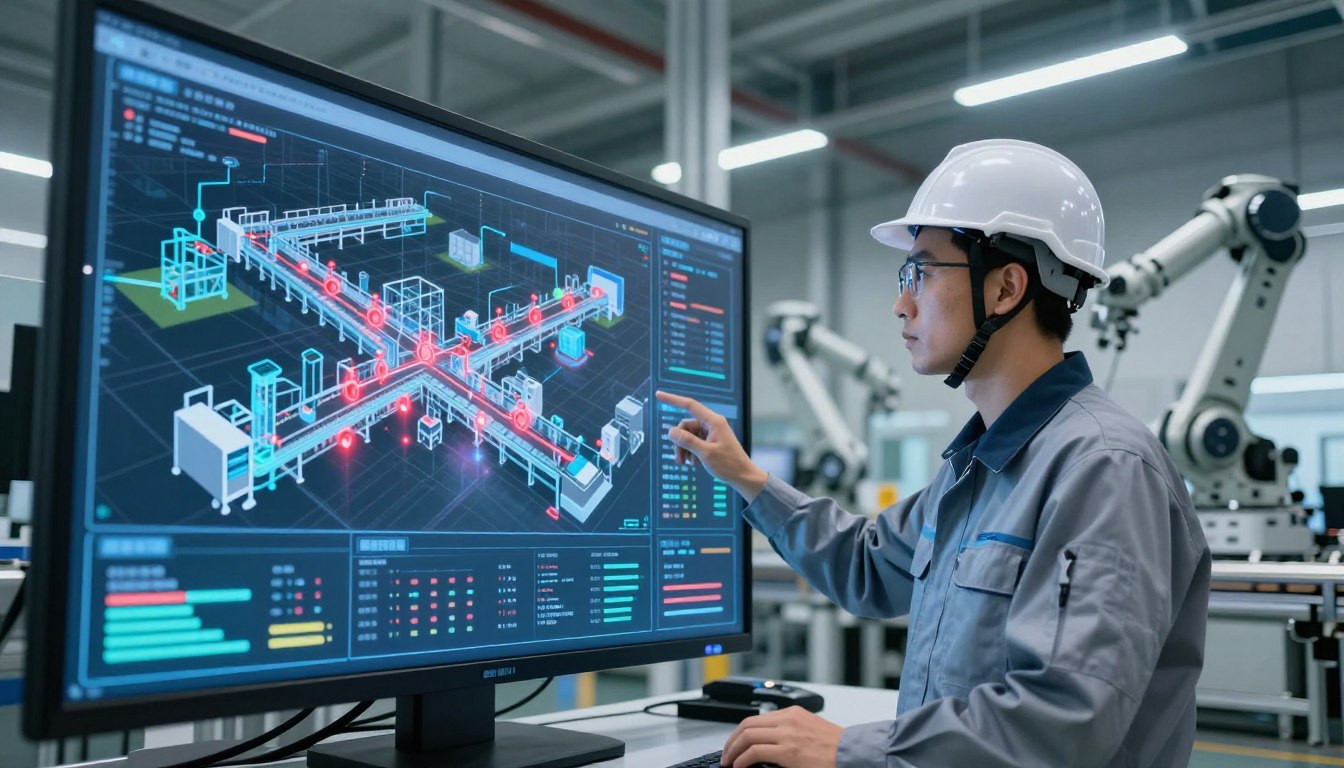
digital twin, Industrial IoT, Smart Manufacturing, Digital Manufacturing

This virtual replica lets you see the flow of materials and work. You can spot where congestion builds. Leaders can test changes in the simulation first. This eliminates risk and improves throughput before any physical adjustments are made.

The shift is from reacting to problems to preventing them. It connects physical assets with intelligent data streams. This creates a foundation for adaptive, self-optimizing systems.

Key Takeaways

  • Hidden production slowdowns severely impact output, cost, and market competitiveness.
  • Virtual simulation provides a proactive tool to find and fix bottlenecks before they cause real-world delays.
  • A real-time virtual model mirrors physical operations, enabling safe testing of improvements.
  • This technology shifts the paradigm from reactive problem-solving to forward-looking optimization.
  • Implementing this approach enhances visibility, supports data-driven decisions, and boosts overall equipment effectiveness.
  • It represents a core element of modern industrial transformation, creating more responsive operations.

Introduction to Virtual Simulation in Manufacturing

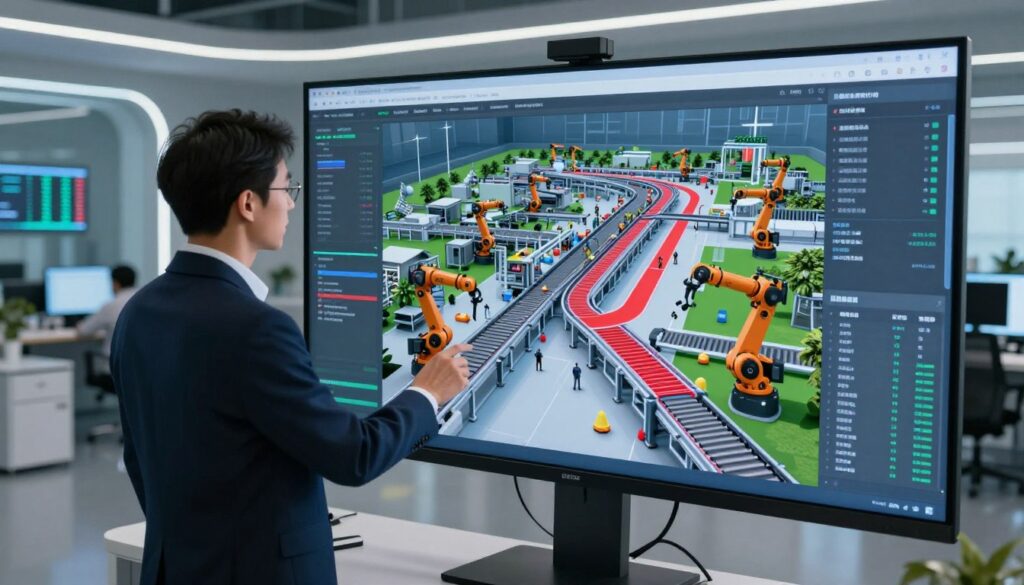
The journey toward operational excellence begins with an accurate virtual representation. This approach builds a dynamic model of your entire production line. It allows for deep analysis and proactive improvement.
virtual simulation manufacturing

Defining Digital Twins and Their Role

A digital twin is a living, virtual replica of a physical system. It synchronizes continuously with real-world equipment and conditions. This model enables predictive analytics and scenario testing.

Its role extends far beyond simple visualization. It transforms how production lines are managed and optimized. Roughly 75% of businesses now use this technology in some form.

The Need for Real-Time Data Integration

Effectiveness hinges on seamless, real-time data integration. Sensors feed information to cloud platforms without delay. This two-way flow ensures the virtual model reflects actual performance.

This immediacy is crucial. It lets teams spot issues and test fixes within seconds. The financial payoff is clear: over 90% of deployments see returns above 10%.

Overview of Digital Twin Technology

The roots of virtual modeling stretch back to ambitious space missions of the mid-20th century. This foundational concept has matured into a powerful tool for modern operations.
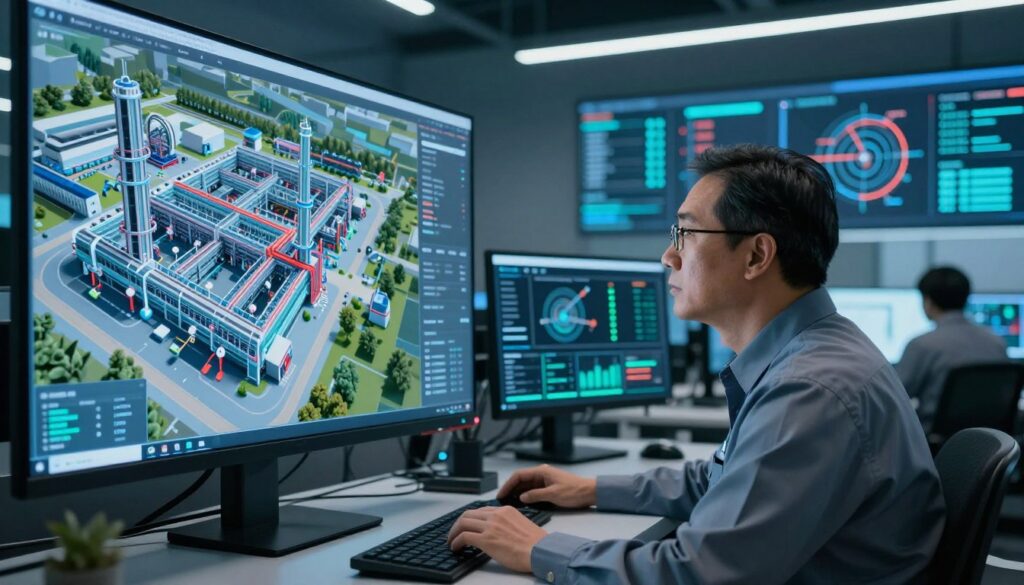
digital twin technology evolution

It creates a living, data-driven counterpart of physical assets. This allows for unprecedented analysis and foresight.

Evolution from Physical Models to Virtual Replicas

In the 1960s, NASA built full-scale physical duplicates of spacecraft. Engineers used these models to simulate mission scenarios and potential failures.

The 1970 Apollo 13 crisis proved their value. Teams on the ground used the replicas to devise and test life-saving procedures.

A major shift occurred in 2002. Dr. Michael Grieves proposed a framework linking a physical product to its virtual counterpart through continuous data.

This idea moved the concept from static mock-ups to dynamic systems. The term “digital twin” was formally adopted by NASA in 2010.

Today’s versions are a quantum leap forward. They leverage cloud computing and AI to create responsive, predictive models.

This evolution has democratized advanced simulation. It now supports everything from initial design to full-scale production optimization.

Leveraging digital twin, Industrial IoT, Smart Manufacturing, Digital Manufacturing

True operational transformation occurs when separate technological streams converge into a unified system. This integration creates a powerful ecosystem that reshapes production capabilities. Four key pillars work together to make this happen.

Industrial IoT acts as the sensory nervous system for the entire operation. Networks of sensors monitor temperature, pressure, and machine performance. This constant stream of live data feeds directly into the virtual model.
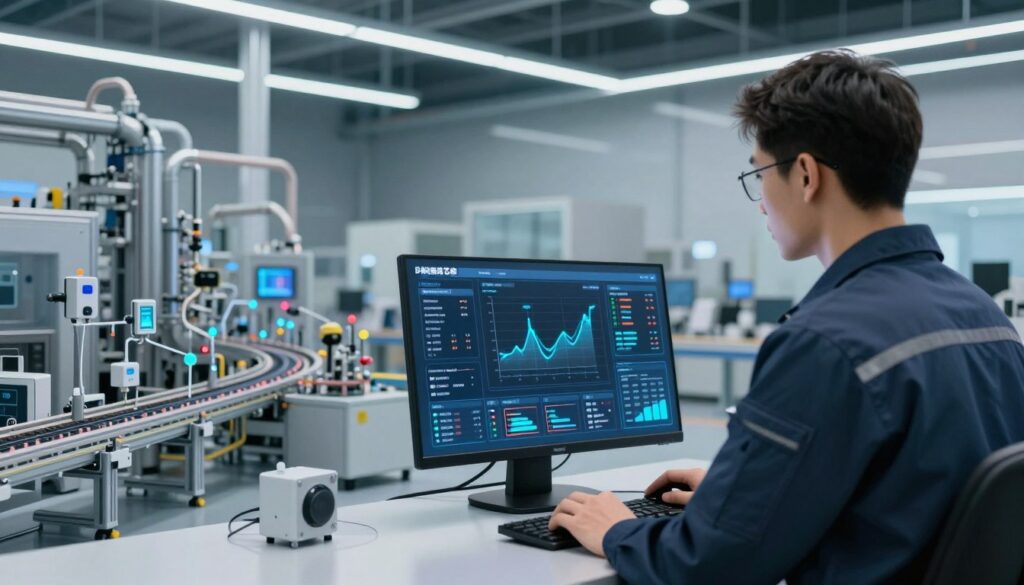
leveraging digital twin industrial iot smart manufacturing

Smart manufacturing takes this information and applies advanced analytics. Artificial intelligence and cloud computing find patterns humans might miss. The result is optimized processes that cut costs and boost product quality.

Digital manufacturing extends this connectivity across the entire value chain. It links product design with production execution and even customer feedback. This creates a unified digital framework from start to finish.

The synergy of these four pillars delivers unprecedented visibility. Leaders gain predictive insights into equipment health and can test changes safely in simulation. This convergence builds a sustainable competitive edge through faster innovation and superior consistency.

Real-Time Production Optimization with Digital Twins

Optimizing a live production line requires more than just historical trends. It demands a living, breathing digital counterpart. This virtual model analyzes every touchpoint continuously.
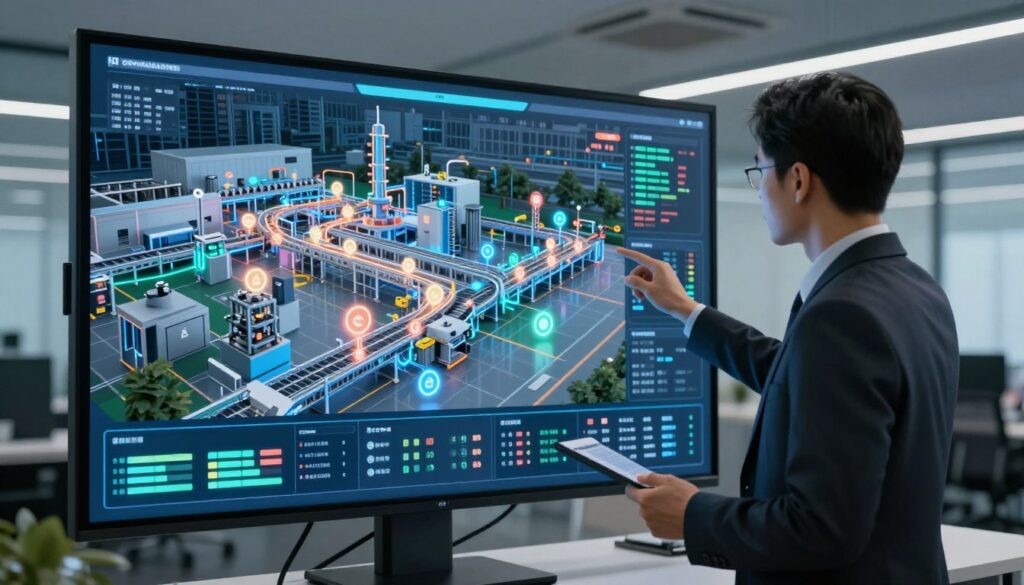
real-time production optimization digital twins

It spots bottlenecks as they form. Teams get operational insights from live streams, not old reports. This transforms the entire production process.

Utilizing IoT Sensors for Continuous Monitoring

Networks of advanced sensors act as the eyes and ears of the line. They track temperature, pressure, vibration, and flow rates from critical equipment components.

Strategic placement captures comprehensive performance data. This constant flow feeds the virtual model, enabling immediate adjustments to process parameters.

Impact on Overall Equipment Effectiveness (OEE)

This approach directly boosts three key OEE factors: availability, performance efficiency, and quality. Issues are corrected before they cause downtime.

Manufacturers see measurable gains in throughput and yield. Resource utilization improves while waste drops across operations, raising overall efficiency.

Aspect Traditional Approach Digital Twin Approach
Data Source Historical records & manual logs Live sensor streams & real-time analytics
Response Time Days or weeks for analysis Seconds for detection and alert
Optimization Scope Isolated equipment adjustments Whole line balancing and workflow sequencing
Impact on OEE Incremental, slow improvements Substantial, continuous gains in availability, performance, quality

The closed-loop feedback between the virtual and physical worlds creates a self-optimizing production system that learns and adapts.

Predictive Maintenance and Data-Driven Insights

Moving beyond scheduled maintenance requires a leap into predictive intelligence. This approach uses data to foresee machine issues long before they cause stoppages.
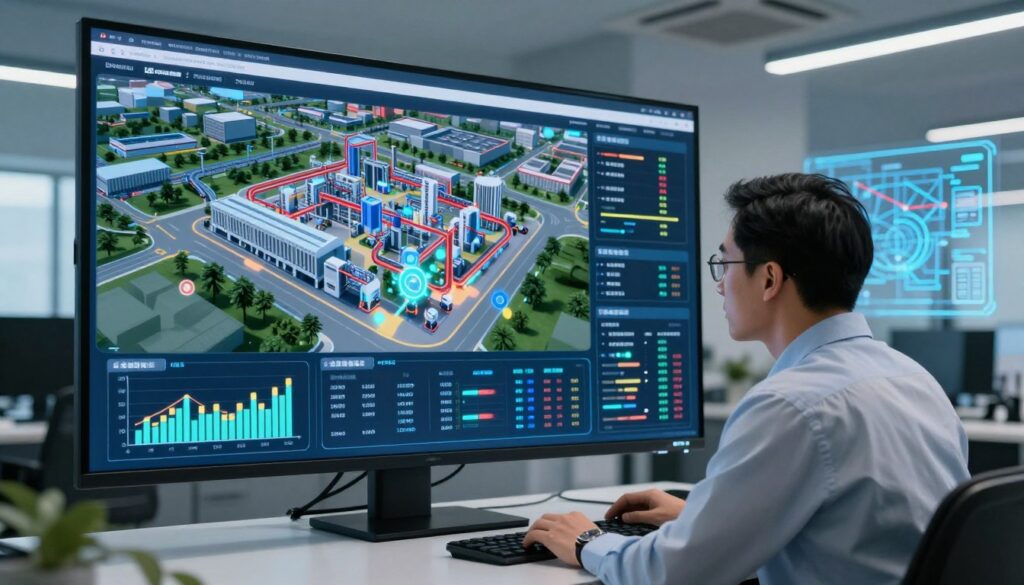
predictive maintenance data insights

It transforms upkeep from a cost center into a strategic advantage. Teams gain actionable insights to optimize asset health and uptime.

Machine Learning Algorithms in Maintenance

Advanced algorithms analyze live sensor streams and historical logs. They learn normal equipment behavior and spot tiny anomalies.

These patterns signal wear or impending failure weeks in advance. This allows for planned repairs during downtime, not emergency fixes.

Maintenance Approach Core Principle Data Usage Typical Outcome
Reactive Fix it when it breaks None High downtime, costly repairs
Preventive Schedule fixes on a calendar Basic time logs Reduced failures, but some wasted effort
Predictive Act on condition-based alerts Real-time sensor analytics Maximized uptime, lower costs, longer asset life

The digital twin is central to this system. It continuously compares real-world performance against the virtual model’s predictions.

This creates a powerful feedback loop. Maintenance becomes a precise science, boosting reliability and cutting expenses.

Smart Manufacturing: Enhancing Efficiency and Quality

Modern production floors achieve new levels of precision by connecting every element of the operation. This interconnected ecosystem allows machines, enterprise software, and supply chain networks to communicate seamlessly.

Unified intelligence enhances efficiency across all processes. It enables rapid adaptation to new customer demands without major retooling, boosting overall efficiency.

Automated Workflows and Quality Control

Automation orchestrates complex sequences based on real-time conditions. This eliminates manual handoffs and reduces human error, accelerating production cycles.

Control transforms from final inspection to continuous monitoring. AI-powered visual systems analyze data streams to detect defects as products move through the line.

Integrating analytics with control systems enables immediate corrective actions. This prevents defective items from advancing, cutting scrap rates and rework costs while ensuring final quality.

These approaches optimize resource use and minimize waste across processes. They provide leaders with clear visibility into performance metrics for informed decision-making across operations. Advanced analytics track energy use and material flow, supporting sustainable operations.

Harnessing AI and Advanced Analytics in Manufacturing

The next frontier in production line mastery lies in the fusion of artificial intelligence with deep analytical power. These technologies process immense streams of live sensor data, uncovering patterns and predicting issues with superhuman speed.

AI-Driven Simulation and Process Optimization

Sophisticated simulation capabilities allow teams to test thousands of production scenarios virtually. This evaluates how different process parameters impact efficiency and cost before any physical change is made.

Advanced analytics platforms autonomously adjust equipment settings and material flows. This continuous optimization refines systems without constant human oversight, driving incremental performance gains.

The strategic value extends beyond the factory floor. Comprehensive analysis informs critical business decisions on product design and supply chain strategy. Analytics engines generate actionable insights, recommending optimal production volumes and resource allocation.

This creates a self-improving operational environment. Manufacturers gain a competitive edge through faster, more accurate decisions and the ability to spot hidden innovation opportunities within complex data.

Integrating IIoT and SCADA for Real-Time Data Capture

The backbone of any responsive production system is a robust data capture infrastructure. It must connect established control technology with modern sensor networks.

Bridging Legacy Systems with Modern Technologies

Legacy SCADA systems hold decades of operational knowledge. Successful integration preserves this functionality while adding modern connectivity.

Unified Namespace architecture is key. It eliminates data silos between SCADA, execution platforms, and business systems.

This creates a single, reliable source of truth. All platforms and people work from the same live data.

Edge computing places processing power close to equipment. This reduces latency for immediate, local decision-making when conditions change.

Strategic placement of modern sensors is critical. They monitor temperature, pressure, vibration, and flow rates across operations.

The final challenge is harmonizing diverse protocols and formats. A unified framework ensures consistent data flows to analytics platforms.

This integration delivers real-time visibility. It turns raw information into actionable insights for superior control.

Simulating Production Scenarios and Bottleneck Identification

Unlocking peak operational flow requires a sandbox where every change can be tested without consequence. This is the core promise of advanced scenario analysis. Teams move beyond guesswork to validate ideas in a dynamic virtual environment.

What-If Analysis and Virtual Testing

What-if analysis empowers teams to explore countless scenarios. They can model new product introductions or major line rebalancing. Each virtual experiment evaluates impacts on throughput, cost, and quality before any physical resource is committed.

This testing occurs in a risk-free space. For example, a team can simulate an assembly line upgrade to see its effect on downstream operations. They assess performance under various conditions without disrupting live production.

The process rapidly identifies constraint points where flow restricts overall output. This analysis reveals true bottlenecks, enabling targeted interventions. Teams focus improvements where they deliver maximum impact on system performance.

Virtual simulation accelerates optimization cycles, letting teams evaluate dozens of potential improvements in the time previously needed for one physical change.

This capability extends beyond equipment. It encompasses workforce scheduling, material flow, and quality strategies. The virtual twin validates hypotheses with high confidence, ensuring modifications work under real conditions. This approach minimizes costly mistakes and drives continuous refinement of the entire process.

Digital Twin Implementation Strategies in Modern Factories

A successful rollout of this advanced modeling technology hinges on meticulous planning and phased execution. Leaders must build a robust framework that grows from a focused pilot to plant-wide transformation.

Phased Approach from Pilot to Scale

The journey begins with a foundation phase. Teams audit existing information infrastructure and prioritize high-impact use cases. This stage sets the cybersecurity and architectural blueprint.

Next, a pilot targets critical equipment. Sensors are deployed to feed live performance metrics into initial models. Validation here proves accuracy and builds confidence for broader rollout.

Scaling expands the sensor network across additional assets. Advanced analytics and enterprise connections are integrated. This phase develops automated optimization algorithms for continuous improvement.

Technology Architecture and Data Integration

A three-layer architecture supports these virtual replicas. The acquisition layer pulls information from sensors, SCADA, and business platforms.

The processing layer uses edge and cloud resources to analyze streams. Analytics engines find patterns and predict outcomes.

The application layer delivers tools for visualization and optimization. Seamless information integration across these layers is critical. It ensures the model reflects true physical conditions for reliable insights.

Overcoming Challenges in Smart Manufacturing Integration

Integrating advanced technologies into existing factory floors presents a complex set of hurdles that demand strategic navigation. These obstacles are both technical and organizational. They can stall progress if not addressed with a clear plan.

Data quality is a foundational issue. Inconsistent formats and siloed information disrupt seamless integration. Automated validation and master data management are essential for reliable systems.

Managing Cybersecurity and Legacy Systems

As operational and information technology converge, the attack surface expands. Robust cybersecurity frameworks are non-negotiable. They protect sensitive data and physical operations from breaches.

Integrating legacy infrastructure is another major hurdle. Older SCADA platforms and controllers often use proprietary protocols. Bridging these to modern cloud technology requires careful strategy.

Skills gaps and change resistance are human challenges. Strategic partnerships with experienced integrators help. Phased implementation allows teams to adapt to new processes.

Overcoming these barriers builds a sustainable competitive edge. It creates manufacturing capabilities that are difficult for rivals to replicate. The discipline required pays off in resilient, optimized processes.

Digitizing the Manufacturing Process: From Plant to Cloud

The key to a responsive operation is a unified data framework that bridges local control with global analytics. This framework establishes a complete data pathway from sensors on the shop floor to powerful off-site computing resources.

This end-to-end flow creates total visibility and command over geographically spread operations. It turns raw machine signals into strategic intelligence.

Unified Namespace (UNS) and Edge Computing

Unified Namespace architecture is the cornerstone. It eliminates traditional data silos separating SCADA, MES, ERP, and sensor networks.

Instead, it creates a single, authoritative source of truth. All platforms and people access the same live information, enabling seamless integration.

Edge computing places processing power physically close to production equipment. This allows for immediate, local decision-making when conditions change rapidly.

It filters and summarizes data before sending it upstream. This reduces network latency and keeps critical systems running smoothly.

Cloud technology provides the scalable backbone for storage and complex analysis. It supports advanced models and enables remote monitoring from anywhere.

Virtual twins leverage this hybrid setup. They sync with edge data in real-time while using cloud power for heavy simulations.

This architecture ensures business continuity and supports a resilient, future-proof operation.

Industrial Transformation and Supply Chain Resilience

Global market volatility has thrust supply chain resilience into the strategic spotlight for modern industry. External shocks from geopolitics to natural disasters now threaten business continuity. This makes robust supply networks a board-level priority.

Industrial transformation through connected platforms fundamentally strengthens this resilience. It provides real-time visibility into material flows and inventory across extended supplier networks. Leaders gain a clear view of production capacity and logistics operations.

Enhancing Visibility and Reducing Disruptions

Virtual models now extend beyond single facilities to map entire supply chain ecosystems. They simulate how disruptions at supplier locations or transportation bottlenecks impact production. This allows for proactive planning before constraints halt lines.

Enhanced visibility lets teams track raw material levels and monitor supplier status. They can anticipate delivery delays and identify alternative sourcing options. This proactive approach reduces costly stoppages.

Integration with planning systems creates closed-loop coordination. Production schedules adjust automatically based on material availability. Procurement systems respond to real capacity changes and demand forecasts.

Predictive analytics applied to supply chain data identify emerging risks. These include supplier instability or regional disruption potential. Teams can enact mitigation strategies before problems materialize.

Organizations leveraging this transformation see measurable gains. They achieve better on-time delivery and higher inventory turnover. This creates adaptive networks capable of rapid reconfiguration.

Emerging Trends and Future Outlook in Digital Twin Technology

Market projections reveal an astonishing trajectory for virtual replica technology, signaling its move from niche tool to industrial cornerstone. Analysts forecast growth from $24.5 billion in 2025 to over $259 billion by 2032.

This expansion is driven by accelerating adoption across aerospace, healthcare, and infrastructure sectors. Nearly 30% of companies had implemented strategies by 2023.

Generative AI and Autonomous Optimization

Generative AI represents the most transformative trend. It enables these models to predict future system behaviors and generate optimization recommendations.

Advanced AI models empower digital twins to make complex, multi-step decisions autonomously. They can anticipate cascading failures and implement operational changes without human intervention.

Delivery models like Digital Twin as a Service (DTaaS) democratize access through the cloud. This allows for rapid deployment without major upfront investment.

Future applications will extend to modeling human cognition and behavior for workforce optimization. The convergence with blockchain and 5G will unlock real-time optimization of globally distributed operations.

Organizations at the forefront of these trends will establish a decisive competitive edge. They will redefine production economics and market responsiveness in the future.

Case Studies and Industry Success Stories

Real-world evidence from top-tier companies demonstrates the powerful impact of advanced simulation technology. A 2025 survey reveals that 92% of deploying companies report returns above 10%. Over half achieve ROI exceeding 20%.

Examples from Leading Manufacturers

Aerospace manufacturers used virtual models to slash development cycles by 40%. They cut physical prototype needs by 60%. This boosted final product quality significantly.

In the automotive industry, production lines saw 25% higher throughput. Changeover times dropped by 35%. These improvements stemmed from precise bottleneck identification.

Quantifiable ROI and Performance Improvements

Operational gains are clear and measurable. Overall Equipment Effectiveness often rises 15-25%. Mean Time Between Failures extends by 30-40%.

First-Pass Yield improves 10-15%. Energy efficiency gains reach 20-30%. These metrics directly lower operational costs.

Metric Category Key Indicators Typical Improvement
Operational OEE, MTBF, Yield 15-40%
Business Cost per Unit, Time to Market 12-50%

Business performance also soars. Cost per unit falls 12-18%. Time to market accelerates 30-50%. Management teams report 98% satisfaction with these projects.

Measurable ROI typically appears within 18 months. Successful companies focus on high-impact use cases and experienced partners. This ensures 95% on-budget delivery.

Conclusion

Looking ahead, the ability to simulate and optimize will define leadership in manufacturing. Virtual simulation through digital twins represents a fundamental transformation. It changes how companies identify bottlenecks and enhance their production lines.

The convergence of this technology with advanced analytics creates integrated ecosystems. They deliver measurable gains in efficiency, quality, and cost. Organizations that adopt this strategy gain a sustainable competitive edge in their industry.

With over 90% of deployments showing positive returns, delay carries significant risk. Future success will depend on the power to test scenarios and predict issues. Leaders should begin with strategic planning and phased rollouts.

FAQ

What exactly is a virtual replica of a production line?

A virtual replica is a dynamic, software-based model of a physical production line. It uses real-time data from sensors and systems to mirror the actual operations. This allows engineers to visualize, analyze, and simulate the entire process to improve performance and find problems before they occur.

How does this technology help with predictive maintenance?

By continuously feeding operational data from equipment into the virtual model, analytics platforms can detect subtle changes. These changes signal potential failures. This data-driven approach allows teams to schedule maintenance precisely when needed, avoiding costly unplanned downtime and extending machine life.

Can these models integrate with older factory systems?

Yes, a key strength is integration with legacy infrastructure. Modern platforms act as a bridge, pulling data from traditional SCADA and control systems. This creates a unified view of operations without requiring a full, immediate replacement of existing assets, protecting prior investments.

What role does AI play in optimizing manufacturing processes?

Artificial Intelligence and machine learning algorithms analyze vast amounts of process data from the virtual model. They identify patterns and correlations humans might miss. This enables autonomous optimization of settings for better quality, higher efficiency, and reduced costs.

How do virtual replicas improve supply chain resilience?

They provide end-to-end visibility. By modeling not just the factory floor but also logistics and inventory flows, companies can simulate disruptions. This “what-if” analysis helps leaders make better decisions, adjust sourcing, and reroute logistics to minimize disruptions and maintain operations.

What is a common first step for a company implementing this solution?

A successful strategy typically starts with a focused pilot project. Companies like Siemens often begin by modeling a single, critical production line or piece of equipment. This proves the value, builds internal expertise, and defines the technology architecture for a broader, scalable rollout across the factory.

Are there measurable returns on investment from using this approach?

Absolutely. Industry leaders report significant ROI. For example, NVIDIA highlights use cases where virtual models have boosted Overall Equipment Effectiveness (OEE) by double digits. Tangible benefits include major reductions in downtime, lower energy consumption, fewer quality defects, and faster time-to-market for new products.


How Iottive Delivers End-to-End IIoT Solutions

1. Concept & Solution Design

Iottive works closely with plant teams, engineering leaders, and stakeholders to understand operational challenges, asset behavior, and production goals. This phase includes use-case validation, system architecture design, sensor selection, connectivity planning, and defining measurable business outcomes.


2. Engineering & System Integration

Iottive engineers industrial-grade IIoT solutions by integrating sensors, PLCs, SCADA systems, gateways, and industrial protocols such as OPC UA, Modbus, MQTT, and BLE. The focus is on reliable data acquisition, secure communication, and seamless integration with existing automation infrastructure.


3. Prototyping & Pilot Deployment

Rapid prototyping enables manufacturers to validate concepts on the shop floor before full-scale rollout. Iottive develops functional prototypes, edge analytics, dashboards, and mobile applications to test performance, data accuracy, and operational feasibility in real manufacturing environments.


4. Product Experience & Data Intelligence

Iottive designs intuitive web and mobile dashboards that provide real-time visibility into machine health, production metrics, and operational KPIs. Advanced analytics, alerts, and visualization tools empower plant teams to take proactive, data-driven decisions with minimal complexity.


5. Commercialization & Scale-Up

From MVP to enterprise deployment, Iottive supports product hardening, scalability, cloud or hybrid deployments, and long-term maintenance. Solutions are designed for multi-plant rollout, system expansion, and continuous optimization—ensuring measurable ROI and operational impact.


Why Manufacturers Choose Iottive

  • Proven experience in Industrial Automation & IIoT
  • Strong understanding of real shop-floor challenges
  • Seamless integration with existing PLC/SCADA systems
  • Scalable, secure, and production-ready architectures
  • Focus on business outcomes, not just technology

📧 Contact Email: sales@iottive.com
Smart Manufacturing Factories: Transforming Production in the Digital Age

The manufacturing landscape is undergoing a profound transformation. Smart Manufacturing Factories represent the convergence of digital technologies, data analytics, and traditional manufacturing processes to create more efficient, flexible, and responsive production environments. As we navigate Industry 4.0, manufacturers who embrace these intelligent systems gain significant competitive advantages through enhanced productivity, reduced costs, and improved quality control. This comprehensive guide explores how smart manufacturing is reshaping the industrial sector and provides actionable insights for your own digital transformation journey.

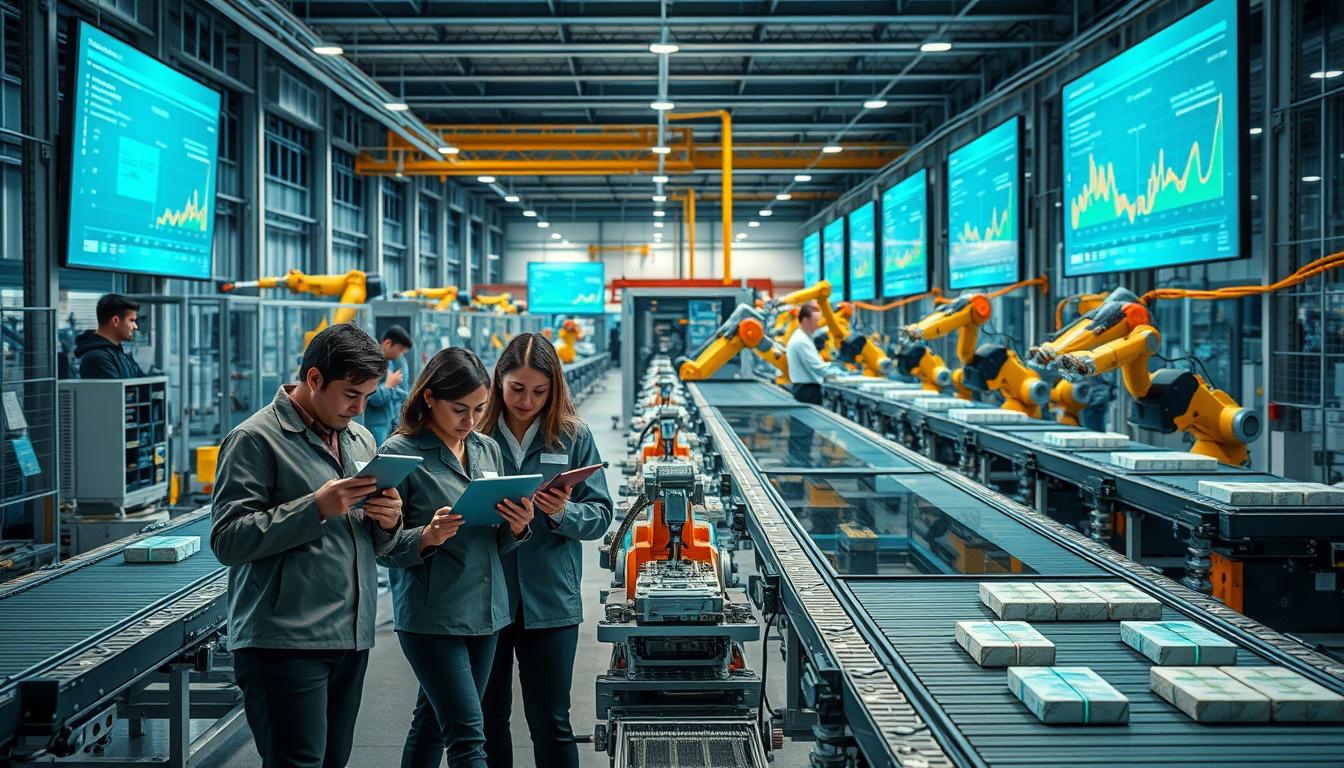
Modern Smart Manufacturing Factory with robotic arms and digital interfaces

What is Smart Manufacturing and Why Does It Matter?

Smart manufacturing represents the seamless integration of advanced technologies with manufacturing processes to create highly efficient, connected, and adaptive production systems. At its core, it’s about leveraging data, automation, and intelligent systems to optimize every aspect of the manufacturing process.

In the context of Industry 4.0, smart manufacturing factories serve as the physical manifestation of the fourth industrial revolution. Unlike traditional manufacturing facilities that operate in relatively isolated environments with limited connectivity, smart factories function as interconnected ecosystems where machines, systems, and humans communicate and collaborate in real-time.

The significance of smart manufacturing extends beyond mere technological advancement. It represents a fundamental shift in how products are conceived, designed, produced, and delivered to customers. This transformation is driven by the need to address several pressing challenges facing the manufacturing sector:

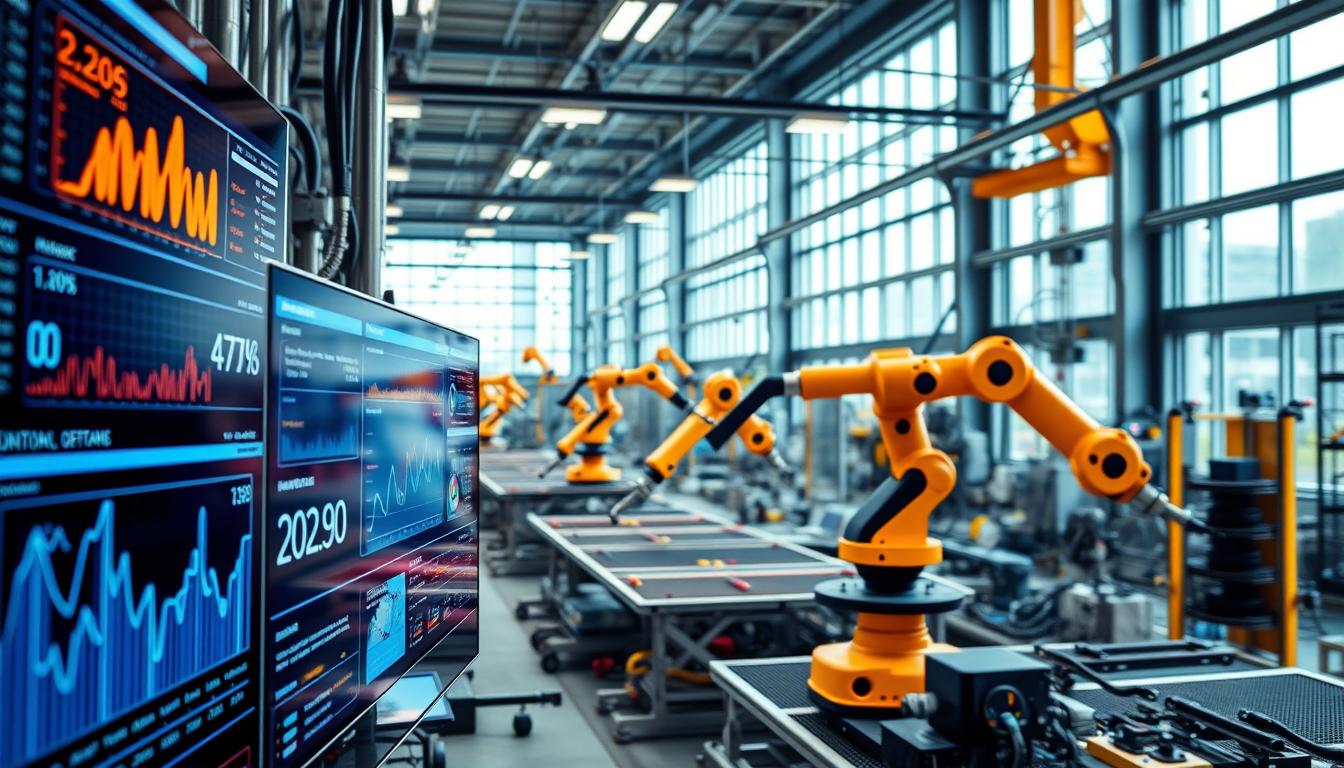
Digital twin visualization of a Smart Manufacturing Factory

Global Competition

Manufacturers face intense pressure to reduce costs while improving quality and speed to market. Smart manufacturing provides the tools to achieve these seemingly contradictory goals simultaneously.

Customer Expectations

Today’s customers demand greater customization, faster delivery, and higher quality at competitive prices. Smart factories enable the flexibility to meet these diverse requirements efficiently.

Workforce Challenges

With skilled labor shortages affecting many regions, smart manufacturing technologies help maximize workforce productivity and create new roles that attract digital talent.

Key Technologies Enabling Smart Manufacturing Factories

The transformation to smart manufacturing is powered by a suite of complementary technologies that work together to create intelligent, connected production environments. Understanding these core technologies is essential for any manufacturer looking to embark on their smart factory journey.

Integration of key technologies in a Smart Manufacturing Factory

Internet of Things (IoT)

IoT forms the foundation of smart manufacturing by connecting machines, products, and systems through networks of sensors that collect and exchange data. These sensors monitor everything from equipment performance and environmental conditions to product quality and inventory levels.

According to Deloitte’s 2025 Smart Manufacturing Survey, 46% of manufacturers are already leveraging industrial IoT solutions, with an additional 27% planning to invest in IIoT within the next 24 months.

Artificial Intelligence and Machine Learning

AI and machine learning algorithms analyze the vast amounts of data generated in smart factories to identify patterns, predict outcomes, and optimize processes. These technologies enable predictive maintenance, quality control, and autonomous decision-making.

The implementation of AI in manufacturing is growing steadily, with 29% of manufacturers using AI/ML at the facility level and 24% deploying generative AI, according to recent industry surveys.

Robotics and Automation

Advanced robotics, including collaborative robots (cobots) that work alongside humans, automate repetitive, dangerous, or precision-requiring tasks. Modern robots are increasingly flexible, able to be reprogrammed quickly to handle different products or processes.

Physical automation ranks as a top investment priority for 37% of manufacturers in the next two years, highlighting its critical role in smart factory implementations.

Cloud Computing

Cloud platforms provide the scalable computing power and storage needed to process the enormous volumes of data generated in smart factories. They also enable remote monitoring, management, and collaboration across global manufacturing networks.

Currently, 57% of manufacturers are using cloud computing, with an additional 29% planning to invest in cloud technologies within the next 24 months.

Big Data Analytics

Advanced analytics tools transform raw data into actionable insights that drive continuous improvement. From real-time dashboards to complex simulation models, these tools help manufacturers optimize everything from equipment performance to supply chain logistics.

Data analytics is being leveraged by 57% of manufacturers, with 40% ranking it as their first or second highest priority for investment in the coming years.

Digital Twins

Digital twins create virtual replicas of physical assets, processes, or entire factories. These digital models enable simulation, testing, and optimization in a virtual environment before implementation in the real world, reducing risk and accelerating innovation.

The digital twin technology is increasingly being adopted for planning, startup, and ongoing optimization of automated systems, providing significant time and cost savings.

Augmented Reality (AR)

AR overlays digital information onto the physical environment, assisting workers with complex assembly, maintenance, and quality inspection tasks. AR can display step-by-step instructions, highlight components, and provide real-time feedback to improve accuracy and efficiency.

5G Connectivity

The high-speed, low-latency capabilities of 5G networks enable real-time communication between machines, systems, and humans. This is particularly important for applications requiring immediate response, such as autonomous vehicles or collaborative robotics.

Approximately 42% of manufacturers are already leveraging 5G technology to enhance connectivity in their smart factory implementations.

Cybersecurity

As manufacturing becomes more connected, robust cybersecurity measures are essential to protect sensitive data, intellectual property, and operational technology from threats. This includes network security, access controls, encryption, and continuous monitoring.

Manufacturers are dedicating an average of 15.74% of their IT budget to cybersecurity, recognizing its critical importance in smart factory environments.

Benefits of Implementing Smart Manufacturing Systems

The transition to smart manufacturing delivers numerous advantages that directly impact a company’s bottom line, operational efficiency, and competitive positioning. Understanding these benefits helps build the business case for investment in smart factory technologies.

Workers collaborating with robots in a Smart Manufacturing Factory

Key Benefits of Smart Manufacturing

  • Increased Operational Efficiency: Smart factories report 10-20% improvement in production output and 7-20% improvement in employee productivity through optimized processes and reduced downtime.
  • Enhanced Product Quality: Real-time monitoring and AI-driven quality control reduce defects, with some implementations achieving defect rates as low as 0.0012%.
  • Production Flexibility: Rapid reconfiguration of production lines enables manufacturers to quickly adapt to changing market demands and produce customized products efficiently.
  • Reduced Costs: Predictive maintenance reduces unplanned downtime by up to 50%, while optimized processes minimize waste, energy consumption, and labor costs.
  • Improved Decision-Making: Data-driven insights enable faster, more informed decisions at all levels of the organization, from the shop floor to the executive suite.
  • Enhanced Worker Safety: Automation of dangerous tasks and real-time monitoring of environmental conditions create safer working environments.
  • Sustainability: Optimized resource utilization and reduced waste contribute to more environmentally sustainable manufacturing operations.

“The magic word for the future is ‘demand-driven production’. Today more than ever, consumers want their goods to be customized according to their wishes, which is why items are now mainly produced as needed. In order to supply these new production lines, dynamic systems are needed with stronger integration and interconnection between production and logistics.”

Christian Brauneis, Vice President KNAPP Industry Solutions
4.5
 
Overall Impact
Productivity Improvement
 
4.5/5
Quality Enhancement
 
4.7/5
Cost Reduction
 
4.3/5
Time-to-Market
 
4.1/5
Workforce Satisfaction
 
4.0/5

Ready to Start Your Smart Manufacturing Journey?

Download our comprehensive implementation guide to learn the step-by-step process for transforming your manufacturing operations.


Real-World Examples of Successful Smart Factory Implementations

Examining successful smart manufacturing implementations provides valuable insights into best practices, challenges, and potential outcomes. These case studies demonstrate how companies across various industries have leveraged smart factory technologies to achieve tangible business results.

Automated production line in a Smart Manufacturing Factory

Siemens Amberg Electronics Plant

Siemens’ Amberg facility represents one of the most advanced smart factories in operation today. By integrating physical manufacturing with digital technologies, Siemens has achieved remarkable results:

  • 99.9988% production quality (defect rate of just 0.0012%)
  • 8x increase in production volume without significant expansion
  • Production of 15 million Simatic products annually
  • Capability to manufacture over 1,000 different product variants

Key to their success has been the integration of real and virtual worlds, direct communication between products and machines, and sophisticated IT systems that optimize all production processes.

Bosch Homburg Plant

Bosch’s factory in Homburg, Germany, transformed its hydraulic valve production line through Industry 4.0 solutions to improve efficiency while maintaining flexibility. Their implementation included:

  • Autonomous intelligent workstations capable of quick product switching
  • Active Assist assembly technology with pick-to-light systems
  • RFID integration for real-time component tracking
  • Customized worker assistance based on qualification level

The results were impressive: setup time reduction from 450 seconds to zero, inventory days halved, 8% decrease in cycle times, and €500,000 in cost savings in the first year alone.

L3Harris Technologies

L3Harris Technologies established a Smart Manufacturing Cell at their Rochester, NY facility to meet increased customer demand for tactical radios. Their implementation featured:

  • Augmented reality for real-time work instructions
  • Common Industry 4.0 platform integrating vision inspection and precision tools
  • Line-agnostic stations capable of building different products
  • Comprehensive data collection and analysis systems

The results included the ability to run three product lines simultaneously with increased efficiency, reduced non-value-added time, improved cognitive ergonomics, and better space utilization and safety.

Company Industry Key Technologies Primary Benefits ROI Timeframe
Siemens Electronics Digital twins, automation, IoT Quality improvement, production volume increase 2-3 years
Bosch Automotive components RFID, pick-to-light, worker assistance Setup time reduction, inventory optimization 1 year
L3Harris Defense electronics Augmented reality, vision inspection, data analytics Efficiency, flexibility, quality control 1-2 years
Magna Automotive Automation, intelligent software Faster parts availability, reduced internal transport 2 years
Fronius Welding equipment Autonomous mobile robots Automated production supply, flexible transport 1-2 years

Challenges and Considerations for Adopting Smart Manufacturing

While the benefits of smart manufacturing are compelling, the transformation journey presents several challenges that manufacturers must address to ensure successful implementation. Understanding these challenges helps organizations develop effective strategies to overcome them.

Team planning a Smart Manufacturing Factory implementation

Implementation Challenges

  • High Initial Investment: Smart manufacturing technologies require significant capital expenditure, with 78% of manufacturers allocating more than 20% of their improvement budget to these initiatives.
  • Integration Complexity: Connecting legacy systems with new technologies creates technical challenges, particularly in older facilities with limited digital infrastructure.
  • Workforce Skills Gap: There’s a significant shortage of talent with the necessary digital skills, with 48% of manufacturers reporting moderate to significant challenges in filling production and operations management roles.
  • Cybersecurity Risks: Increased connectivity exposes manufacturing systems to potential cyber threats, with 55% of manufacturers citing unauthorized access as a high concern.
  • Change Management: Transitioning to new ways of working requires careful change management to overcome resistance and ensure adoption.

Strategic Considerations

  • Phased Implementation: Rather than attempting a complete transformation at once, successful manufacturers typically adopt a staged approach, starting with high-impact, lower-risk initiatives.
  • Clear Business Case: Each smart manufacturing investment should be tied to specific business outcomes with measurable KPIs to ensure ROI.
  • Data Strategy: A comprehensive data strategy addressing collection, storage, analysis, and governance is essential for extracting value from smart manufacturing technologies.
  • Talent Development: Building internal capabilities through training and recruitment is critical, with 53% of manufacturers using in-house training for executives and 43% leveraging vendor-provided training.
  • Ecosystem Partnerships: Collaborating with technology providers, consultants, and academic institutions can accelerate implementation and provide access to specialized expertise.

Key Risk Mitigation Strategies

According to Deloitte’s 2025 Smart Manufacturing Survey, manufacturers are taking several approaches to mitigate risks associated with smart factory implementations:

  • 68% performed a cybersecurity risk or maturity assessment of their smart manufacturing technology stack in the last year
  • 72-74% conduct internal and external penetration testing and vulnerability assessments
  • 52% have developed a central team or working group tasked with researching, developing, and deploying smart manufacturing initiatives
  • 45% have developed a process to communicate to employees and customers the implications of smart manufacturing
  • 44% have established a smart manufacturing center of excellence

Practical Steps for Manufacturers to Begin Their Smart Factory Transformation

Transforming traditional manufacturing operations into smart factories is a journey that requires careful planning, strategic investments, and organizational alignment. The following roadmap provides practical guidance for manufacturers at any stage of their smart manufacturing journey.

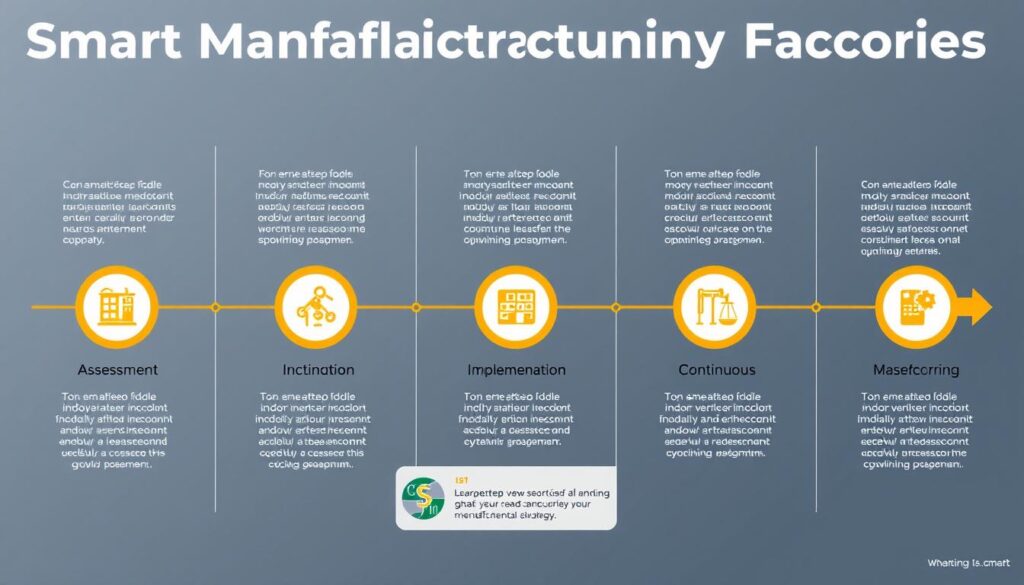
Step-by-step implementation roadmap for Smart Manufacturing Factories

Phase 1: Assessment and Strategy Development

  • Evaluate Current State
    Conduct a comprehensive assessment of existing manufacturing operations, technology infrastructure, data capabilities, and workforce skills. Identify pain points, inefficiencies, and opportunities for improvement.
  • Define Clear Objectives
    Establish specific, measurable goals for your smart manufacturing initiative, such as reducing downtime by 30%, improving quality by 25%, or increasing throughput by 15%. These objectives should align with broader business strategies.
  • Develop a Technology Roadmap
    Create a phased implementation plan that prioritizes technologies based on potential impact, implementation complexity, and alignment with business objectives. Start with foundational capabilities like connectivity and data collection before moving to more advanced applications.
  • Build the Business Case
    Develop a detailed business case that quantifies the expected benefits, costs, and ROI of your smart manufacturing initiative. This should include both tangible benefits (cost savings, productivity improvements) and intangible benefits (enhanced agility, improved safety).
  • Secure Leadership Commitment
    Gain executive sponsorship by demonstrating how smart manufacturing aligns with strategic priorities. Ensure leaders understand the transformational nature of the initiative and are prepared to provide sustained support.

Phase 2: Foundation Building

  • Establish Connectivity Infrastructure
    Implement the necessary network infrastructure to connect machines, sensors, and systems. This may include upgrading to industrial Ethernet, implementing wireless networks, and establishing edge computing capabilities.
  • Implement Data Collection and Management
    Deploy sensors and data collection systems to capture information from manufacturing processes. Establish data management practices including storage, governance, and quality control.
  • Develop Analytics Capabilities
    Build the capability to analyze manufacturing data for insights. Start with basic descriptive analytics before progressing to more advanced predictive and prescriptive approaches.
  • Address Cybersecurity
    Implement robust cybersecurity measures to protect connected manufacturing systems from threats. This should include network segmentation, access controls, encryption, and continuous monitoring.
  • Develop the Workforce
    Invest in training programs to equip employees with the skills needed for smart manufacturing. This may include technical skills (data analysis, automation programming) and soft skills (digital literacy, problem-solving).

Phase 3: Implementation and Scaling

  • Start with Pilot Projects
    Implement small-scale pilot projects to test technologies, processes, and approaches. Focus on high-impact areas with clear success metrics and use these pilots to demonstrate value and learn lessons for broader deployment.
  • Implement Core Technologies
    Based on your roadmap and pilot results, implement the core technologies that will drive your smart manufacturing transformation. This may include production execution systems, quality management systems, and automation solutions.
  • Integrate Systems and Data
    Connect previously siloed systems to enable seamless data flow and process coordination. This may involve implementing middleware, APIs, or industrial IoT platforms to facilitate integration.
  • Scale Successful Solutions
    Expand successful pilot implementations across additional production lines, facilities, or business units. Apply lessons learned from pilots to improve implementation approaches and outcomes.
  • Manage Change Effectively
    Implement a structured change management program to help employees adapt to new technologies and ways of working. This should include communication, training, and mechanisms to address concerns and resistance.

Phase 4: Continuous Improvement and Innovation

  • Monitor and Measure Performance
    Establish dashboards and reporting mechanisms to track key performance indicators and the impact of smart manufacturing initiatives. Use this data to identify areas for further improvement.
  • Foster a Culture of Innovation
    Encourage experimentation and continuous improvement by establishing mechanisms for employees to suggest and implement new ideas. Recognize and reward innovative contributions to the smart manufacturing journey.
  • Stay Current with Technology Trends
    Continuously monitor emerging technologies and industry best practices. Evaluate new solutions for potential implementation as they mature and align with business needs.
  • Expand Ecosystem Partnerships
    Develop relationships with technology providers, research institutions, and industry consortia to access expertise, share knowledge, and collaborate on innovation initiatives.

Implementation Success Factors

Research and experience from successful smart manufacturing implementations highlight several critical success factors:

  • Cross-functional collaboration: Involve stakeholders from operations, IT, engineering, and business units in planning and implementation
  • Data-driven decision making: Base investment and implementation decisions on data and measurable outcomes
  • Agile approach: Use iterative implementation methods that allow for learning and adjustment
  • Focus on people: Recognize that successful transformation depends as much on people and processes as on technology
  • Long-term commitment: Maintain focus and investment over time, recognizing that transformation is a journey rather than a destination

Conclusion: The Future of Manufacturing is Smart

Smart Manufacturing Factories represent not just an evolution in production technology but a fundamental reimagining of how products are conceived, designed, manufactured, and delivered. By integrating digital technologies with physical processes, manufacturers can achieve unprecedented levels of efficiency, quality, and responsiveness.

The journey to smart manufacturing is challenging but essential for manufacturers who wish to remain competitive in an increasingly digital world. Those who successfully navigate this transformation will be rewarded with significant advantages: lower costs, higher quality, greater agility, and the ability to create innovative products and business models that were previously impossible.

As we look to the future, the convergence of technologies like AI, IoT, robotics, and advanced analytics will continue to expand the possibilities of smart manufacturing. The most successful manufacturers will be those who view smart manufacturing not as a one-time technology implementation but as an ongoing journey of continuous improvement and innovation.

Future vision of integrated Smart Manufacturing Factories ecosystem

Ready to Transform Your Manufacturing Operations?

Our team of smart manufacturing experts can help you develop a customized roadmap for your digital transformation journey. Schedule a consultation to discuss your specific challenges and opportunities.

Schedule a Smart Manufacturing Consultation

Frequently Asked Questions About Smart Manufacturing Factories

What is the difference between a traditional factory and a smart factory?

Traditional factories operate with limited connectivity between machines and systems, rely heavily on manual processes and decision-making, and have minimal real-time visibility into operations. In contrast, smart factories feature comprehensive connectivity across all systems, utilize data and analytics for automated decision-making, implement advanced automation and robotics, and enable real-time monitoring and optimization of all processes. Smart factories are also characterized by their ability to adapt quickly to changing requirements and self-optimize their operations.

How much does it cost to implement a smart manufacturing system?

The cost of implementing smart manufacturing varies widely depending on the scope, existing infrastructure, and specific technologies deployed. Small-scale pilots might start at ,000-0,000, while comprehensive factory-wide transformations can require investments of millions of dollars. According to industry surveys, 78% of manufacturers allocate more than 20% of their overall improvement budget toward smart manufacturing initiatives. Rather than viewing this as a one-time capital expense, it’s more accurate to consider it an ongoing investment with returns realized through improved efficiency, quality, and agility over time.

How long does it take to implement a smart factory transformation?

Smart manufacturing is best viewed as a journey rather than a destination. Initial pilots can be implemented in 3-6 months, while more comprehensive transformations typically unfold over 2-5 years. Many manufacturers adopt a phased approach, starting with foundational capabilities like connectivity and data collection before progressing to more advanced applications. The timeline depends on factors including organizational readiness, existing infrastructure, available resources, and the complexity of manufacturing processes.

What skills are needed for smart manufacturing implementation?

Successful smart manufacturing requires a blend of traditional manufacturing expertise and digital skills. Key capabilities include data science and analytics, automation engineering, cybersecurity, systems integration, IoT implementation, and change management. Many manufacturers develop these capabilities through a combination of hiring, training existing employees, and partnering with external experts. According to recent surveys, 48% of manufacturers report moderate to significant challenges in filling production and operations management roles with the necessary digital skills.

How do smart factories impact the workforce?

Smart factories transform workforce requirements rather than simply reducing headcount. While some routine tasks may be automated, new roles emerge in areas such as data analysis, automation engineering, and systems integration. Workers often shift from manual tasks to monitoring, programming, and optimizing automated systems. This transition requires significant investment in training and skill development. According to industry research, 85% of manufacturers believe smart manufacturing initiatives will attract new talent to the industry by creating more engaging, technology-focused roles.

IoT Enable Smart Manufacturing Factories

The industrial landscape is undergoing a profound transformation. Traditional production facilities are evolving into intelligent, interconnected ecosystems as manufacturers deploy data-driven technologies to stay competitive in a volatile global economy.

IoT enabled smart manufacturing factory

According to a Deloitte survey, 92% of executives at large manufacturing companies view digital transformation as a primary driver of competitiveness, and 85% expect it to fundamentally change how products are made (source: Deloitte Industry 4.0 survey).1 These figures reflect widespread industry commitment to smart manufacturing and investment in connected systems.

When factories combine sensors, cloud analytics, and automation, they unlock measurable gains: improved production output, higher product quality, and greater operational efficiency. For example, several manufacturers report production output increases in the 10–20% range after deploying integrated IoT and analytics stacks (see industry case studies).2

This guide explains how IoT and related technologies form the foundation for Smart Manufacturing Factories. We will walk through core components, practical use cases, and the steps manufacturers take to move from pilot projects to scaled production.

Key Takeaways

  • Smart manufacturing is widely recognized as essential for future competitiveness.
  • Intelligent, interconnected systems are replacing traditional production methods.
  • Companies are achieving significant improvements in output and productivity.
  • This transformation represents a fundamental shift in how products are designed and produced.
  • Real-time data-driven decision-making is central to operational excellence.
  • Connected factories enable faster responses to market demand while supporting sustainability goals.

See the section “How Iottive Pvt. Ltd. Supports End-to-End IoT Productization” near the conclusion for a practical partner example on product design, hardware, firmware, apps, testing, and commercialization support.

Next: we examine the core building blocks of IIoT systems and how they deliver operational intelligence across the factory floor.

Exploring the Future of IoT-Enabled Manufacturing

The blueprint for next-generation industrial operations is built on interconnected networks of intelligent devices. This foundation—commonly called the Industrial Internet of Things (IIoT)—creates a continuous stream of operational intelligence that drives smarter, faster decisions across the factory floor.

IoT enabled modern production ecosystem

In practice, the internet of things connects equipment sensors, vision cameras, actuators, and robots with edge and cloud compute. Where available, high-bandwidth options such as private 5G or industrial Wi‑Fi increase throughput and lower latency, enabling more real-time controls and richer telemetry for analytics.

Defining IoT in Modern Production

IIoT integrates people, machines, and systems into a cohesive digital framework. Operational intelligence here means the continuous ingestion and interpretation of sensor and process data to support automated responses and human decisions. Typical flows look like: vibration sensor → edge pre-processing → anomaly detected → cloud model predicts failure → maintenance ticket created.

Typical IIoT stack (high-level):

  • Edge devices and sensors (temperature, vibration, vision)
  • Connectivity layer (Ethernet, private 5G, Wi‑Fi, LPWAN)
  • Edge compute and gateways (local preprocessing, ML inferencing)
  • Cloud platforms and data lakes (storage, model training, orchestration)
  • Applications and dashboards (operator HMIs, executive analytics, mobile apps)

With this stack in place, real-time data flows drive predictive models and closed-loop controls. Facilities gain visibility into equipment performance, material flows, and product quality—information that directly improves production efficiency and reduces operating costs when teams act on the insights.

See how an IIoT stack is implemented in practice in the section “How Iottive Pvt. Ltd. Supports End-to-End IoT Productization” for an example workflow and toolchain.

Industry Trends and Developments in Smart Manufacturing

Contemporary production environments face a complex mix of market, regulatory, and economic pressures. Demand for personalized products and stricter environmental standards are reshaping how manufacturers design production systems and source materials.

industry trends and developments in manufacturing

Companies that embrace smart manufacturing technologies can shift from mass-produced, identical runs to more flexible, small-batch and customized production while maintaining cost discipline.

Evolving Market Demands and Sustainability

Mass production is giving way to customization: consumers increasingly expect unique products and faster delivery. This trend pushes manufacturers to adopt agile production techniques and modular systems that support frequent changeovers and short product runs.

Sustainability has moved from a nice-to-have to a business requirement. Regulations such as the EU Green Deal and retailer sustainability commitments are forcing manufacturers to report emissions and material provenance. IoT-driven energy monitoring and process optimization are proven solutions: connected sensors and analytics can cut energy use and waste, helping companies meet regulatory targets and deliver measurable environmental benefits.

Impact of Global Economic Factors

At the same time, global instability—geopolitical tensions, commodity shortages, and logistics disruptions—creates pressure on traditional supply models. The modern supply chain is more exposed to shocks, which increases the need for visibility and flexibility.

Manufacturers face several interrelated issues:

  • Fragile international logistics networks that extend lead times
  • Shortages of skilled labor in specialized production roles
  • Rising cost pressures from materials and transportation

Adopting advanced technologies and data-driven solutions is the practical path to resilience. Smart factories that combine sensors, analytics, and flexible automation can better anticipate supply disruptions, optimize resource use, and maintain consistent product quality—delivering both operational benefits and stronger market positioning.

Core Technologies Driving Smart Factories

Modern smart manufacturing relies on an integrated stack of data-first technologies that work together to deliver operational intelligence and continuous improvement. When combined correctly, these solutions give manufacturers the visibility and control needed to optimize production, reduce waste, and scale across sites.

Big Data, Cloud Integration, and the Internet of Things

Big data platforms ingest large volumes of time-series and event data from machines, sensors, and production systems to reveal patterns missed by manual analysis. Cloud computing supplies elastic storage and compute capacity for model training, cross-site analytics, and centralized dashboards—capabilities that are especially valuable for multi-site manufacturing operations.

IoT networks link sensors and devices across the factory: temperature, vibration, and current sensors provide equipment telemetry; vision systems capture quality data; and PLC/robot interfaces report process states. Edge gateways perform local filtering and preprocessing so only relevant telemetry and anomalies are sent to the cloud for deeper analysis and long-term storage.

core technologies for smart factories

Recommended high-level architecture: edge devices → connectivity (Ethernet, private 5G, industrial Wi‑Fi) → edge compute/gateways → cloud data & analytics → apps & dashboards. Each layer has distinct implementation and cost drivers—sensors and gateways are hardware-focused; cloud and analytics demand software and data engineering expertise.

Digital Twins and Advanced Sensor Systems

Digital twins are virtual models that mirror physical production assets, lines, or entire plants. Use cases include layout optimization, throughput simulation, scenario testing (e.g., change in product mix), and “what-if” analyses to validate process changes before applying them on the shop floor. Digital twins improve confidence in change management and reduce commissioning time for new lines.

Advanced sensor suites—especially machine vision combined with edge inferencing—enable automated quality inspection and near real-time defect detection. While no system guarantees absolute zero defects, vision plus ML-based analytics helps manufacturers approach zero-defect targets by catching subtle anomalies earlier than human inspection alone.

Sensor data feeds cloud-based analytics that retrain and refine digital twin models, creating a closed-loop improvement cycle: sensors → analytics → updated models → control or operator guidance. This synergy progressively increases throughput and product quality while reducing downtime.

Implementation Notes

  • Maturity & priorities: start with high-value use cases (predictive maintenance, quality inspection) before committing to full-scale digital twins.
  • Cost drivers: sensors, wiring, gateways, edge compute, cloud storage, and custom analytics development—budget for integration and change management.
  • Vendors & partners: expect to combine hardware suppliers, connectivity providers, cloud platforms, and system integrators; choose partners with manufacturing domain expertise.

Practical tip: include a short pilot that integrates sensors, an edge gateway, and a basic analytics dashboard to prove value before scaling. For help with digital twin modeling, sensor integration, and hardware-software co-design, see the section “How Iottive Pvt. Ltd. Supports End-to-End IoT Productization” later in this guide.

Enhancing Production through Automation and Robotics

Automation has shifted from a desirable upgrade to a strategic requirement for competitive manufacturing. Recent industry surveys show a strong focus on both process and physical automation investments, as companies prioritize faster cycle times, consistent product quality, and lower operational costs.

Automated Storage Systems and Material Handling

Automated storage and retrieval systems (AS/RS), conveyor automation, and robotic picking/packing form the backbone of modern material handling. These centralized systems manage inventory with precision and speed, reduce manual errors, and shorten lead times between storage and production.

Typical benefits include reduced throughput time, lower labor costs for repetitive tasks, and improved inventory accuracy—many adopters report measurable ROI within 12–36 months depending on scale and complexity.

automation and robotics in production

Autonomous Mobile Robots in Action

Autonomous mobile robots (AMRs) and automated guided vehicles (AGVs) handle repetitive material transport tasks with accuracy while requiring minimal fixed infrastructure. Their route flexibility allows factories to reconfigure production lines faster than with fixed conveyors.

For example, in mixed-model production environments, AMRs enable shorter changeover times and smoother flows to assembly stations—helping maintain consistent production rates when product mixes change.

Integrating automation and robotics creates a more efficient material-flow ecosystem. Companies that combine AS/RS, AMRs, and process automation commonly see meaningful reductions in cycle times and operational costs, while freeing human workers to focus on higher-value activities such as quality control, supervision, and continuous improvement.

Human + Robot: Workforce Transition

Automation doesn’t replace workers so much as shift their roles. Manufacturers should plan upskilling programs focused on systems operation, robot supervision, basic programming, and maintenance. A successful transition includes defined career paths, hands-on training, and collaboration between engineering and HR to retain institutional knowledge.

AI and Machine Learning in Optimizing Manufacturing Processes

Advanced computational capabilities are turning traditional manufacturing methods into predictive, self-improving systems. Artificial intelligence (AI) and machine learning (ML) form the cognitive core of modern production environments, using operational data to detect patterns, forecast outcomes, and recommend corrective actions faster than manual analysis.

AI and machine learning in manufacturing processes

Machine learning models apply statistical and computational techniques to sensor and process data to identify subtle correlations that humans might miss. When deployed at the edge or in the cloud, these models enable real-time insights and automated interventions that improve uptime, product quality, and throughput.

Predictive Maintenance Strategies

Predictive maintenance uses ML to analyze equipment sensor data (vibration, temperature, current) and historical failure records to forecast when machines will need service. By scheduling maintenance during planned windows, manufacturers can significantly reduce unplanned stoppages and extend asset lifetimes.

Typical KPIs for predictive maintenance pilots:

  • Mean Time Between Failures (MTBF)
  • Mean Time To Repair (MTTR)
  • Reduction in unplanned downtime (targeted %)
  • Maintenance cost per asset

Industry reports commonly cite unplanned downtime reductions in the tens of percent after mature predictive programs—actual results vary by asset criticality and data quality. Implementation decisions (edge inferencing vs. cloud scoring) depend on latency requirements and bandwidth constraints.

Quality Assurance and Process Optimization

Computer vision and ML-driven analytics automate quality inspection, spotting defects and deviations that are difficult for human inspectors to detect consistently. ML continuously analyzes production data to surface root causes, enabling rapid corrective actions that improve product quality.

Process optimization uses AI to model complex relationships among temperature, speed, humidity, and other parameters to find operating settings that maximize throughput while maintaining product quality. These models can run in simulation or as live controllers to tune setpoints dynamically.

Selecting and Running an ML Use Case

Practical guidance for starting an ML initiative:

  • Choose a high-value, well-scoped use case (e.g., gearbox vibration prediction, visual defect detection of critical surfaces).
  • Assess data readiness: sensor density, historical logs, labeling effort required.
  • Run a short pilot (6–12 weeks) with clear success metrics: precision/recall for detection models, % downtime reduction for maintenance pilots.
  • Plan model lifecycle: retraining cadence, monitoring for drift, and integration with maintenance or MES systems.

Implementation caveats: ML success depends on data quality and representative labeling; latency-sensitive use cases often require edge ML, while broader analytics and retraining workflows fit cloud platforms. For organizations that need an ML readiness assessment or help designing pilots, consider evaluating partner services that combine data engineering, domain expertise, and deployment experience.

Smart Manufacturing Factories: Improving Efficiency and Flexibility

Operational excellence today depends on integrating digital technologies that boost productivity while preserving the flexibility to respond to changing demand. Smart manufacturing systems deliver measurable improvements across throughput, workforce productivity, and capacity utilization when deployed with clear objectives and governance.

Industry reports and case studies consistently document gains after successful pilots and rollouts. Typical improvement ranges observed across multiple implementations include:

Performance MetricImprovement RangePrimary Benefit
Production Output 10% to 20% Increased capacity
Employee Productivity 7% to 20% Optimized workflows
Unlocked Capacity 10% to 15% Better resource use

How these metrics are typically measured:

  • Production output: units produced per shift or hourly throughput compared to baseline.
  • Employee productivity: output per labor hour, factoring out product mix changes.
  • Unlocked capacity: percent increase in available capacity without additional capital equipment.

“Nearly half of industry leaders prioritize operational benefits as their primary value driver when implementing advanced production technologies.”

Smart factories achieve reduced error rates through predictive maintenance, automated quality inspection, and closed-loop setpoint management. For example, combining machine vision with analytics often reduces escape rate of defects and decreases rework costs. Cost reductions also come from demand-driven procurement that lowers inventory carrying costs and shorter cycle times that reduce work-in-progress.

Before / After: A Mini Case

In a mixed-model assembly line pilot, a manufacturer combined targeted sensorization and a lightweight analytics dashboard. Within six months they reported a 12% increase in hourly throughput and a 15% reduction in rework—improvements driven by faster anomaly detection and quicker operator response.

Buyer Checklist: Pilot to Scale

  • Define clear success metrics (throughput, defect rate, ROI timeframe).
  • Scope a narrow pilot with measurable KPIs and a defined timeline (3–6 months).
  • Ensure data collection and quality before modeling or ML work begins.
  • Plan integration points with MES/ERP and maintenance systems.
  • Prepare an upskilling roadmap for operators and maintenance teams.

Workforce impact: automation removes repetitive tasks and shifts employees toward system operation, quality oversight, and continuous improvement. Upskilling programs should include hands-on training in HMI operation, basic troubleshooting, and data-driven decision-making.

For organizations seeking implementation support, a partner with both manufacturing domain expertise and systems integration capabilities can help design pilots, measure impact, and scale successful projects. See the section later in this guide, “How Iottive Pvt. Ltd. Supports End-to-End IoT Productization,” for an example of a partner-led approach to piloting and scaling smart manufacturing solutions.

Leveraging Data Analytics for Informed Decision Making

The strategic value of operational data has made analytics a top investment area for many manufacturers. Research indicates a growing share of companies prioritize analytics within near-term planning cycles as they recognize that connected systems generate high-velocity data streams that require advanced interpretation to deliver business value.

Without an analytics capability, large volumes of sensor and process data remain underused; with analytics, organizations convert raw telemetry into prescriptive actions that improve uptime, product quality, and supply responsiveness.

Real-Time Data Integration and Analysis

Modern data platforms ingest operational information from equipment sensors, vision systems, quality monitors, and material handling devices into unified repositories. A recommended ingestion architecture includes edge buffering and preprocessing, streaming pipelines (e.g., Kafka), time-series databases for telemetry, and cloud storage for historical analysis and model training.

Advanced analysis applies statistical methods, rule-based engines, and machine learning to detect anomalies, predict failures, and identify process optimization opportunities. These capabilities enable predictive maintenance and faster quality issue resolution by surfacing insights to operators and triggering automated workflows.

Typical analytics maturity steps for manufacturers:

  1. Collect: instrument the right sensors and ensure reliable data capture at the edge.
  2. Clean: establish data quality rules, standardize timestamps, and normalize units.
  3. Analyze: apply dashboards, statistical monitoring, and ML models to detect patterns.
  4. Operationalize: integrate insights into MES/ERP, create alerts, and automate corrective actions.

Suggested KPIs and dashboards:

  • Operator view: real-time alarms, asset health score, current throughput, immediate corrective steps.
  • Supervisor view: shift performance, defect rates by line, mean time to detect.
  • Executive view: overall equipment effectiveness (OEE), yield, and supply chain lead-time variance.

Data Governance and Practical Considerations

Define ownership for data sources, retention policies, and data quality SLAs before scaling analytics. Address compliance (local data laws) and cybersecurity controls for telemetry and cloud storage. Choose edge vs. cloud processing based on latency, bandwidth, and cost—edge for millisecond responses, cloud for heavy model training and cross-site correlation.

Micro-case idea: a pilot that layered an anomaly-detection model on top of vibration telemetry reduced average time-to-detect bearing issues from days to hours, allowing scheduled maintenance and preventing line stoppages. Track success with concrete metrics such as mean time to detect, false-positive rate, and % reduction in downtime.

For manufacturers seeking a practical analytics roadmap or a partner to run a pilot, consider vendors and systems integrators with combined experience in industrial data ingestion, cloud computing, and applied analytics solutions.

Addressing Challenges and Ensuring Cybersecurity in Manufacturing

Digital transformation delivers major benefits, but manufacturers must navigate significant challenges to realize them safely. Operational risks — including business disruption from system failures or cyber incidents — top the list of concerns for many organizations, so risk-aware planning is essential before scaling IIoT projects.

Survey figures cited throughout the industry highlight these worries; when using such statistics in the final article, cite the original source and date to provide context for regional or sector differences.

Risk Management and Compliance in Digital Environments

In highly connected factories, cybersecurity and risk management are central to maintaining continuous operations and protecting intellectual property. Increased connectivity increases the attack surface across OT and IT environments, so manufacturers must adopt a defense-in-depth posture.

Practical cybersecurity checklist for manufacturers:

  • Network segmentation and OT/IT isolation to limit lateral movement.
  • Strong identity and access management (least privilege, MFA for critical systems).
  • Encrypted communications for telemetry and remote access.
  • Regular patching and coordinated vulnerability management for both IT and OT assets.
  • Endpoint detection, monitoring, and anomaly detection tuned for industrial protocols.
  • Incident response plan and table-top exercises that include operations and engineering teams.

Recommended compliance frameworks and standards to reference: NIST Cybersecurity Framework, IEC 62443 for industrial control systems, and ISO 27001 for information security management. Start with a gap analysis against one of these standards, then prioritize mitigations that reduce operational risk quickly.

Security ConcernPercentage ConcernedPrimary Impact
Unauthorized Access 55% System compromise
Intellectual Property Theft 47% Competitive disadvantage
Operational Disruption 46% Production stoppages

Workforce Upskilling and Talent Retention

Workforce issues are another major barrier to Industry 4.0 adoption. Manufacturers often lack personnel with combined skills in OT, IT, data analytics, and process engineering. Addressing this requires a structured upskilling program and partnerships that extend internal capabilities.

Practical action plan for workforce readiness:

  • Map job families and identify new roles (data engineer, edge compute technician, ML ops for manufacturing).
  • Create reskilling pathways with short courses, on-the-job training, and vendor-led workshops.
  • Establish apprenticeship or rotation programs so operations staff gain exposure to analytics and automation systems.
  • Measure progress with KPIs: % of staff trained, reduction in mean time to resolve incidents, and time-to-competency for new roles.

Common pitfalls and mitigations:

  • Ignoring OT constraints: involve plant engineers early to avoid unrealistic IT-led changes.
  • Over-centralizing data without edge capabilities: use edge preprocessing for latency-sensitive controls.
  • Underestimating integration effort: budget time for MES/ERP/Maintenance system integration and validation.

Effective risk management goes beyond technology to include supply chain resilience, vendor risk assessments, and contractual safeguards that ensure continuity. For manufacturers without in-house security or analytics expertise, working with experienced systems integrators or managed security providers that understand industrial contexts is a pragmatic path forward.

How Iottive Pvt. Ltd. Supports End-to-End IoT Productization

Iottive Pvt. Ltd. is an end-to-end IoT product engineering company that helps manufacturers and product companies take IoT concepts from idea to market-ready product. Their multidisciplinary teams combine product strategy, hardware engineering, firmware, cloud and edge software, mobile/web apps, testing, and commercialization support to deliver accountable, production-grade solutions.

Services Offered

  • Product ideation & UX: user research, requirement definition, feature prioritization, and prototyping to validate market fit and use cases.
  • Electronics & PCB design: schematic capture, multi-layer PCB layout, component selection, BOM optimization, and DFx reviews to prepare designs for manufacturability.
  • Enclosure & mechanical design: industrial design, CAD, thermal and EMC considerations, and tolerance analysis for robust factory-grade products.
  • Firmware & embedded software: real-time firmware, bootloaders, OTA update frameworks, secure device identity, and edge inferencing support.
  • Mobile and web app development: operator HMIs, mobile supervision apps, and web dashboards with role-based access for operators, supervisors, and executives.
  • Cloud & edge platform integration: secure telemetry pipelines, time-series storage, model training and deployment, and integration with MES/ERP systems.
  • QA, validation & regulatory testing: environmental, EMC, safety testing plans, and support for certifications such as FCC/CE/UL where applicable.
  • Pilot deployments & small-batch manufacturing: pilot site installs, production validation test plans (PVT), test-jig design, and coordination with contract manufacturers.
  • Commercialization & supply-chain support: manufacturing partner selection, vendor onboarding, production BOM finalization, logistics planning, and handoff to scaled manufacturing.

Typical Engagement Workflow

A representative engagement follows a phased workflow designed to de-risk product development and accelerate time-to-market:

  1. Discovery & feasibility: technical and business assessment, user journeys, and success metrics definition.
  2. Prototype & alpha: rapid hardware prototypes (functional boards and enclosures), initial firmware, and a minimum viable cloud/backend plus operator app for validation.
  3. Pilot & integration: deploy pilot units at one or more sites, collect operational data, refine edge/cloud analytics and digital twin models, and complete safety/EMC testing.
  4. Certification & small-batch production: finalize BOM and gerbers, perform DFM/DFX reviews, execute certification testing, and produce a controlled small batch for field validation.
  5. Scale & commercialization: establish contract manufacturing relationships, implement production test plans, support logistics and supply-chain onboarding, and provide maintenance and feature roadmaps.

Key handoffs emphasized during the workflow include BOM optimization and cost-down reviews, DFM/DFX documentation, production test-jig and validation plans, and release artifacts such as firmware images, signed binaries, and cloud deployment manifests.

Typical Deliverables

  • Functional prototype units and test reports
  • Production-ready schematics, PCB gerbers, and a finalized BOM
  • Production validation test plan (PVT) and test-jig designs
  • Stable firmware images and OTA update package
  • Mobile/web applications and operator dashboards
  • Cloud integration scripts, data schemas, and analytics dashboards
  • Certification support documentation and test certificates

The Iottive team structure typically combines hardware engineers, embedded/firmware developers, cloud engineers, data scientists, mobile/web developers, QA/test engineers, and product managers—delivering end-to-end accountability across product, systems, and operations.

Contact Iottive for a free IoT product feasibility review and pilot scoping session to assess readiness, estimated budget, and an initial timeline for a minimum viable deployment.

Conclusion

The consensus among industry leaders is unmistakable: digital transformation represents the definitive path forward for modern production. With 92% of companies recognizing this approach as essential for competitiveness, investment patterns confirm this strategic direction.

The comprehensive benefits span operational efficiency, supply chain resilience, and enhanced product quality. Industry 5.0 frameworks emphasize human-technology collaboration, where advanced systems handle data-intensive tasks while workers focus on creative problem-solving.

This evolution positions forward-thinking companies to thrive in tomorrow’s technology-driven landscape. The integration of intelligent technologies creates sustainable advantages that redefine competitive standards across the industry.

Frequently Asked Questions

What are the primary benefits of implementing IoT in a production facility?

The primary benefits include enhanced operational efficiency, superior product quality, and significant cost savings. IoT enables real-time monitoring of equipment and processes, leading to data-driven decisions that boost overall productivity and resource utilization.

How does machine learning contribute to maintenance strategies?

Machine learning algorithms analyze historical and real-time data from sensors to predict equipment failures before they occur. This predictive maintenance approach minimizes unplanned downtime, extends asset life, and reduces repair costs.

What role do digital twins play in modern industrial operations?

Digital twins create virtual replicas of physical systems, processes, or products. They allow for simulation, analysis, and control, enabling operators to test scenarios, optimize performance, and identify potential issues without disrupting the actual production line.

Why is cybersecurity a critical concern for connected factories?

As facilities become more interconnected through the Industrial Internet of Things (IIoT), they become larger targets for cyber threats. A robust cybersecurity framework is essential to protect sensitive data, ensure operational continuity, and safeguard intellectual property from attacks.

How does data analytics improve supply chain management?

Advanced analytics provide deep insights into supply chain dynamics, from raw material sourcing to final delivery. This visibility helps manufacturers anticipate disruptions, optimize inventory levels, improve logistics, and enhance responsiveness to market changes.

What is the impact of automation on the manufacturing workforce?

Automation transforms the workforce by handling repetitive, manual tasks. This shift allows human workers to focus on more complex, value-added activities like system management, problem-solving, and innovation, necessitating ongoing upskilling and training programs.

How do I choose a partner for IoT product development?

Choose a partner with proven manufacturing domain expertise, full-stack engineering capabilities (hardware, firmware, cloud, apps), strong cybersecurity practices, references or case studies, and established relationships with contract manufacturers and testing labs. Look for clear project governance, transparent cost estimates, and a plan for pilot-to-scale transition.


Book A Meeting