Why Retail Stores Lose Sales Due to Shelf Inventory Mismatch and How Iottive Smart Shelves Solve it

The global retail industry is massive, generating over 27 trillion dollars in sales. It’s projected to pass 30 trillion dollars soon. This growth makes precise inventory control more crucial than ever for success.

Traditional tracking methods are failing. Manual counts and barcode scans are slow and full of errors. They create a gap between what the computer says is in stock and what is actually on the shelf.

This mismatch is a silent profit killer. When a product shows as available online but the shelf is empty, you lose the sale. Customers leave frustrated, often going to a competitor. For retailers, this means lost revenue and damaged loyalty.
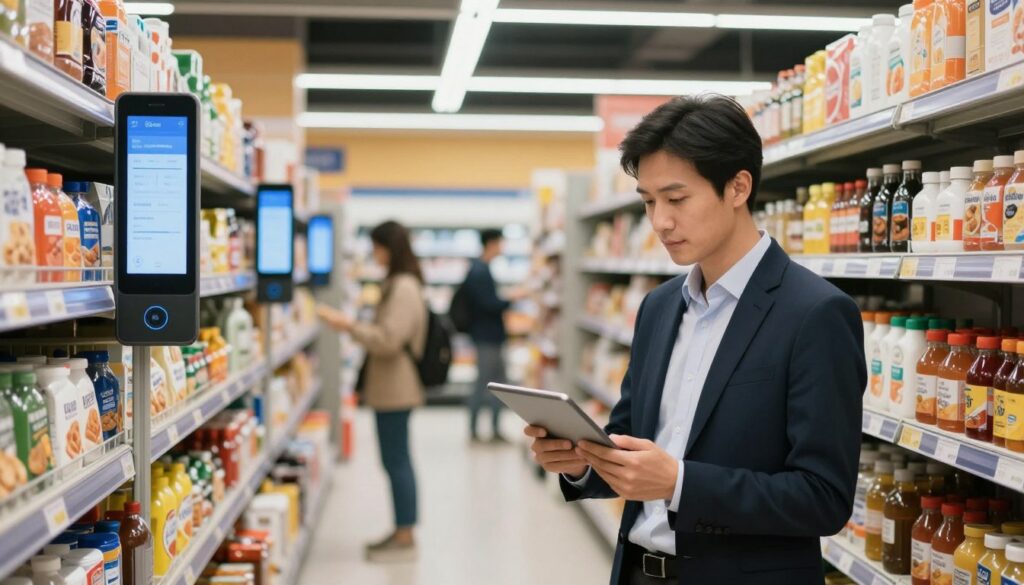
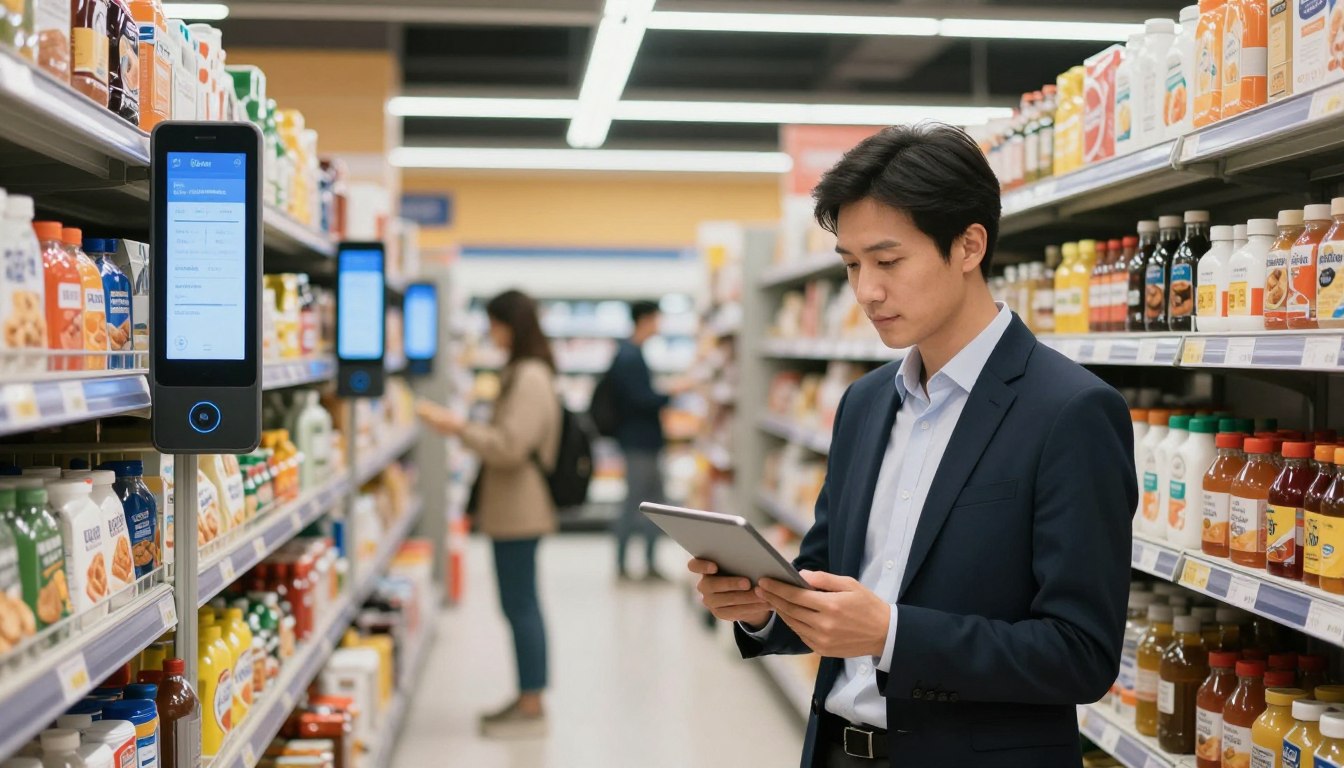
smart shelves inventory solution

New technology offers a clear solution. Smart shelves equipped with IoT sensors provide constant, automated monitoring. They instantly detect when an item is missing or low. This closes the inventory gap for good.

Adopting this approach protects your sales and keeps customers happy. It aligns with the huge economic impact forecast for IoT technology. This shift is essential for modern retail operations to thrive.

Key Takeaways

  • The retail industry’s enormous size makes accurate inventory critical for profitability.
  • Old-fashioned manual tracking methods are prone to errors and cannot keep pace.
  • Discrepancies between recorded stock and physical shelf stock directly cause lost sales.
  • This inventory mismatch damages customer satisfaction and brand loyalty.
  • IoT-enabled smart shelves provide real-time, automated monitoring to eliminate these gaps.
  • Implementing this technology is a proactive step to prevent revenue loss.
  • Smart inventory management is becoming essential for competitive retail operations.

Understanding Shelf Inventory Mismatch in Retail

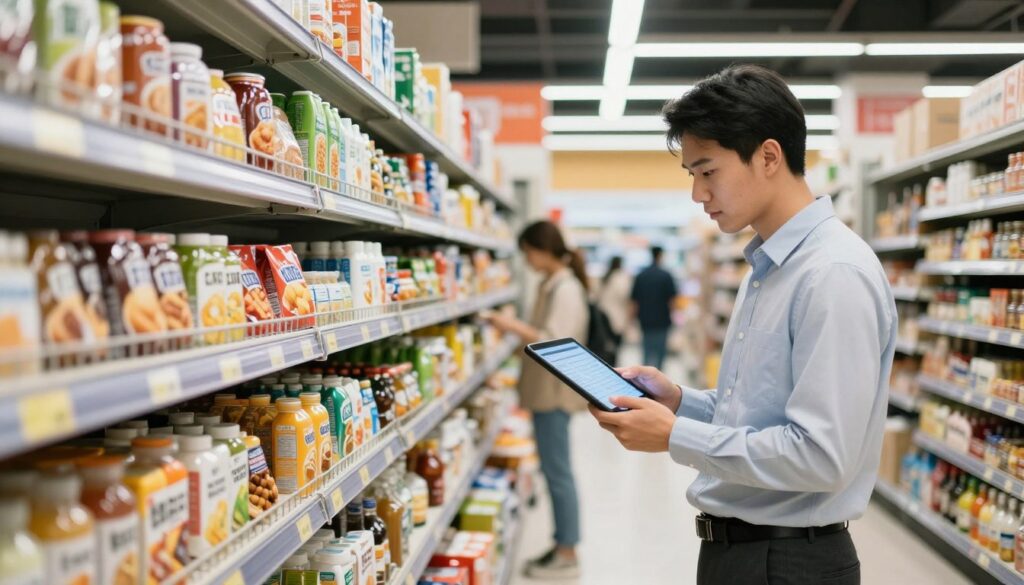
When a store’s digital records and its physical stock diverge, the result is a costly gap known as shelf inventory mismatch. This occurs when the products actually on the shelf don’t match the inventory data in the system.

It creates two big problems: phantom stock and unrecorded items. Both scenarios hurt sales and store efficiency.
shelf inventory mismatch retail

The root causes are often simple human errors. Mistakes during restocking, theft, or items placed in the wrong spot all contribute. There’s also a built-in time lag in old systems.

This mismatch affects every part of a store’s operation. Automated reorders fail. Promises to customers are broken. Shoppers leave for competitors.

Perishable goods face a worse challenge. Expired products can sit on the shelf while the system says they’re available. This leads to frustration and wasted stock.

The financial hit goes beyond a single lost sale. It includes extra labor for emergency restocking, rush shipping fees, and costly markdowns. Customer loyalty suffers when shelves are empty.

Traditional fixes like more manual counts don’t solve the core issue. They are slow and still prone to error. Modern retail needs a better way to track inventory levels accurately.

The Role of IoT and ML in Modern Inventory Management

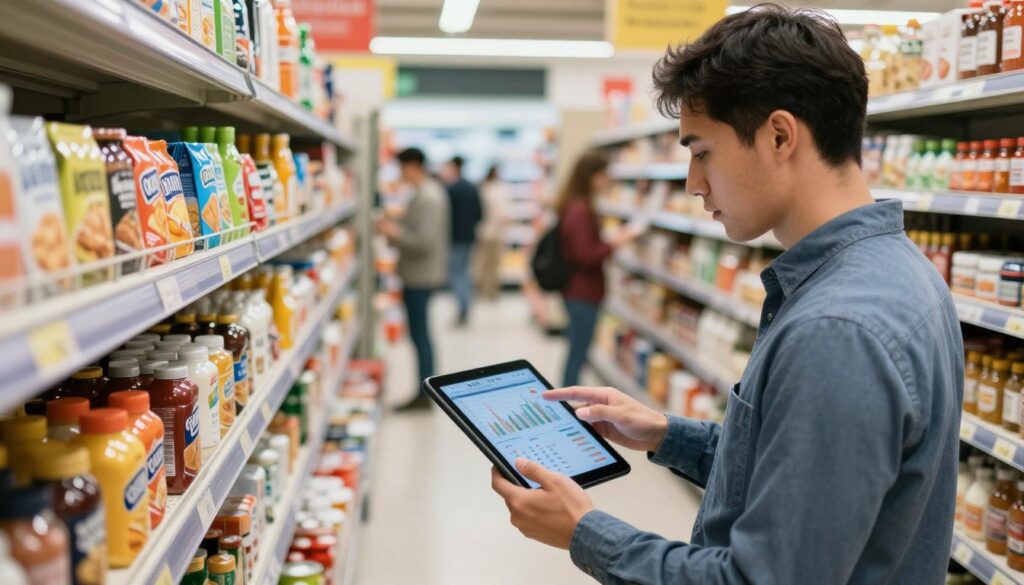
Two powerful technological forces are converging to solve age-old retail challenges. The Internet of Things (IoT) and Machine Learning (ML) form the core of a new, intelligent approach to stock control.
iot ml inventory management

This combination moves far beyond basic automation. It creates a living, learning system for store operations.

Evolution of Retail Technology

Stock tracking has progressed through clear phases. Each step brought more accuracy and less manual work.

Early manual counts were slow and error-prone. Barcode scanners added speed but still required human action. RFID tags improved visibility but offered only periodic updates.

Today, integrated IoT ecosystems provide constant communication. Connected sensors and devices deliver a real-time view of every shelf.

Technological Phase Key Mechanism Data Type Primary Limitation
Manual Counts Physical tally sheets Static, infrequent High labor cost, human error
Barcode Scanning Laser scanners at POS Transaction-based Misses shrinkage, blind between scans
RFID Tags Radio frequency identification Batch location updates Cost per tag, limited granularity
IoT & ML Systems Connected sensors & predictive algorithms Continuous stream, predictive insights Higher initial integration

Data-Driven Decision Making

Machine Learning algorithms analyze the vast data from IoT networks. They find patterns humans cannot see.

These tools predict future demand with high accuracy. They consider sales history, seasons, and local events. This allows for proactive restocking before a gap appears.

The result is a fundamental shift in philosophy. Management moves from reactive guesses to empirical strategy. Store operations become optimized through actionable insights, protecting sales and customer trust.

Smart Retail Smart Shelves, Smart Retail System, Smart Inventory Management

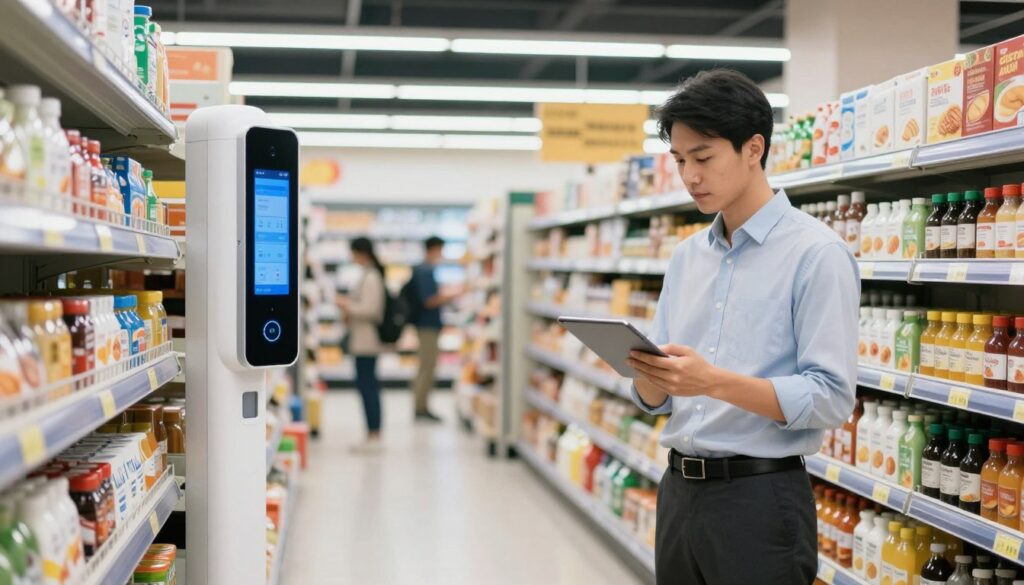
The integration of sensors and networking into store shelving creates a perpetual inventory system. These electronically connected shelves automatically track product presence and movement.

They utilize multiple detection technology. Weight sensors, RFID readers, and digital displays work together. This creates a constant data stream within a connected ecosystem.
smart retail smart shelves

The complete Smart Retail System architecture includes embedded hardware and central databases. Wireless networks transmit real-time data. Sophisticated algorithms then process this information instantly.

This enables true Smart Inventory Management. It replaces manual checks with continuous monitoring. The result is exceptional stock accuracy and major gains in operational efficiency for modern retail operations.

Real-Time Data: Enhancing Inventory Monitoring and Customer Experience

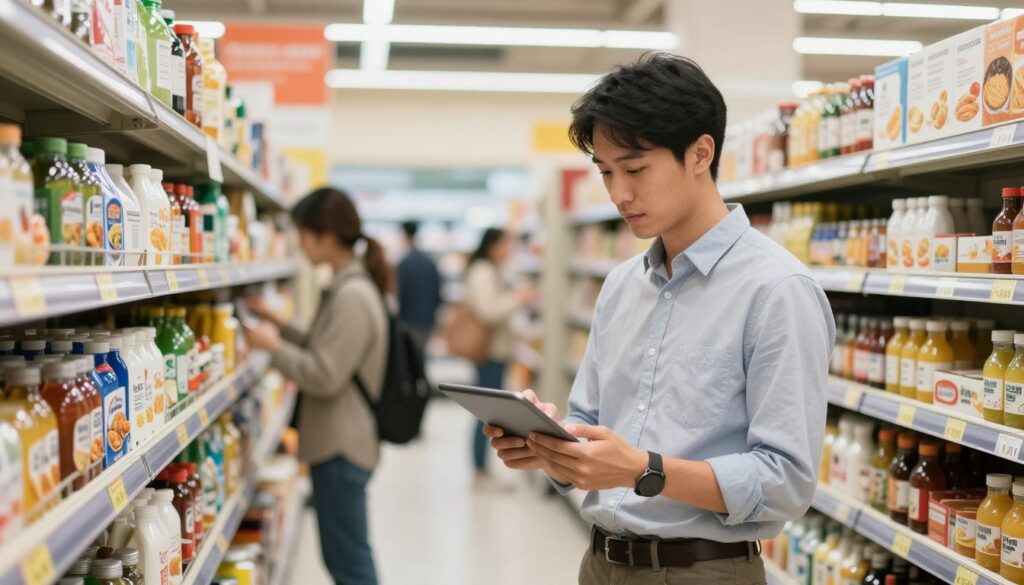
Immediate access to accurate shelf data transforms how stores operate and serve shoppers. This constant flow of information closes the visibility gap that once plagued traditional methods.

It turns every product interaction into a valuable data point for the business.
real-time inventory monitoring

Accurate Stock Monitoring

Connected shelves provide real-time inventory updates. Weight sensors detect the removal of items instantly.

This continuous monitoring ensures inventory levels in the system mirror the physical shelf. Alerts for low stock are generated proactively.

As one industry analyst noted,

“The shift from periodic counts to live tracking is the single biggest leap in retail accuracy.”

This eliminates out-of-stock scenarios before they disappoint a customer.

Personalized In-Store Engagement

The same data stream enriches the shopper’s experience. By understanding which products are picked up, systems can offer tailored recommendations.

Shoppers see relevant deals or product details on integrated displays. This personal touch, driven by live inventory data, makes shopping more efficient and satisfying.

Real-time inventory tracking ensures the products they want are there. It builds trust and encourages return visits.

Implementing Smart Shelves in a Retail Environment

The journey to automated stock tracking begins with a detailed assessment of store infrastructure. Implementing these intelligent systems requires careful integration planning.
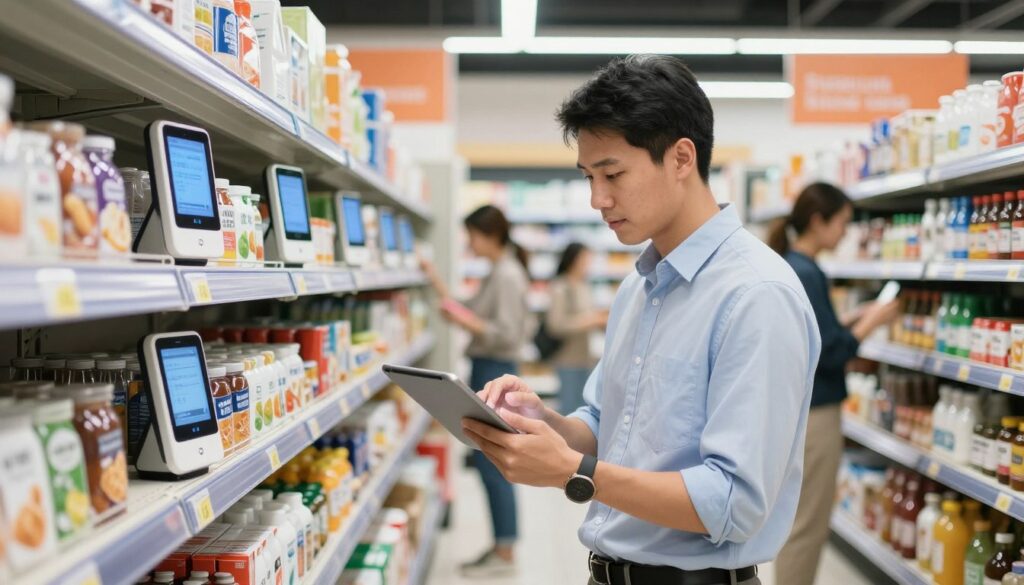
implementing smart shelves integration

Integration into Existing Store Infrastructure

Successful deployment evaluates electrical power and wireless connectivity. The system must connect with existing inventory software via standard APIs.

Physical installation places weight-sensing platforms beneath shelf surfaces. Each node is calibrated to specific products for accurate baselines.

Optimizing Sensor and Weight Technologies

Choosing the right detection mechanism is crucial for different product categories. Optimized sensors provide reliable data for real-time updates.

Sensor Technology Ideal Application Primary Benefit
Precision Weight Sensors Items with uniform mass Accurate quantity tracking
RFID Readers Tagged merchandise Individual item identification
Computer Vision Systems Bulk or variable products Visual verification
Environmental Monitors Perishable goods Condition and quantity data

Calibration accounts for product weight variations. Restocking alerts trigger when inventory falls below a set threshold, often three times a single item’s weight.

IoT Communication Protocols and System Architecture

The backbone of any reliable automated shelf system lies in its communication framework and data architecture. Connected technologies must transmit information instantly and accurately.

This constant stream of data enables real-time inventory updates. It ensures the digital record always matches the physical shelf.

Leveraging MQTT and REST for Seamless Connectivity

These systems rely on standard IoT communication protocols. MQTT handles lightweight telemetry from weight sensors efficiently.

Its publish-subscribe model lets shelf sensors broadcast changes without complex configurations. Backend systems then consume this data for analysis.

REST APIs provide the request-response pattern for control. Teams use them to set product parameters or check historical logs.

This dual-protocol approach ensures seamless integration with existing platforms. All sensor readings use validated JSON payloads for consistency.

Advantages of a Robust Relational Database

A structured database is central to these operations. It organizes information into key tables like Products and ScaleReadings.

Each table links to others through defined relationships. This design enforces data consistency and prevents errors.

Queries can quickly identify restocking needs across stores. The system logs every restocking action and weight measurement for audit trails.

Transaction integrity guarantees that simultaneous updates don’t corrupt records. This reliability is vital for accurate inventory levels and timely restocking alerts.

The complete architecture creates a dependable data flow from shelf-level sensors to central servers. It identifies low product quantities and dispatches notifications within minutes.

This IoT ecosystem turns raw sensor readings into actionable insights for integration into daily workflows.

Smart Retail Solutions: Transforming Operations and Customer Engagement

Beyond simple stock tracking, modern retail solutions create a seamless bridge between operational data and personalized customer interactions.

These integrated platforms connect various in-store technologies. They turn raw data into actionable insights for staff and richer experiences for shoppers.

Interactive Displays and Beacon Technology

Digital kiosks use live stock data to show accurate product details and alternatives. This guides customer decisions and prevents frustration from empty shelves.

Beacon technology detects a shopper’s location within the store. It then sends timely promotions to their smartphone for items nearby.

This combination ensures offers are relevant and products are available. It makes the shopping trip more efficient and engaging.

Technology Component Primary Function Key Benefit for Retailers
Interactive Displays Provide product info & alternatives Increases conversion rates
Beacon Systems Deliver location-based promotions Boosts average transaction value
Cashier-less Systems Automate checkout & payment Eliminates checkout friction
Predictive Analytics Forecast future product demand Optimizes stock levels & pricing

Cashier-less Experiences and Predictive Analytics

Pioneers like Amazon have introduced stores where you just pick items and leave. Sensors and cameras track selections, and payments happen automatically.

This removes the final point of friction. It saves customers valuable time.

Behind the scenes, AI tools analyze behavior and sales trends. They predict future demand to keep shelves full and operations smooth.

Retailers gain powerful insights to optimize pricing and staffing. The entire shopping experience becomes faster, smarter, and more satisfying.

Cost Efficiency and Operational Benefits of Smart Shelving

The economic case for automated shelf monitoring centers on converting wasted labor hours into enhanced customer engagement. This technology delivers clear financial benefits and streamlines store operations.

Reducing Labor Costs and Restocking Errors

Automation slashes labor costs by ending daily manual counts. Freed-up staff time can focus on helping shoppers and building displays.

Precise alerts for restocking cut errors dramatically. Workers get exact product, quantity, and location data. This prevents misplacements and ongoing stock gaps.

The system supports teams by handling repetitive checks. This reduces burnout and lets staff use their skills better. The result is happier employees and improved service.

Benefit Area Operational Impact Financial Outcome
Labor Optimization Eliminates manual stock counts; directs staff efficiently Direct wage savings; higher sales per labor hour
Restocking Accuracy Virtually eliminates misplacement and quantity errors Reduces lost sales; lowers inventory carrying cost
Inventory Efficiency Enables lower stock levels with same product availability Frees up capital; reduces shrinkage and storage needs
Staff Empowerment Shifts focus to customer service and merchandising Improves retention; boosts customer satisfaction scores

These efficiency gains compound. Better inventory management leads to faster turnover and stronger cash flow. For retailers, the payback period is often swift, with ongoing benefits that grow each year.

Conclusion

The era of guessing what’s on the shelf is ending. It is replaced by data-driven certainty that boosts both profits and loyalty.

Connected shelf technology provides the definitive solution to a costly, age-old problem. It transforms store operations from reactive to proactive.

This shift is now a business imperative. Meeting modern shopper expectations requires this efficiency and accuracy.

Implementing an IoT-powered system turns inventory tracking into a strategic asset. It protects sales and enhances the entire customer experience.

FAQ

What is the main problem smart shelf technology solves?

This system directly addresses shelf inventory mismatch, where the stock level shown in a store’s central database does not match the actual product quantity on the shelf. This discrepancy leads to lost sales, poor customer experience, and inefficient operations.

How do these shelves actually track items?

They use integrated weight sensors and sometimes RFID or vision technologies. These components constantly monitor the quantity of items on display. Any change, like a customer picking up a product, is instantly detected and recorded.

What kind of data does the system provide to store managers?

It delivers real-time inventory insights directly to a dashboard. Managers can see stock levels for every shelf, track high-velocity products, and receive instant alerts for low stock or misplaced items, enabling data-driven decision making.

Is it difficult to install this into an existing store?

Deployment is designed for minimal disruption. The solution often involves integration with current store infrastructure and point-of-sale systems. A good provider ensures seamless connectivity and compliance with your existing tech stack.

How does this technology improve the shopping experience?

It ensures products are always available for customers, reducing frustration. It can also enable personalized promotions through connected displays and support faster checkout experiences by keeping accurate inventory data.

What are the biggest operational benefits for retailers?

The primary benefits are significant labor savings by automating manual stock counts, drastic reduction in restocking errors, optimized demand forecasting, and lower overall costs from improved efficiency and reduced shrink.

What happens to the collected data?

Inventory data is securely transmitted via reliable protocols like MQTT to a cloud-based relational database. This architecture allows for robust reporting, trend analysis, and integration with other business intelligence systems for comprehensive insights.


How Iottive Delivers End-to-End Smart Retail Solutions

1. Retail Strategy & Solution Design

Iottive collaborates with retail leaders, digital heads, store operations teams, and supply chain stakeholders to understand customer journeys, inventory challenges, and growth objectives. This phase includes retail use-case validation, omnichannel architecture design, IoT device selection, AI personalization planning, and defining measurable KPIs such as promotion ROI, stock accuracy, and conversion rates.


2. Smart Systems Engineering & Retail Integration

Iottive engineers scalable Smart Retail solutions by integrating IoT sensors, RFID, smart shelves, digital mirrors, edge devices, and cloud platforms. We ensure seamless connectivity between POS systems, ERP, CRM, warehouse systems, and e-commerce platforms. The focus is on real-time visibility, secure data flow, and unified customer and inventory intelligence across stores and digital channels.


3. Pilot Deployment in Stores & Warehouses

Before enterprise rollout, Iottive deploys pilot solutions in selected retail stores, warehouses, or pharmacy locations. This includes testing AI-driven recommendations, smart inventory tracking, cold chain monitoring systems, and digital try-on experiences. Retailers can validate performance, customer engagement impact, and operational feasibility in live environments before scaling across locations.


4. Customer Experience & Retail Intelligence

Iottive builds intuitive dashboards and retail intelligence platforms that provide real-time insights into:

  • Customer behavior & segmentation
  • Promotion performance & ROI
  • Store-level inventory accuracy
  • Warehouse efficiency metrics
  • Cold chain compliance tracking
  • Online conversion and upsell analytics

Advanced analytics, alerts, and AI-driven insights empower retail teams to make faster, data-driven decisions that improve revenue, reduce losses, and enhance customer satisfaction.


5. Enterprise Rollout & Retail Scale-Up

From MVP to multi-location deployment, Iottive supports solution hardening, cloud scalability, cybersecurity, and long-term support. Smart Retail solutions are designed for:

  • Multi-store expansion
  • Omnichannel integration
  • Regional inventory balancing
  • Cross-border retail operations
  • Continuous optimization using AI insights

Our approach ensures measurable ROI through improved customer engagement, reduced shrinkage, better inventory control, and operational efficiency.


Why Retailers Choose Iottive

  • Proven expertise in Smart Retail & IoT-driven transformation
  • Deep understanding of store operations, warehousing, and pharmacy compliance
  • Seamless integration with POS, ERP, CRM, and e-commerce platforms
  • Secure, scalable, and production-ready retail architectures
  • Strong focus on measurable business outcomes — not just technology

📧 Contact Email: sales@iottive.com
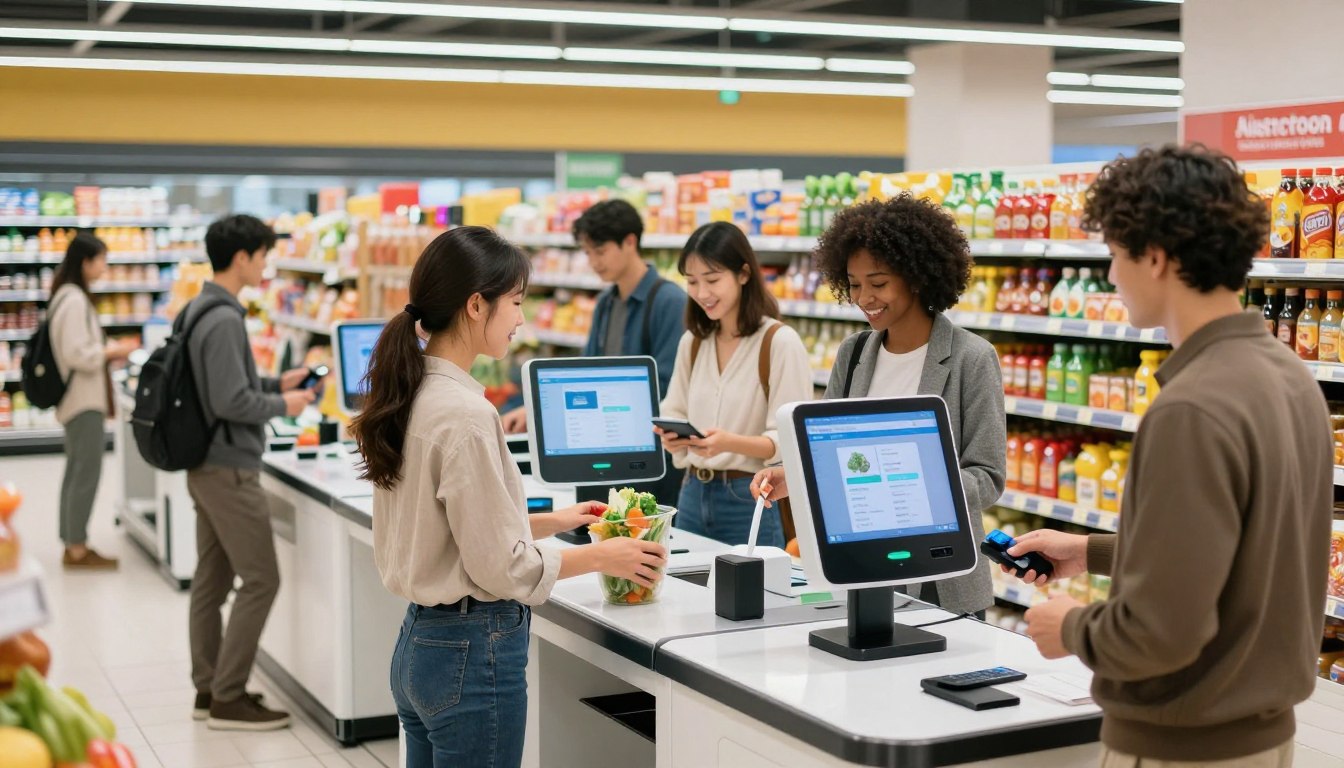
Smart Retail checkout automation to reduce long billing queues at peak hours

Long lines at the cash register are a major headache for shoppers. They hurt the customer experience and limit how much a store can sell. This is especially true during busy times like holidays or weekends.

Smart Retail, Retail Automation, Smart Billing Process, AI in Retail, Smart IoT

For store owners, these delays are more than just an annoyance. They represent lost sales and frustrated shoppers who might not return. Retailers need a better way to handle high traffic without adding more staff or checkout lanes.

Modern technology offers a powerful solution. Automated checkout systems can speed up transactions dramatically. This allows a business to serve more people in less time, turning a bottleneck into an opportunity.

The move toward automation is changing the fundamental shopping journey. It creates a smoother, faster, and more pleasant experience for everyone. This guide explores how this innovation works and why it’s essential for modern commerce.

Key Takeaways

  • Long checkout lines drive customers away and cap sales, especially during peak hours.
  • Automated systems are a direct answer to improving store throughput and efficiency.
  • This technology addresses core operational challenges for retailers.
  • Shoppers today expect speed and convenience at every point of sale.
  • Implementing these solutions can lead to higher customer satisfaction and loyalty.
  • Stores can handle significantly higher transaction volumes without physical expansion.
  • The right tools transform the payment process from a wait into a seamless moment.

Introduction to Smart Retail Checkout Automation

A seamless fusion of in-store experiences and digital capabilities defines today’s retail landscape. This blend, often called smart retail, uses technology to support every shopper interaction.

It specifically tackles the frustrating bottleneck at the register during busy periods. Long waits drain staff resources and often lead to abandoned carts.

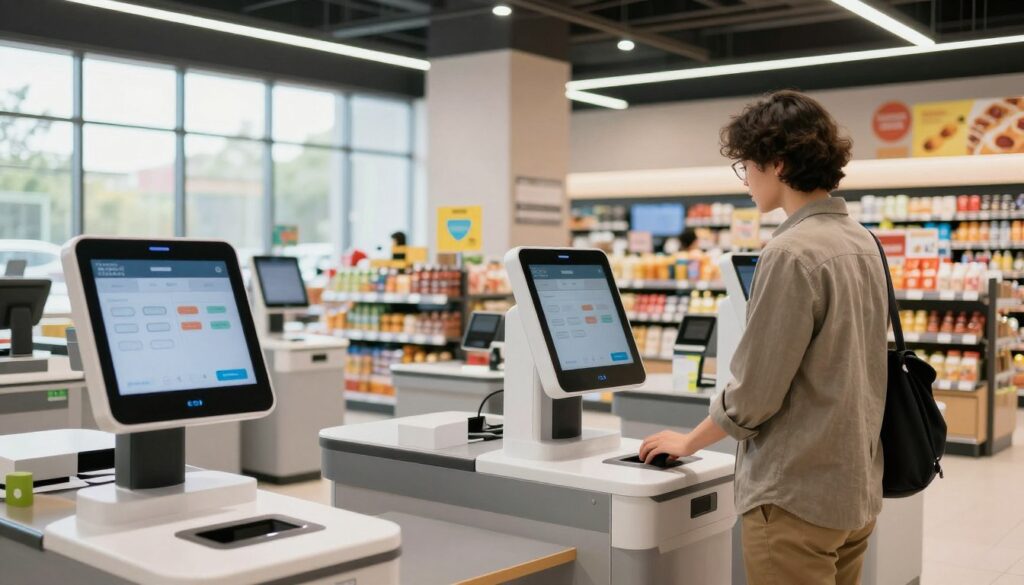
A modern supermarket interior featuring a sleek self-checkout kiosk in the foreground. A customer, dressed in professional business attire, stands confidently at the kiosk, engaged in scanning items with a focused expression. The middle ground showcases several additional kiosks, each equipped with touch screens and integrated bagging areas, highlighting the automated checkout process. In the background, bright LED lighting illuminates the store, creating a welcoming atmosphere filled with shoppers interacting with automated systems. The angle captures the scene from a slightly elevated perspective, emphasizing the efficiency of the checkout automation and allowing viewers to feel immersed in this innovative retail environment. The overall mood is vibrant and tech-forward, symbolizing progress in retail technology.

Automated solutions range from self-service kiosks to cashier-less formats. These tools track purchases using sensors and computer vision.

The value extends beyond convenience. It optimizes labor, improves accuracy, and gathers vital purchase data.

Modern systems connect with existing store infrastructure. This creates a unified ecosystem for management and sales.

Aspect Traditional Checkout Automated Checkout
Staffing Requirement High (1+ cashiers per lane) Low (monitoring only)
Transaction Speed Slower, manual scanning Faster, seamless processing
Customer Experience Often frustrating queues Streamlined, self-directed
Integration Capability Limited, often standalone High, connects to inventory & CRM
Cost Efficiency Higher ongoing labor costs Lower operational overhead

Early adopters see much higher transaction throughput. This technology is now accessible for mid-size establishments seeking a competitive edge.

The Evolution of Retail Automation & AI Integration

Retail operations have transformed dramatically since the first barcode was scanned decades ago. What began in the 1970s as simple price tracking has evolved into sophisticated, AI-powered Retail Automation. Today’s merchants face immense pressure from ecommerce, rising costs, and wage demands. This makes advanced systems essential for survival.

The current frontier is AI in Retail. Machine intelligence analyzes vast amounts of customer data. It predicts demand, optimizes pricing, and personalizes shopping at scale. This artificial intelligence creates competitive advantages traditional stores cannot match.

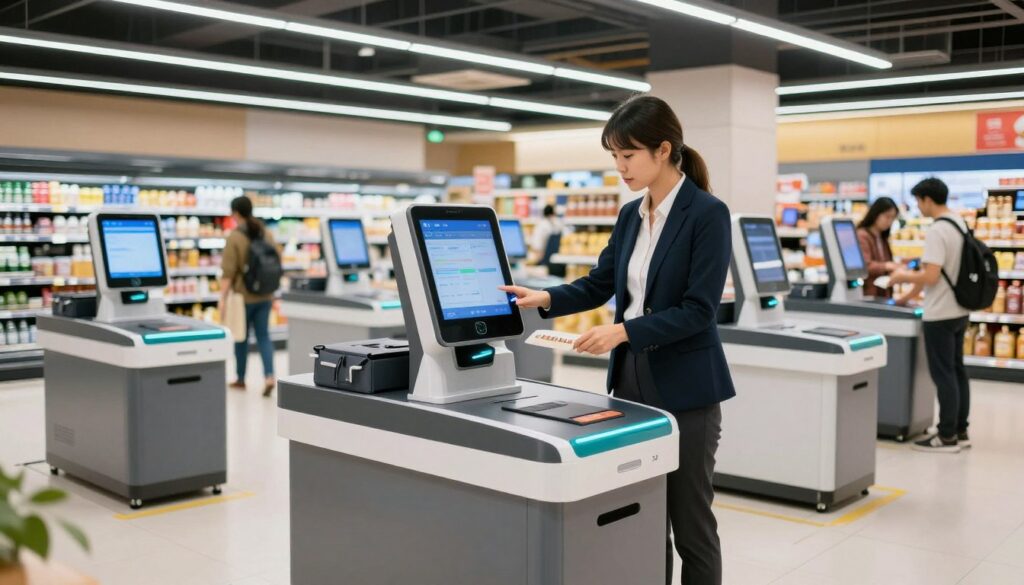
A vibrant and realistic supermarket scene showcasing the evolution of retail automation. In the foreground, a satisfied customer, dressed in professional business attire, interacts with a sleek modern self-checkout kiosk, scanning groceries with ease. The middle ground features a variety of automated checkout solutions, including mobile payments and robotic assistants guiding shoppers. In the background, traditional checkout lanes are visible, highlighting a contrast between past and present technologies. Soft, warm lighting creates an inviting atmosphere, while a wide-angle lens captures the bustling aisles filled with shoppers. The overall mood conveys innovation and convenience, emphasizing the progressive integration of AI in retail automation to streamline the shopping experience and reduce long billing queues.

Market projections confirm this shift is accelerating. The global AI in retail market is expected to reach $15.3 billion by 2025. Overall retail automation is set to hit $33 billion by 2030. According to McKinsey, generative AI could unlock $240 to $390 billion in value for the sector.

This evolutionary trajectory shows no signs of slowing. Emerging technology like advanced computer vision continues to expand possibilities. For modern retailers, integrating these intelligent systems is no longer just an option. It is the key to future growth and efficiency.

Benefits of Smart Billing Process and AI in Retail

Implementing intelligent checkout systems delivers concrete advantages for both store operations and the people shopping there. These benefits directly tackle the core challenges of modern commerce.

Enhanced Operational Efficiency

The Smart Billing Process fundamentally transforms store economics. It cuts the labor intensity of checkout while boosting transaction speed and accuracy.

This efficiency allows businesses to reallocate staff from repetitive tasks. They can focus on higher-value work like personalized service and inventory management.

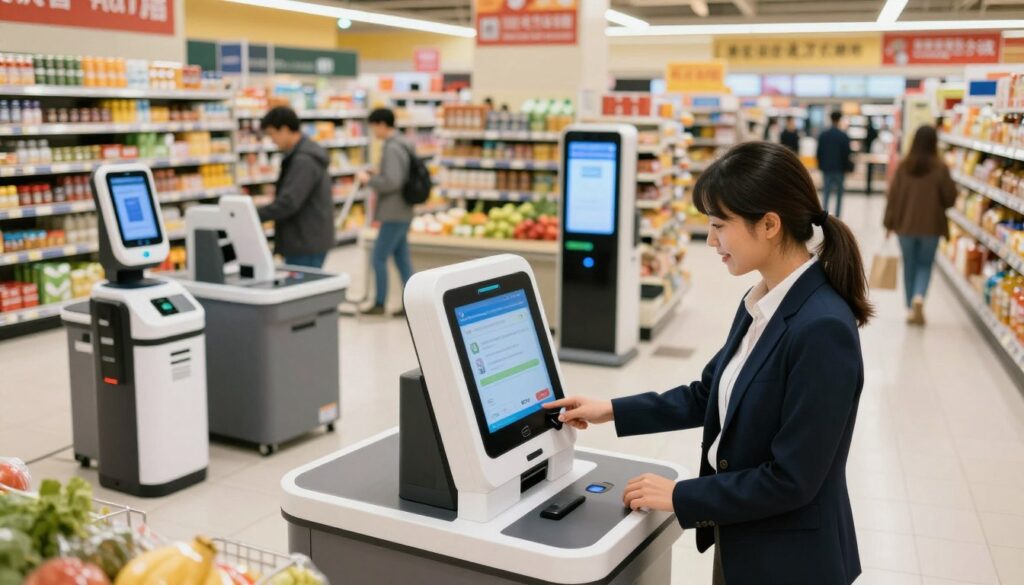
A modern supermarket scene showcasing the efficiency of automated checkout processes. In the foreground, a diverse group of satisfied customers is using sleek self-checkout kiosks, dressed in professional business attire and modest casual clothing. One customer is happily scanning groceries, while another is confirming their payment. The middle layer features colorful product displays and neatly organized checkout area designed for smooth flow, highlighting the convenience of smart billing systems. In the background, bright lighting illuminates the store's interior, enhancing the vibrant atmosphere. The scene captures a sense of speed and satisfaction as queues are minimized, symbolizing the benefits of AI in retail. The overall mood is optimistic and efficient, reflecting a harmonious blend of technology and retail shopping.

According to a Capgemini survey, retailers using this technology noted an 11% rise in customer visits. Superior operations attract more foot traffic and improve the overall shopping experience.

Reduced Customer Wait Times

This addresses the primary friction point in any store. Long lines directly cause lost sales, as many shoppers simply leave without buying anything.

Automated systems process transactions in a fraction of the time. Some formats even eliminate the wait entirely by charging shoppers as they exit.

Data shows broad acceptance of this convenience. Over 74% of people prefer automated interactions for common queries. This comfort extends directly to a faster, frictionless checkout time.

Smart Retail, Retail Automation, Smart Billing Process, AI in Retail, Smart IoT

The physical store is undergoing a digital metamorphosis, powered by interconnected devices and real-time data streams. This network of sensors and smart equipment forms the foundation of a responsive commercial environment.

Market projections highlight this massive shift. The IoT-enabled retail sector is predicted to be valued at $94 billion by 2025. This growth reflects the unlimited possibilities these breakthroughs provide.

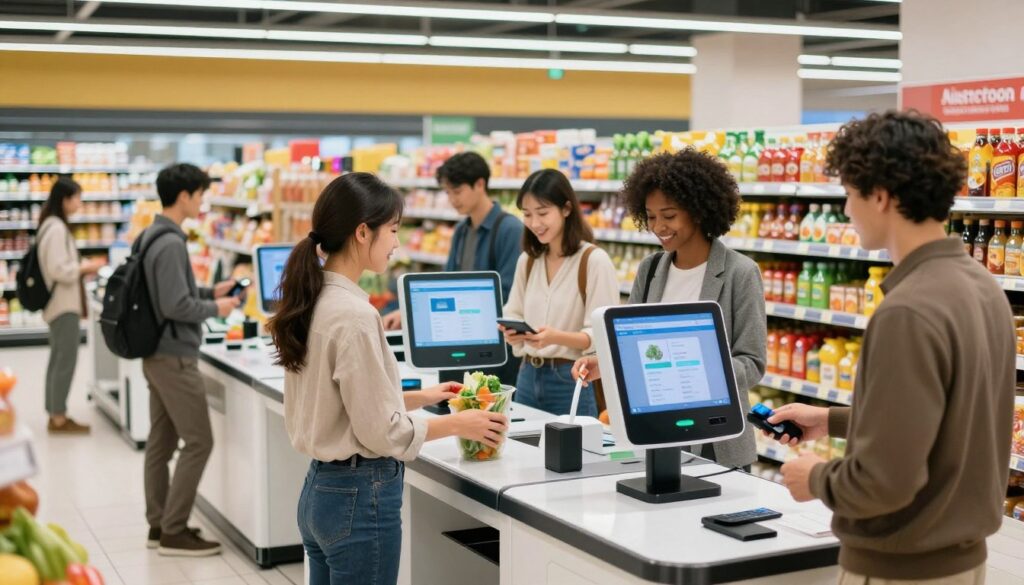
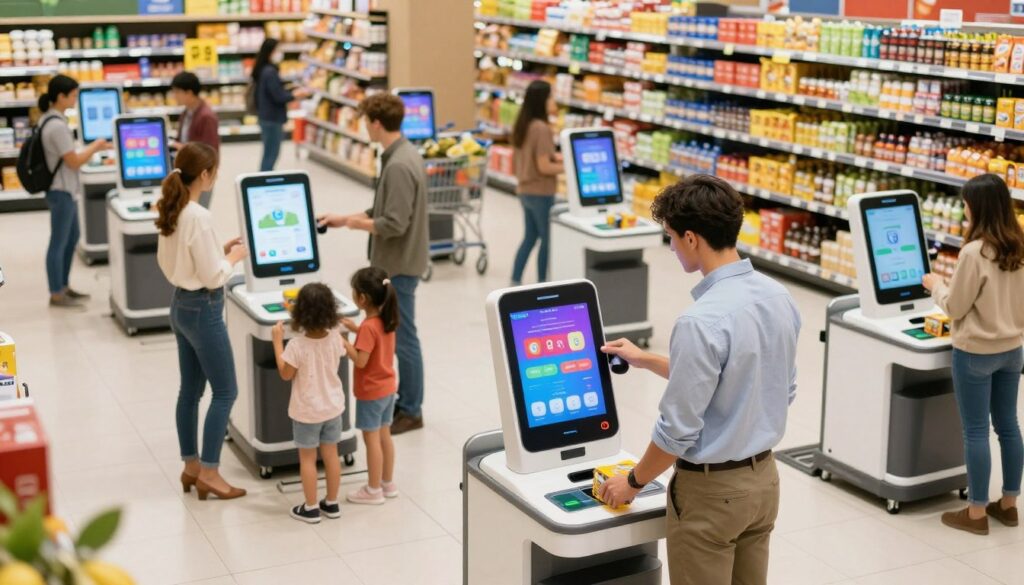
A modern supermarket filled with customers engaging with advanced self-checkout kiosks. In the foreground, a young professional man in smart casual attire is scanning items at a sleek, high-tech kiosk, which displays vibrant graphics and an intuitive interface. The middle ground features a diverse group of shoppers, including a woman in business attire supervising her children as they interact with digital displays. The background showcases an array of automated robotic carts moving through the aisles, delivering products efficiently. The lighting is bright and inviting, with warm tones accentuating the clean, modern design of the retail space. The atmosphere conveys innovation and convenience, emphasizing a smooth and automated smart billing process that enhances the shopping experience at peak hours.

These connected technologies create a synergistic stack. Shelf monitors track inventory, while beacons enable personalized marketing. The entire ecosystem gathers continuous data on operations and shopper behavior.

For retailers, this delivers unprecedented visibility. It enables data-driven decisions across all business functions. The integration with artificial intelligence creates self-improving systems that adapt automatically.

Comprehensive solutions offer a clear competitive edge. They boost productivity, enhance the customer experience, and establish new, insight-based business models. This connected intelligence is now essential for modern commerce.

Cutting-Edge AI and IoT Technologies in Smart Retail

Modern commerce now hinges on the seamless integration of predictive software and sensor networks. This fusion, known as AIoT, combines real-time data collection with analytical intelligence.

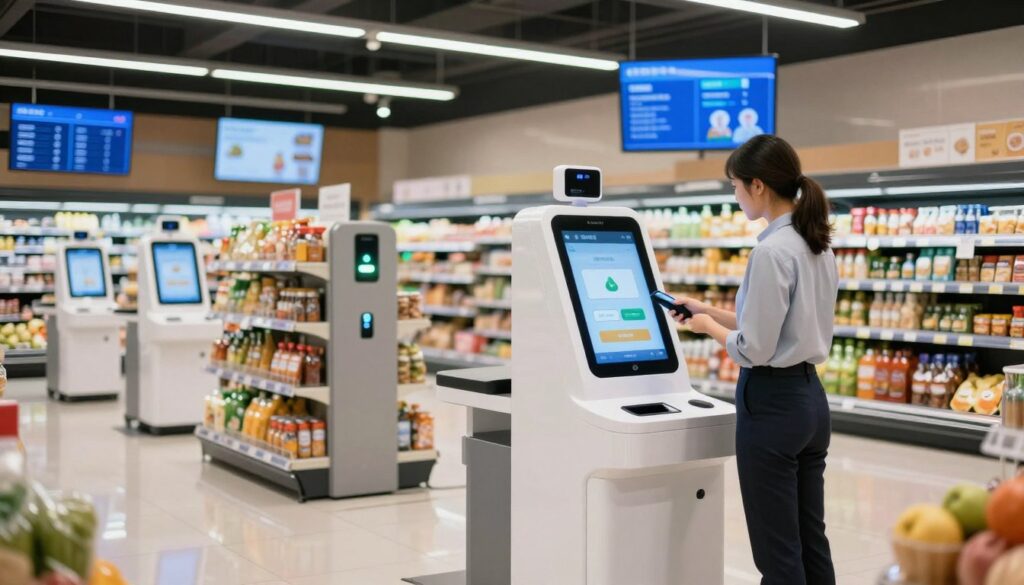
A modern supermarket self-checkout area showcasing cutting-edge AI and IoT technologies. In the foreground, a customer in professional attire stands at a sleek, futuristic self-checkout kiosk, scanning groceries with a smart handheld device. The kiosk features an intuitive touchscreen interface displaying seamless payment options. In the middle ground, rows of smart shelves are equipped with sensors, lighting up to indicate product availability. The background includes digital display panels showing real-time inventory data and customer assistance options. The scene is well-lit with ambient overhead lighting, creating a welcoming atmosphere. Soft reflections on the polished floor enhance the high-tech feel, while the overall mood is efficient and innovative, capturing the essence of smart retail checkout automation.

Smart shelf sensors monitor stock levels instantly. They connect to enterprise software to automate reordering. This prevents empty shelves and optimizes supply chains.

Cameras and beacons track shopper dwell time. This behavioral data identifies genuine product interest. Stores can then trigger personalized offers at the perfect moment.

Edge computing processes information locally on kiosks and carts. It enables ultra-fast, personalized promotions without latency. Computer vision systems analyze customer movements for deeper insights.

Store Function Traditional Approach AIoT-Enabled Solution
Inventory Management Manual stock checks Automated, sensor-driven alerts
Customer Insight Surveys & guesswork Real-time behavioral tracking
Checkout Process Cashier-dependent Sensor fusion for seamless exit
Data Analysis Periodic reports Continuous machine learning

Connected platform architectures unify disparate store systems. They create a single ecosystem for smooth information flow. Machine learning algorithms find patterns in this data.

These advanced solutions give retailers proactive decision-making power. They move from reactive operations to predictive management. This technology stack is the new foundation for competitive stores.

Customer Experience Revolution with Smart IoT Innovations

Innovative technologies are turning routine shopping trips into curated journeys of discovery. Connected devices and data now allow stores to anticipate needs and remove friction at every step.

This revolution moves beyond simple transactions. It builds deeper relationships through tailored interactions.

Personalized Interaction Strategies

Advanced personalization leverages purchase history and real-time behavior. For example, Sephora’s Color IQ scans a shopper’s skin to match perfect foundation shades.

These AI-generated recommendations link directly to loyalty accounts. They ensure consistent experiences across all channels.

Relevance builds trust. A significant 72% of consumers trust companies more when recommendations feel highly relevant to their needs.

This data-driven approach transforms marketing into contextual commerce. Offers appear precisely when interest is demonstrated.

Frictionless Checkout Experience

The pinnacle of convenience is eliminating the wait. Amazon’s Just Walk Out technology uses ceiling cameras and shelf sensors.

It automatically identifies selected items and charges customers as they exit the store. Checkout time drops to zero seconds.

Complementary tools like Dash Carts track purchases in real-time. Shoppers see a running total and finalize payment without stopping.

These innovations respect the shopper’s most valuable resource—time. They dramatically enhance customer satisfaction and loyalty by delivering a superior, modern experience.

Optimizing Inventory and Supply Chain Efficiency with Automation

Billions of dollars are lost annually by merchants due to two opposing problems: empty shelves and overstocked backrooms. This chronic inventory inefficiency stems from poor tracking and forecasting.

Connected tracking sensors now provide complete visibility. They monitor a product‘s journey from manufacture to final purchase in real-time. Three-quarters of merchants plan to use this technology for supply chain management.

Item-level tagging boosts inventory accuracy to 95%. This eliminates the discrepancies that plague manual stock counts.

Management Aspect Traditional Method Automated System
Accuracy Rate ~65-75% (manual counts) ~95% (RFID/sensor tags)
Reorder Trigger Periodic review & guesswork Real-time analytics & alerts
Demand Forecasting Historical sales only Multi-source data (trends, weather)
Perishable Goods Monitoring Spot checks Continuous temperature tracking

Intelligent systems analyze stock levels continuously. They suggest optimal reorder quantities to prevent shortages without excess capital tied up.

Advanced forecasting, like H&M’s system, processes social media trends and local event data. It predicts which items will surge in specific regions.

Real-time visibility enables dynamic product allocation across stores. This optimizes distribution and reduces waste from unsold merchandise.

For perishables, temperature sensors maintain quality throughout the cold chain. They alert operations teams to potential issues before losses occur. This end-to-end automation creates a lean, responsive, and highly efficient supply chain.

Real-World Case Studies Transforming Retail Automation

Pioneering companies have turned theoretical automation concepts into operational realities. These real-world examples from leading brands show measurable results across different store formats.

Amazon Go: The Cashier-Less Experience

Amazon Go stores represent a revolutionary leap. Shoppers scan an app, pick items, and walk out. The system uses computer vision and deep learning to track selections.

Automatic charging happens without any checkout line. This technology slashes wait times and labor costs dramatically. It defines the ultimate frictionless shopping experience.

Walmart & Sephora: AI in Action

Established retailers use artificial intelligence to stay competitive. Walmart employs AI algorithms for inventory and supply chain management.

This reduces stockouts and minimizes excess stock. Sephora analyzes customer data to offer personalized product tips. Its Virtual Artist feature uses augmented reality for virtual makeup trials.

Company Core Technology Primary Benefit Impact Metric
Amazon Go Computer Vision & Sensor Fusion Eliminates Checkout Queues Near-Zero Wait Time
Walmart AI Forecasting Algorithms Optimized Inventory Levels Reduced Stockouts
Sephora AI & Augmented Reality Personalized Customer Experience Increased Conversion Rates

These case studies prove automation delivers value. It enhances customer experience and operational efficiency for modern companies.

Overcoming Peak Hour Billing Queues with Automated Checkout Systems

Abandoned carts at the register represent a direct revenue leak that retailers can no longer ignore. This scenario peaks during high-traffic hours when billing queues stretch longest.

Shoppers consistently rank checkout as the most tedious and time-consuming part of their trip. Many will simply leave without completing a purchase rather than wait.

Automated checkout systems directly attack this problem. They process transactions much faster and can handle higher volumes of people.

In advanced setups, they eliminate queues altogether through cashier-less technology. This protects sales that would otherwise be lost to frustration.

Streamlined Payment Processes

These modern processes use connected devices to automate the point of sale. Sensors read product tags as a customer exits, charging them via a mobile app.

This automation stops the common situation where long waits kill potential sales. It ensures people complete their intended purchases.

Enabled point-of-sale systems are often portable and cloud-based. A store can deploy pop-up stations during rush times to spread out the flow.

Cashierless payment also tracks inventory in real time and gathers valuable shopper data. This provides operational benefits beyond just transaction processing.

Implementing such automation lets businesses manage sudden spikes in transactions. They do this without needing to hire proportionally more staff.

This change fundamentally improves operations during the busiest periods. It turns a major pain point into a seamless experience for customers.

Leveraging Data Analytics and Machine Learning for Retail Growth

Beyond speeding up transactions, the next frontier for stores is using predictive insights to fuel growth. Advanced analysis turns the vast streams of operational and customer data into a clear strategic advantage.

This intelligence layer helps stores shift from reactive reports to proactive planning. Predictive models anticipate market shifts before they fully happen.

Dynamic pricing algorithms are a prime example. They analyze competitor actions and shopper behavior in real-time. This automatically adjusts prices to protect margins and boost sales.

Furthermore, machine learning excels at spotting unusual patterns. It identifies suspicious transactions as they occur, minimizing financial risk.

Forecasting models synthesize historical sales data, trends, and external factors. They predict future demand with great accuracy.

This helps retailers optimize stock levels and marketing spend. It avoids costly overstock and targets campaigns for maximum return.

Ultimately, these tools reveal hidden opportunities for revenue and growth. They enable merchants to serve customers better and operate more efficiently.

The systems learn continuously, improving their predictions over time. This creates a compounding advantage for businesses that invest in these capabilities.

Conclusion

Adopting modern checkout systems is no longer a luxury for forward-thinking merchants; it’s a core requirement for survival. Early adopters gain a compounding data advantage that refines operations and deepens customer insight.

This creates a performance gap competitors cannot quickly bridge. The right solutions turn information into better decisions, directly fueling business growth.

Successful implementation strategies are holistic. They integrate new technologies with staff training and process updates.

For retailers, the central question is no longer “if,” but “how fast.” Moving now secures a decisive edge in revenue, efficiency, and future readiness for the evolving retail landscape.

FAQ

How does automated checkout directly improve efficiency for businesses?

Automated checkout systems streamline the entire payment process, significantly reducing transaction times. This allows staff to focus on higher-value tasks like customer service and restocking, boosting overall productivity. The result is a smoother operation that can handle higher sales volume without increasing labor costs.

What role does artificial intelligence play in managing store inventory?

Artificial intelligence analyzes sales patterns and historical data to predict future demand with high accuracy. This enables precise stock management, preventing both overstocking and out-of-stock situations. Platforms like those used by Walmart optimize supply chains, ensuring products are available when and where customers need them.

Can these technologies create a more personalized shopping experience?

Absolutely. By leveraging data from intelligent sensors and purchase history, businesses can tailor promotions and product recommendations to individual shoppers. Brands like Sephora use this approach to enhance engagement and build stronger customer loyalty through relevant, personalized interactions.

What is a real-world example of a frictionless checkout system?

Amazon Go stores are a prime example. They utilize a network of cameras and sensors to track items customers take off shelves. Shoppers simply walk out, and their account is automatically charged, eliminating traditional billing queues entirely and revolutionizing the in-store experience.

How do Internet of Things (IoT) devices help during peak shopping hours?

Connected devices and smart shelves monitor stock levels in real-time and can alert staff instantly when items are low. This, combined with self-service kiosks and scan-and-go apps, distributes the checkout workload. It prevents long lines from forming during busy periods, improving satisfaction for everyone.

How does machine learning contribute to a store’s growth strategy?

Machine learning algorithms sift through vast amounts of transaction and customer behavior data to uncover deep insights. These models identify trends, forecast sales, and optimize pricing strategies. This intelligence empowers companies to make data-driven decisions that directly increase revenue and market share.


How Iottive Delivers End-to-End Smart Retail Solutions

1. Retail Strategy & Solution Design

Iottive collaborates with retail leaders, digital heads, store operations teams, and supply chain stakeholders to understand customer journeys, inventory challenges, and growth objectives. This phase includes retail use-case validation, omnichannel architecture design, IoT device selection, AI personalization planning, and defining measurable KPIs such as promotion ROI, stock accuracy, and conversion rates.


2. Smart Systems Engineering & Retail Integration

Iottive engineers scalable Smart Retail solutions by integrating IoT sensors, RFID, smart shelves, digital mirrors, edge devices, and cloud platforms. We ensure seamless connectivity between POS systems, ERP, CRM, warehouse systems, and e-commerce platforms. The focus is on real-time visibility, secure data flow, and unified customer and inventory intelligence across stores and digital channels.


3. Pilot Deployment in Stores & Warehouses

Before enterprise rollout, Iottive deploys pilot solutions in selected retail stores, warehouses, or pharmacy locations. This includes testing AI-driven recommendations, smart inventory tracking, cold chain monitoring systems, and digital try-on experiences. Retailers can validate performance, customer engagement impact, and operational feasibility in live environments before scaling across locations.


4. Customer Experience & Retail Intelligence

Iottive builds intuitive dashboards and retail intelligence platforms that provide real-time insights into:

  • Customer behavior & segmentation
  • Promotion performance & ROI
  • Store-level inventory accuracy
  • Warehouse efficiency metrics
  • Cold chain compliance tracking
  • Online conversion and upsell analytics

Advanced analytics, alerts, and AI-driven insights empower retail teams to make faster, data-driven decisions that improve revenue, reduce losses, and enhance customer satisfaction.


5. Enterprise Rollout & Retail Scale-Up

From MVP to multi-location deployment, Iottive supports solution hardening, cloud scalability, cybersecurity, and long-term support. Smart Retail solutions are designed for:

  • Multi-store expansion
  • Omnichannel integration
  • Regional inventory balancing
  • Cross-border retail operations
  • Continuous optimization using AI insights

Our approach ensures measurable ROI through improved customer engagement, reduced shrinkage, better inventory control, and operational efficiency.


Why Retailers Choose Iottive

  • Proven expertise in Smart Retail & IoT-driven transformation
  • Deep understanding of store operations, warehousing, and pharmacy compliance
  • Seamless integration with POS, ERP, CRM, and e-commerce platforms
  • Secure, scalable, and production-ready retail architectures
  • Strong focus on measurable business outcomes — not just technology

📧 Contact Email: sales@iottive.com